Department of Chemistry, University of Calgary, 2500 University Drive NW, Calgary, AB T2N 1N4, Canada.
Metallomics. 2024 Jun 4;16(6). doi: 10.1093/mtomcs/mfae028.
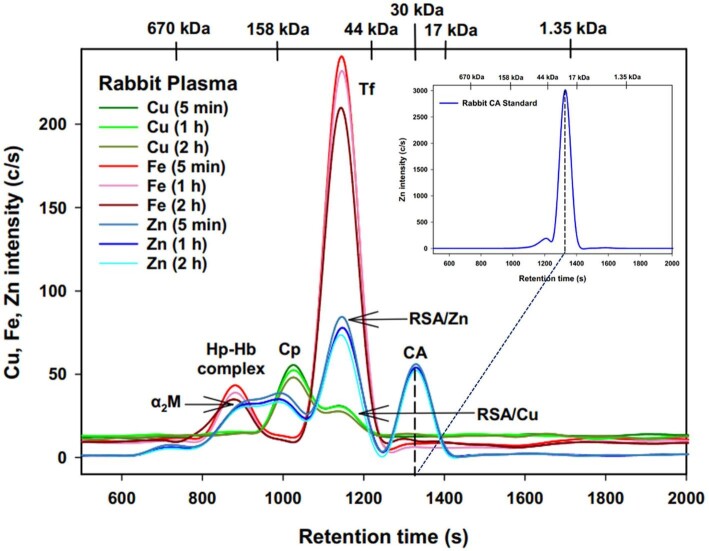
Red blood cells (RBCs) constitute ∼50% of the bloodstream and represent an important target for environmental pollutants and bacterial/viral infections, which can result in their rupture. In addition, diseases such as sickle cell anaemia and paroxysmal nocturnal haemoglobinuria can also result in the rupture of RBCs, which can be potentially life-threatening. With regard to the release of cytosolic metalloproteins from RBCs into the blood-organ system, the biochemical fate of haemoglobin is rather well understood, while comparatively little is known about another highly abundant Zn-metalloprotein, carbonic anhydrase (CA I). To gain insight into the interaction of CA I with human blood plasma constituents, we have employed a metallomics tool comprised of size-exclusion chromatography (SEC) coupled online with an inductively coupled plasma atomic emission spectrometer (ICP-AES), which allows to simultaneously observe all Cu, Fe, and Zn-metalloproteins. After the addition of CA I to human blood plasma incubated at 37°C, the SEC-ICP-AES analysis using phosphate buffered saline (pH 7.4) after 5 min, 1 h, and 2 h revealed that CA I eluted after all endogenous Zn-metalloproteins in the 30 kDa range. Matrix-assisted laser desorption-time of flight mass spectrometry analysis of the collected Zn-peak confirmed that CA I eluted from the column intact. Our in vitro results suggest that CA I released from RBCs to plasma remains free and may be actively involved in health-relevant adverse processes that unfold at the bloodstream-endothelial interface, including atherosclerosis and vision loss.
红细胞(RBCs)约占血流的 50%,是环境污染物和细菌/病毒感染的重要靶标,这些因素可能导致红细胞破裂。此外,镰状细胞性贫血和阵发性夜间血红蛋白尿等疾病也可能导致红细胞破裂,这可能会带来生命威胁。至于红细胞胞质金属蛋白酶释放到血液-器官系统中,血红蛋白的生化命运相当清楚,而另一种高度丰富的锌金属蛋白酶,碳酸酐酶(CA I)则相对知之甚少。为了深入了解 CA I 与人类血浆成分的相互作用,我们采用了一种金属组学工具,包括尺寸排阻色谱(SEC)与电感耦合等离子体原子发射光谱仪(ICP-AES)在线联用,该工具可以同时观察所有 Cu、Fe 和 Zn-金属蛋白酶。在将 CA I 添加到在 37°C 孵育的人类血浆中后,使用磷酸盐缓冲盐水(pH 7.4)在 5 分钟、1 小时和 2 小时后进行 SEC-ICP-AES 分析,结果表明 CA I 在所有内源性 Zn-金属蛋白酶在 30 kDa 范围内洗脱。对收集到的 Zn-峰进行基质辅助激光解吸飞行时间质谱分析证实 CA I 从柱上完整洗脱。我们的体外结果表明,从 RBC 释放到血浆中的 CA I 保持游离状态,并且可能积极参与在血液内皮界面展开的与健康相关的不利过程,包括动脉粥样硬化和视力丧失。