Louropoulou Evangelia, Gledhill Martha, Browning Thomas J, Desai Dhwani K, Barraqueta Jan-Lukas Menzel, Tonnard Manon, Sarthou Géraldine, Planquette Hélène, Bowie Andrew R, Schmitz Ruth A, LaRoche Julie, Achterberg Eric P
GEOMAR Helmholtz Centre for Ocean Research Kiel, Kiel, Germany.
Institute for General Microbiology, Christian-Albrechts-Universität zu Kiel, Kiel, Germany.
Front Microbiol. 2019 Jul 11;10:1566. doi: 10.3389/fmicb.2019.01566. eCollection 2019.
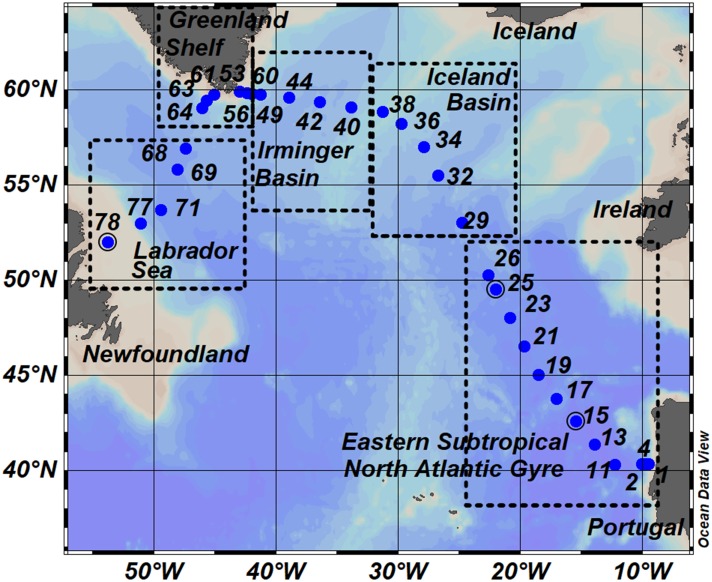
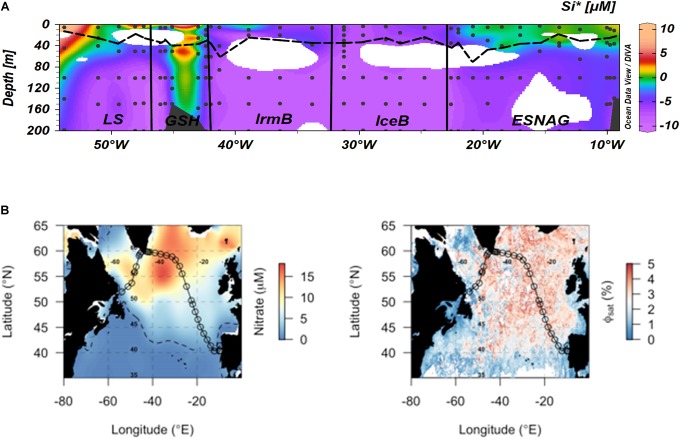
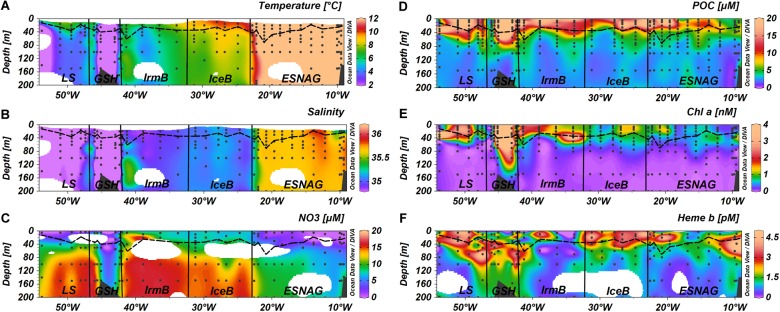
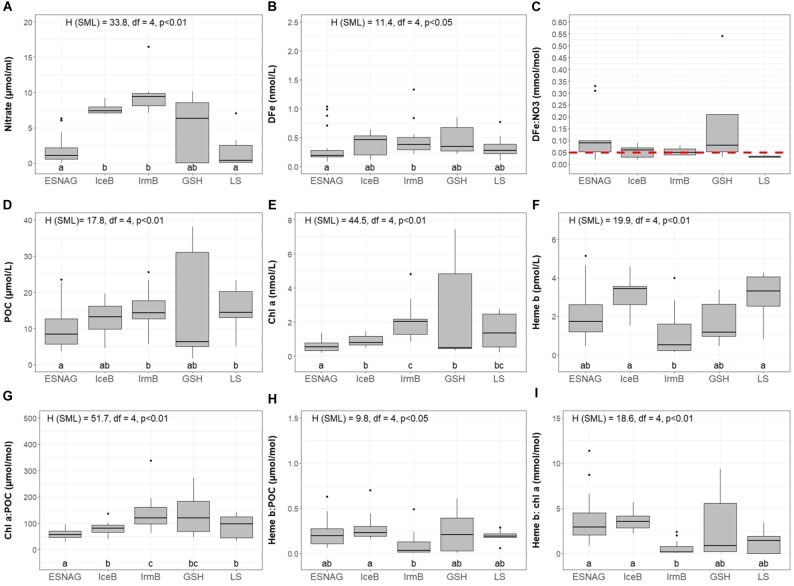
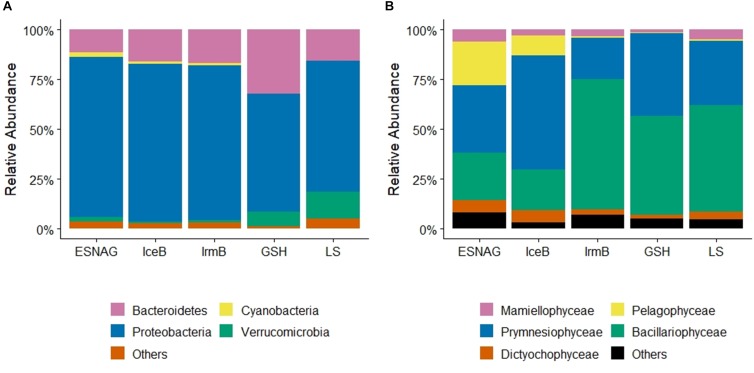
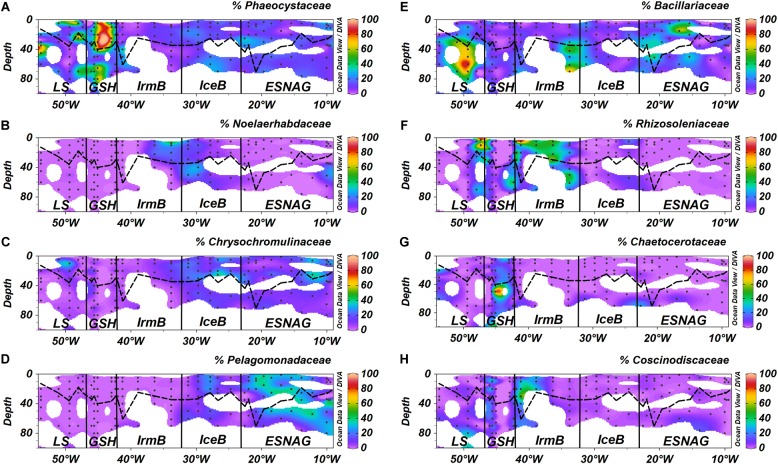
Heme is an iron-containing co-factor in hemoproteins. Heme concentrations are low (<1 pmol L) in iron limited phytoplankton in cultures and in the field. Here, we determined heme in marine particulate material (>0.7 μm) from the North Atlantic Ocean (GEOVIDE cruise - GEOTRACES section GA01), which spanned several biogeochemical regimes. We examined the relationship between heme abundance and the microbial community composition, and its utility for mapping iron limited phytoplankton. Heme concentrations ranged from 0.16 to 5.1 pmol L (median = 2.0 pmol L, = 62) in the surface mixed layer (SML) along the cruise track, driven mainly by variability in biomass. However, in the Irminger Basin, the lowest heme levels (SML: median = 0.53 pmol L, = 12) were observed, whilst the biomass was highest (particulate organic carbon, median = 14.2 μmol L, = 25; chlorophyll : median = 2.0 nmol L, = 23) pointing to regulatory mechanisms of the heme pool for growth conservation. Dissolved iron (DFe) was not depleted (SML: median = 0.38 nmol L, = 11) in the Irminger Basin, but large diatoms ( sp.) dominated. Hence, heme depletion and regulation is likely to occur during bloom progression when phytoplankton class-dependent absolute iron requirements exceed the available ambient concentration of DFe. Furthermore, high heme concentrations found in the Iceland Basin and Labrador Sea (median = 3.4 pmol L, = 20), despite having similar DFe concentrations to the Irminger Basin, were attributed to an earlier growth phase of the extant phytoplankton populations. Thus, heme provides a snapshot of the cellular activity and could both be used as indicator of iron limitation and contribute to understanding phytoplankton adaptation mechanisms to changing iron supplies.
血红素是血红蛋白中一种含铁的辅因子。在培养的和野外的铁限制浮游植物中,血红素浓度较低(<1皮摩尔/升)。在此,我们测定了来自北大西洋(GEOVIDE航次——GEOTRACES GA01断面)跨越多个生物地球化学区域的海洋颗粒物质(>0.7微米)中的血红素。我们研究了血红素丰度与微生物群落组成之间的关系,以及其在绘制铁限制浮游植物分布图方面的效用。沿着航迹的表层混合层(SML)中,血红素浓度范围为0.16至5.1皮摩尔/升(中位数 = 2.0皮摩尔/升,n = 62),主要受生物量变化的驱动。然而,在伊尔明厄盆地,观察到最低的血红素水平(SML:中位数 = 0.53皮摩尔/升,n = 12),而生物量最高(颗粒有机碳,中位数 = 14.2微摩尔/升,n = 25;叶绿素a:中位数 = 2.0纳摩尔/升,n = 23),这表明血红素库存在用于生长维持的调节机制。在伊尔明厄盆地,溶解铁(DFe)并未耗尽(SML:中位数 = 0.38纳摩尔/升,n = 11),但大型硅藻(属)占主导。因此,当浮游植物类群依赖的绝对铁需求超过可用的环境DFe浓度时,在水华发展过程中可能会发生血红素的耗尽和调节。此外,在冰岛盆地和拉布拉多海发现的高血红素浓度(中位数 = 3.4皮摩尔/升,n = 20),尽管其DFe浓度与伊尔明厄盆地相似,但这归因于现存浮游植物种群的较早生长阶段。因此,血红素提供了细胞活性的一个快照,既可以用作铁限制的指标,也有助于理解浮游植物对不断变化的铁供应的适应机制。