Kennedy Andrew, Shipley Dianna, Shpak Max, Blakely Laura, Hemphill Brian, Shih Kent, Lane Cassie, Zimmerman Lisa, McKenzie Andrew, Mainwaring Mark, Peyton James D, Zubkus John, Wright David, Singh Jaswinder, Bendell Johanna C
Sarah Cannon Research Institute, Nashville, TN, United States.
Tennessee Oncology, PLLC, Nashville, TN, United States.
Front Oncol. 2019 Jul 10;9:624. doi: 10.3389/fonc.2019.00624. eCollection 2019.
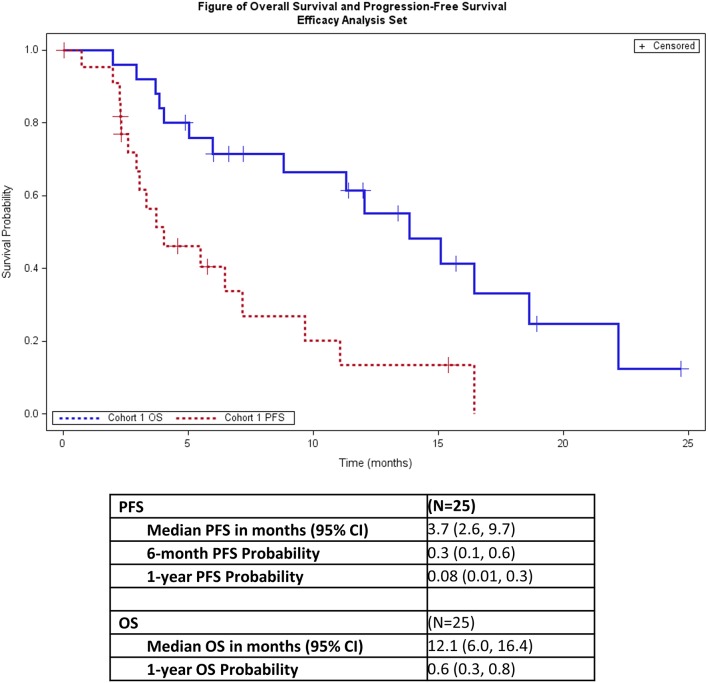
This Phase II, open-label, study examined the safety of regorafenib followed by selective internal radiation therapy (SIRT) with regorafenib re-initiation in the treatment of metastatic colorectal cancer (mCRC) patients with liver metastases who are not surgical candidates. Patients received 160 mg regorafenib daily on a 21-day course followed by a 1 week washout prior to SIRT. Liver function was evaluated at 2 and 4 weeks after SIRT, and regorafenib re-initiated if liver function was normal. Patients were evaluated for safety, and restaged at weeks 6 and 12 following SIRT. In addition, protein and cytokine assays of blood were performed to identify candidate molecular biomarkers associated with outcomes. Individual patient voxel-based dosimetry assessment was performed post-SIRT. Twenty-Five patients were enrolled and received a median 11 weeks regorafenib. Three patients received regorafenib, but not SIRT due to disease progression. The remaining 22 patients received SIRT with a median activity delivered to the liver of 38 mCi, mean normal liver dose of 14.98 Gy and tumor mean dose of 29.0 Gy with a tumor to normal ratio mean of 2.42. There were four treatment-related serious AEs and no treatment-related deaths. Median progression-free survival was 3.7 months and the median overall survival was 12.1 months. The relative densities of several biomolecules changed significantly during the course of treatment, most notably post-treatment increases in levels of sex-hormone binding globulin () and decreased levels of the cytokine . Decreases in von Willebrand factor (), the ankyrin repeat domain (), and were associated with improved survival times. Post-treatment increases in alpha-2-macroglobulin () and the cytokine intercellular adhesion molecule ( were associated with reduced overall survival time, while increases in Eotaxin ( predicted longer overall survival times. The treatment of mCRC patients with liver metastases using regorafenib followed by SIRT was tolerable in this patient population. Further efficacy analysis of this treatment schema and analysis of potential molecular biomarkers using larger sample sizes is merited.
这项II期开放标签研究考察了瑞戈非尼的安全性,随后进行选择性内放射治疗(SIRT)并重新启用瑞戈非尼,用于治疗无法进行手术的伴有肝转移的转移性结直肠癌(mCRC)患者。患者在21天疗程中每日接受160 mg瑞戈非尼治疗,在进行SIRT之前有1周的洗脱期。在SIRT后2周和4周评估肝功能,如果肝功能正常则重新启用瑞戈非尼。对患者进行安全性评估,并在SIRT后的第6周和第12周重新分期。此外,进行血液蛋白质和细胞因子检测以识别与预后相关的候选分子生物标志物。在SIRT后进行基于体素的个体患者剂量测定评估。25名患者入组,接受瑞戈非尼治疗的中位时间为11周。3名患者因疾病进展接受了瑞戈非尼治疗,但未进行SIRT。其余22名患者接受了SIRT,肝脏接受的中位活性剂量为38 mCi,正常肝脏平均剂量为14.98 Gy,肿瘤平均剂量为29.0 Gy,肿瘤与正常组织剂量比平均为2.42。有4例与治疗相关的严重不良事件,无治疗相关死亡。中位无进展生存期为3.7个月,中位总生存期为12.1个月。在治疗过程中,几种生物分子的相对密度发生了显著变化,最明显的是治疗后性激素结合球蛋白()水平升高,细胞因子水平降低。血管性血友病因子()、锚蛋白重复结构域()和的降低与生存期改善相关。治疗后α-2-巨球蛋白()和细胞因子细胞间黏附分子()升高与总生存期缩短相关,而嗜酸性粒细胞趋化因子()升高预示总生存期延长。在该患者群体中,使用瑞戈非尼后进行SIRT治疗mCRC肝转移患者是可耐受的。值得使用更大样本量对该治疗方案进行进一步疗效分析以及对潜在分子生物标志物进行分析。