Birkl Patrick, Chow Jacqueline, McBride Peter, Kjaer Joergen B, Kunze Wolfgang, Forsythe Paul, Harlander-Matauschek Alexandra
Department of Animal Biosciences, University of Guelph, Guelph, ON, Canada.
Friedrich-Loeffler-Institute, Federal Research Institute for Animal Health, Institute of Animal Welfare and Animal Husbandry, Celle, Germany.
Front Vet Sci. 2019 Jul 11;6:230. doi: 10.3389/fvets.2019.00230. eCollection 2019.
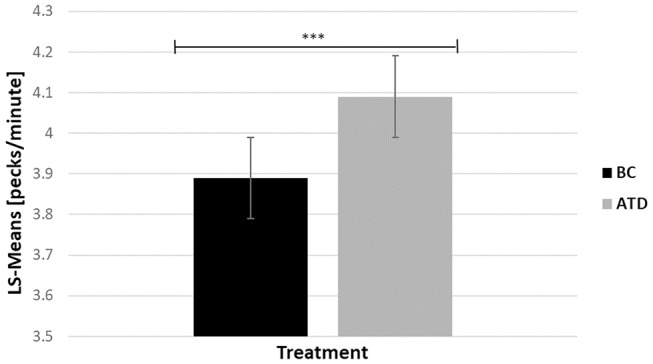
Repetitive pecking at the feather cover of other birds (FP) is one of the most important welfare problems in domestic birds. It is not only characterized by motor symptoms, but also by an innate vulnerability of the serotonergic system. Moreover, the serotonergic system influences cognitive function. Acute tryptophan depletion (ATD) is a widely used method for studying serotonergic function in mammals and has been recently validated in birds. However, a tryptophan-deficient amino acid mixture has never been tested on groups of birds to impact their social behavior, including repetitive feather pecking, nor has it been given to potentially impact their cognition and motor performance. One hundred and sixty White Leghorn laying hens consisting of two genetic lines divergently selected to perform high (H) or low (L) levels of FP, and an unselected control line (UC), were kept in 10 groups consisting of 4 H, 3 L, and 9 UC genotypes. In a counterbalanced order, half of the groups were first subjected to an ATD treatment, while the other half were first given a balanced control (BC) treatment, and vice versa, after which their feather pecking behavior was observed. The effect of ATD/BC on repetitive pecking, motor performance, and cognition was investigated in a 5-s delayed reward task in an operant chamber with 10 phenotypic feather peckers, 10 recipients of feather pecking, and 10 bystanders (who neither performed nor received feather pecks). ATD given to groups of birds induced gentle, repetitive feather pecking in all genotypes. Following ATD, phenotypic feather peckers performed more poorly during the delayed reward task, as seen by their higher number of repetitive, non-rewarded key, and non-key pecks in the operant chamber. In conclusion, ATD impacted the hens' social behavior by increasing the number of repetitive gentle feather pecks at conspecifics. Furthermore, feather peckers were more likely to peck while waiting for a reward after ATD, suggesting a role for the serotonergic system on cognition in these birds.
在家禽中,反复啄食其他鸟类的羽毛覆盖部位(FP)是最重要的福利问题之一。它不仅具有运动症状的特征,还具有血清素能系统的先天性脆弱性。此外,血清素能系统会影响认知功能。急性色氨酸耗竭(ATD)是研究哺乳动物血清素能功能的一种广泛使用的方法,最近已在鸟类中得到验证。然而,一种色氨酸缺乏的氨基酸混合物从未在鸟类群体中进行过测试,以影响它们的社会行为,包括反复啄羽行为,也从未给予过这种混合物以潜在影响它们的认知和运动表现。160只白来航蛋鸡分为两个遗传品系,分别经过不同方向的选择以表现出高(H)或低(L)水平的FP,以及一个未经过选择的对照品系(UC),它们被分成10组,每组包含4只H基因型、3只L基因型和9只UC基因型。以平衡的顺序,一半的组首先接受ATD处理,而另一半首先接受平衡对照(BC)处理,反之亦然,之后观察它们的啄羽行为。在一个操作箱中,通过一个5秒延迟奖励任务,对10只表型啄羽者、10只被啄羽者和10只旁观者(既不进行也不接受啄羽),研究了ATD/BC对反复啄羽、运动表现和认知的影响。给鸟类群体施用ATD会在所有基因型中诱发温和的、反复的啄羽行为。施用ATD后,表型啄羽者在延迟奖励任务中的表现更差,从它们在操作箱中更多的反复的、无奖励的按键和非按键啄击次数可以看出。总之,ATD通过增加对同种个体反复温和啄羽的次数来影响母鸡的社会行为。此外,啄羽者在ATD后等待奖励时更有可能啄羽,这表明血清素能系统在这些鸟类的认知中发挥作用。