Department of Neurosciences, University of California, San Diego, La Jolla, CA, USA.
Department of Family Medicine and Public Health, University of California, San Diego, La Jolla, CA, USA.
J Alzheimers Dis. 2019;71(1):109-118. doi: 10.3233/JAD-190491.
Although physical activity has been associated with better cognitive function and reduced dementia risk, its association with cognitive decline in normal aging remains uncertain.
To determine whether physical activity in youth and older age are associated with age-related cognitive change.
Over a period of 27 years, 2,027 community-dwelling adults (mean age 73.5; 60% women) of the Rancho Bernardo Study of Healthy Aging completed up to seven cognitive assessments, including tests of global cognitive function, executive function, verbal fluency, and episodic memory. At each visit, participants reported concurrent physical activity. At baseline (1988- 1992), participants additionally reported physical activity as a teenager and at age 30. For each age period, participants were classified as regularly active (3+ times/week) or inactive.
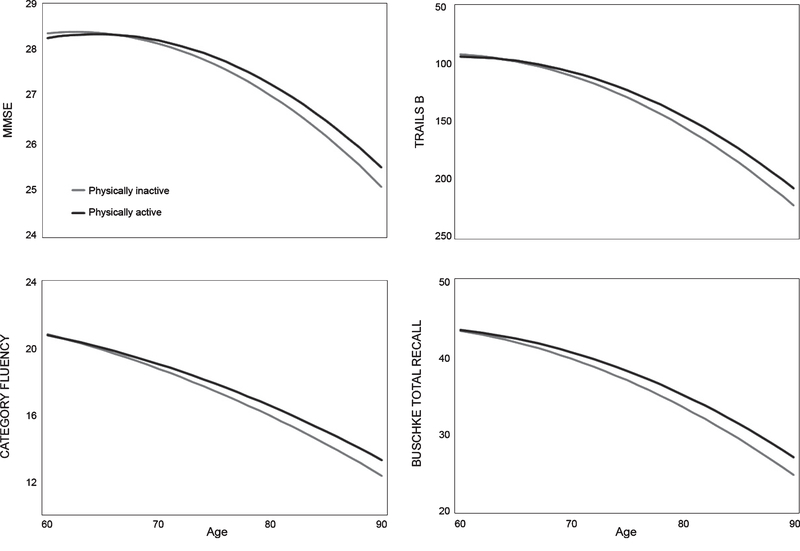
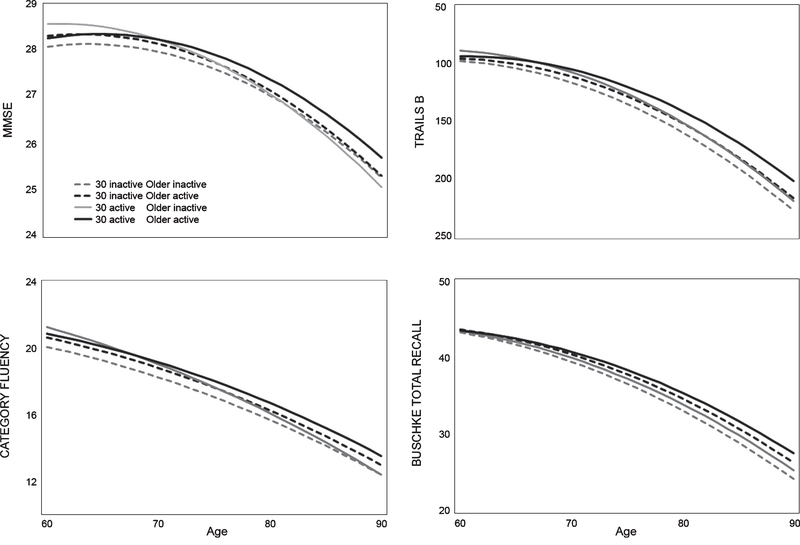
Associations between concurrent physical activity and better cognitive function were stronger with advancing age on all tests, even after accounting for education, health, and lifestyle factors, as well as survival differences (ps < 0.05). Baseline physical activity did not predict rates of cognitive decline (ps > 0.40). Individuals who were physically active at age 30 and older age maintained the highest global cognitive function with advancing age (p = 0.002).
Regular physical activity is associated with better cognitive function with advancing age. Physical activity in young adulthood may contribute to cognitive reserve, which together with physical activity in later years, may act to preserve cognitive function with age.
尽管身体活动与更好的认知功能和降低痴呆风险有关,但它与正常衰老过程中的认知能力下降的关系仍不确定。
确定青年和老年时期的身体活动是否与年龄相关的认知变化有关。
在 27 年的时间里,2027 名居住在社区的 Rancho Bernardo 健康老龄化研究的成年人(平均年龄 73.5;60%为女性)完成了多达 7 次认知评估,包括整体认知功能、执行功能、语言流畅性和情景记忆测试。在每次访问时,参与者报告了当前的身体活动情况。在基线(1988-1992 年)时,参与者还报告了青少年时期和 30 岁时的身体活动情况。对于每个年龄阶段,参与者被分为经常活动(每周 3 次以上)或不活动。
在所有测试中,随着年龄的增长,与当前身体活动相关的认知功能更好,即使考虑到教育、健康和生活方式因素以及生存差异(p<0.05)也是如此。基线身体活动并不能预测认知能力下降的速度(p>0.40)。在 30 岁及以上年龄时保持身体活动的个体,随着年龄的增长,其整体认知功能保持最高(p=0.002)。
定期进行身体活动与随着年龄增长认知功能的提高有关。青年时期的身体活动可能有助于认知储备,这种储备与晚年的身体活动一起,可能有助于随着年龄的增长保持认知功能。