Song Suhang, Gaynor Alexandra M, Gazes Yunglin, Lee Seonjoo, Xu Qianhui, Habeck Christian, Stern Yaakov, Gu Yian
Taub Institute for Research on Alzheimer's Disease and the Aging Brain, Columbia University, New York, NY, United States.
Department of Health Policy and Management, College of Public Health, University of Georgia, Athens, GA, United States.
Front Aging Neurosci. 2022 Oct 12;14:945645. doi: 10.3389/fnagi.2022.945645. eCollection 2022.
Greater physical activity (PA) could delay cognitive decline, yet the underlying mechanisms remain unclear. White matter hyperintensity (WMH) burden is one of the key brain pathologies that have been shown to predict faster cognitive decline at a late age. One possible pathway is that PA may help maintain cognition by mitigating the detrimental effects of brain pathologies, like WMH, on cognitive change. This study aims to examine whether PA moderates the association between WMH burden and cognitive change.
This population-based longitudinal study included 198 dementia-free adults aged 20-80 years. Leisure-time physical activity (LTPA) was assessed by a self-reported questionnaire. Occupational physical activity (OPA) was a factor score measuring the physical demands of each job. Total physical activity (TPA) was operationalized as the average of z-scores of LTPA and OPA. Outcome variables included 5-year changes in global cognition and in four reference abilities (fluid reasoning, processing speed, memory, and vocabulary). Multivariable linear regression models were used to estimate the moderation effect of PA on the association between white matter hyperintensities and cognitive change, adjusting for age, sex, education, and baseline cognition.
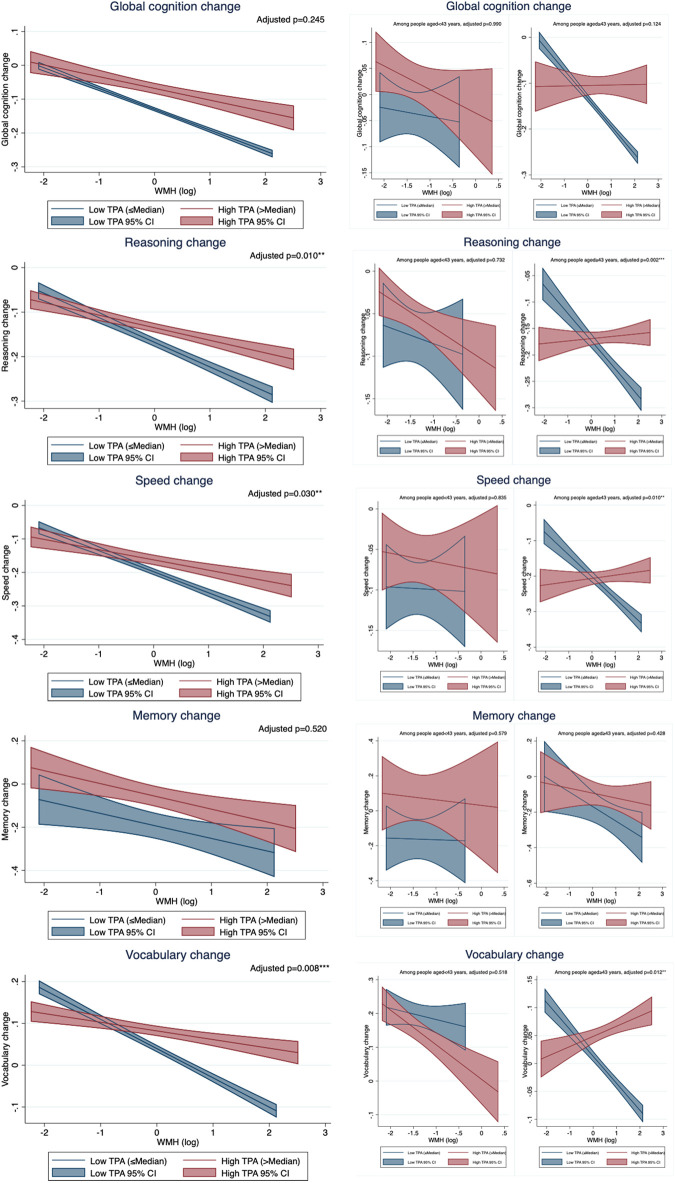
Over approximately 5 years, global cognition ( < 0.001), reasoning ( < 0.001), speed ( < 0.001), and memory ( < 0.05) scores declined, and vocabulary ( < 0.001) increased. Higher WMH burden was correlated with more decline in global cognition (Spearman's rho = -0.229, = 0.001), reasoning (rho = -0.402, < 0.001), and speed (rho = -0.319, < 0.001), and less increase in vocabulary (rho = -0.316, < 0.001). Greater TPA attenuated the association between WMH burden and changes in reasoning (β = 0.029, 95% CI = 0.006-0.052, = 0.013), speed (β = 0.035, 95% CI = -0.004-0.065, = 0.028), and vocabulary (β = 0.034, 95% CI = 0.004-0.065, = 0.029). OPA seemed to be the factor that exerted a stronger moderation on the relationship between WMH burden and cognitive change.
Physical activity may help maintain reasoning, speed, and vocabulary abilities in face of WMH burden. The cognitive reserve potential of PA warrants further examination.
增加身体活动(PA)可能会延缓认知衰退,但其潜在机制尚不清楚。白质高信号(WMH)负荷是关键的脑病变之一,已被证明可预测晚年更快的认知衰退。一种可能的途径是,PA可能通过减轻脑病变(如WMH)对认知变化的有害影响来帮助维持认知。本研究旨在探讨PA是否能调节WMH负荷与认知变化之间的关联。
这项基于人群的纵向研究纳入了198名年龄在20 - 80岁之间无痴呆的成年人。通过自我报告问卷评估休闲时间身体活动(LTPA)。职业身体活动(OPA)是一个衡量每份工作体力需求的因子得分。总身体活动(TPA)通过LTPA和OPA的z分数平均值来计算。结果变量包括全球认知以及四种参考能力(流体推理、处理速度、记忆和词汇)的5年变化。使用多变量线性回归模型来估计PA对白质高信号与认知变化之间关联的调节作用,并对年龄、性别、教育程度和基线认知进行了调整。
在大约5年的时间里,全球认知(<0.001)、推理(<0.001)、速度(<0.001)和记忆(<0.05)得分下降,而词汇(<0.001)得分上升。更高的WMH负荷与全球认知(Spearman相关系数rho = -0.229,P = 0.001)、推理(rho = -0.402,P < 0.001)和速度(rho = -0.319,P < 0.001)的更多下降以及词汇(rho = -0.316,P < 0.001)的较少增加相关。更大的TPA减弱了WMH负荷与推理变化(β = 0.029,95%置信区间 = 0.006 - 0.052,P = 0.013)、速度(β = 0.035,95%置信区间 = -0.004 - 0.065,P = 0.028)和词汇(β = 0.