Department of Internal Medicine, University of Michigan Rogel Cancer Center, Ann Arbor, Michigan.
SWOG Statistical Center, Seattle, Washington.
Clin Cancer Res. 2019 Oct 15;25(20):6089-6097. doi: 10.1158/1078-0432.CCR-19-0208. Epub 2019 Jul 29.
Metastasis requires malignant cell circulation from the primary to a distant tissue. Elevated levels of circulating tumor cells (CTC) portend a poor prognosis in breast and other cancers. Recent studies have suggested that CTC clusters may be a factor in the metastatic process. We conducted a prospective retrospective study of the SWOG0500 clinical trial to test whether CTC clusters are associated with poorer prognosis.
CTC CellSearch galleries from SWOG0500 trial were reread using prespecified criteria for CTC clusters, doublets, and enumeration. Survival analysis methods include Kaplan-Meier plots and log-rank tests.
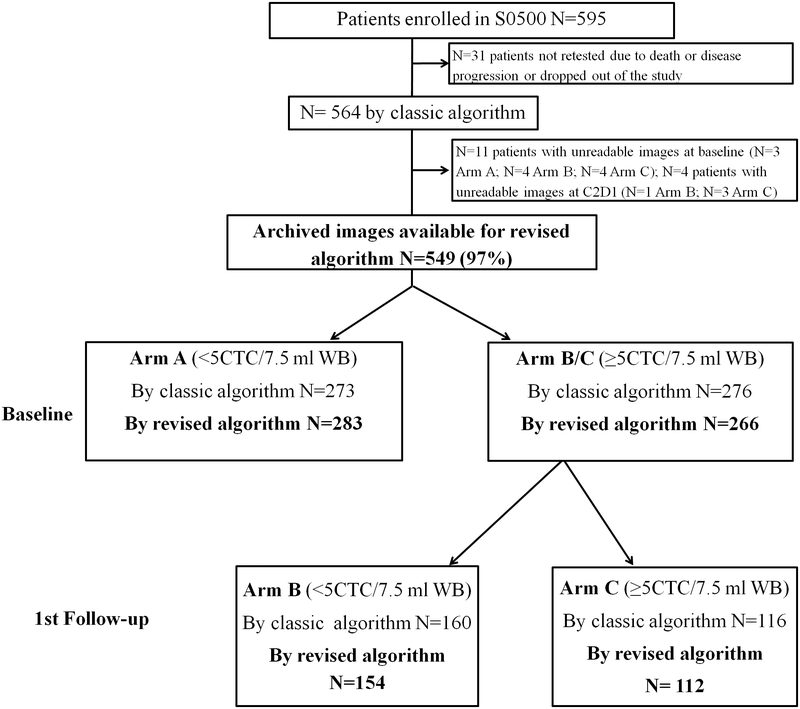
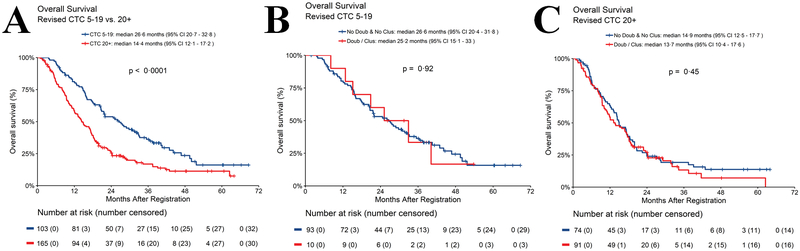
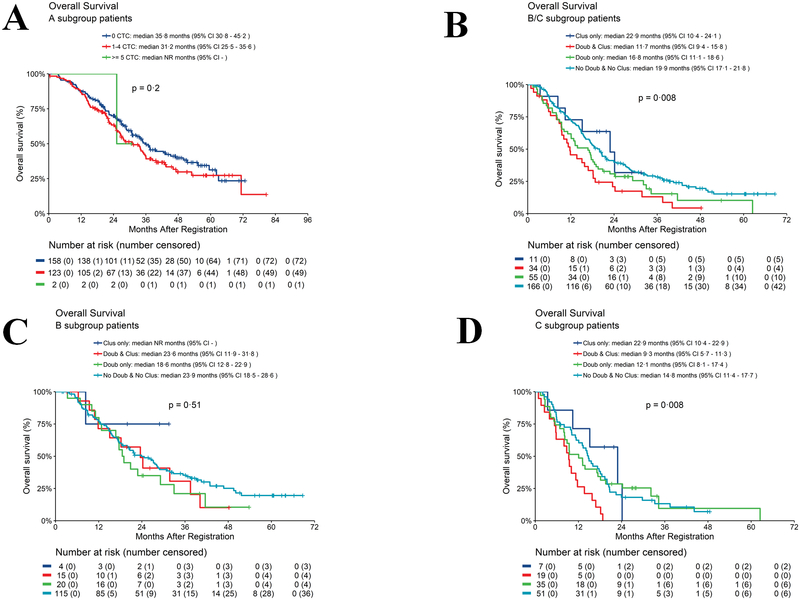
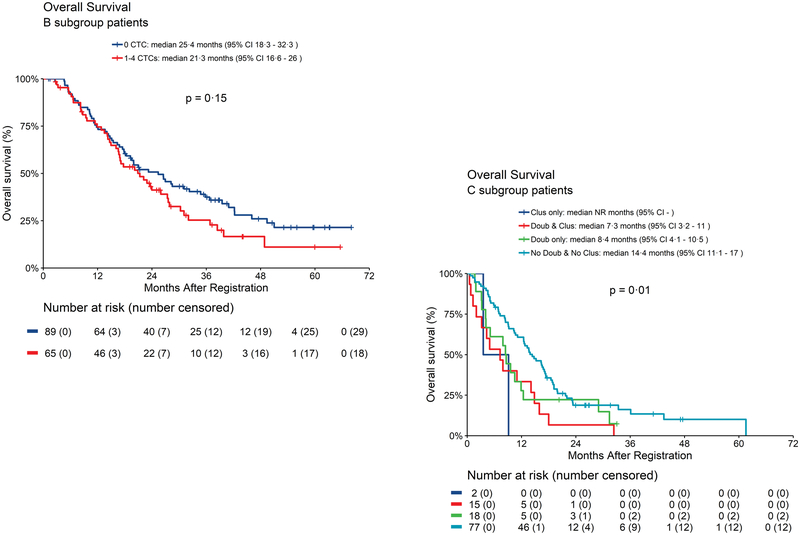
Patients were classified into three prognostic subgroups based on baseline CTC/7.5 mL whole blood (WB): Arm A: <5CTC; Arm B/C: ≥5CTC and then B (<5CTC) and C (≥5CTC)/7.5 mL WB at first follow-up. At baseline, 19% of patients had CTC doublets or clusters, which were more likely in Arm B/C versus Arm A (38% vs. 1.4%; < 0.0001). Furthermore, doublets or clusters were significantly more common in patients who were ultimately assigned to Arm C versus B (54% vs. 25%; < 0.0001). In Arm C, doublets and clusters were associated with worse overall survival than only doublets, clusters, or no doublets nor clusters at baseline ( = 0.008) and first follow-up ( = 0.010). When compared with enumeration alone, doublets, clusters, or both were not prognostic in patients who had 5-19 or ≥20 CTC/7.5 mL WB.
In patients with metastatic breast cancer starting first-line chemotherapy, mortality is independent of the presence of CTC clusters, but rather depends on the number of CTC/7.5 mL WB.
转移需要恶性细胞从原发性肿瘤循环到远处组织。循环肿瘤细胞(CTC)水平升高预示着乳腺癌和其他癌症的预后不良。最近的研究表明,CTC 簇可能是转移过程中的一个因素。我们对 SWOG0500 临床试验进行了前瞻性回顾性研究,以测试 CTC 簇是否与较差的预后相关。
使用 CTC CellSearch 画廊,根据 CTC 簇、双联体和计数的预设标准重新读取 SWOG0500 试验的 CTC CellSearch 画廊。生存分析方法包括 Kaplan-Meier 图和对数秩检验。
根据基线 CTC/7.5mL 全血(WB),患者被分为三个预后亚组:A 臂:<5CTC;B/C 臂:≥5CTC,然后 B(<5CTC)和 C(≥5CTC)/7.5mL WB 首次随访时。基线时,19%的患者有 CTC 双联体或簇,B/C 臂比 A 臂更常见(38%比 1.4%;<0.0001)。此外,双联体或簇在最终被分配到 C 臂的患者中比 B 臂更为常见(54%比 25%;<0.0001)。在 C 臂中,双联体和簇与总体生存较差相关,与基线时仅双联体、簇或无双联体和簇相比(=0.008)和首次随访时(=0.010)。与单独计数相比,在 CTC/7.5mL WB 为 5-19 或≥20 的患者中,双联体、簇或两者均无预后意义。
在开始一线化疗的转移性乳腺癌患者中,死亡率与 CTC 簇的存在无关,而是取决于 CTC/7.5mL WB 的数量。