Department of Psychology & Centre for Cognitive Neuroscience, University of Salzburg, Salzburg, Austria.
Sci Rep. 2019 Jul 29;9(1):11003. doi: 10.1038/s41598-019-47446-4.
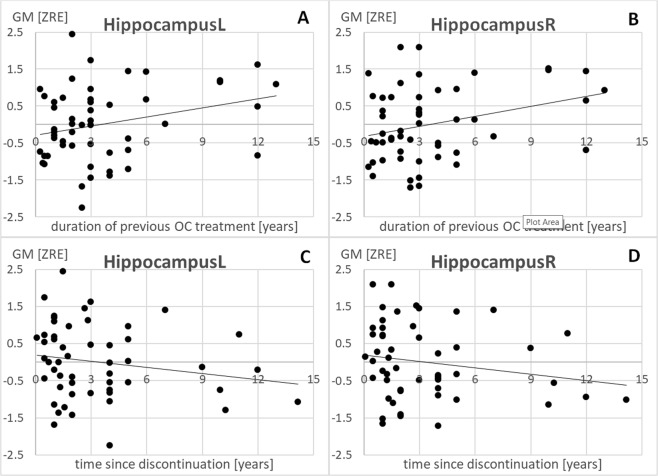
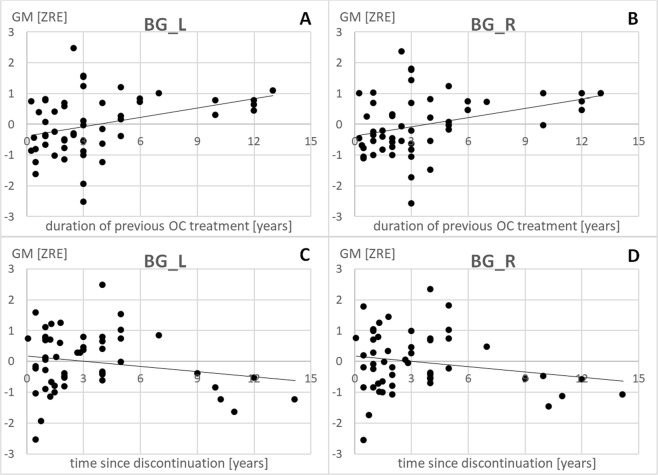
Oral contraceptive (OC) effects on the brain have gained increasing interest, but are highly controversial. Previous studies suggest that OC users have larger hippocampi, parahippocampi, fusiform gyri and Cerebelli. Preliminary evidence from one of those studies even suggests an effect of previous contraceptive use on the hippocampi of women who are not current users of OCs. Furthermore, more recent studies postulate an involvement of previous OC treatment in later development of mood disorders. To address the question whether previous OC treatment affects women's brain structure later in life, high resolution structural images were obtained from 131 naturally cycling women. Among them, 52 women had never used OC before, 52 had previously used one OC for a continuous time period and 27 had previously used multiple contraceptives. The groups did not differ in gray matter volumes. Since endogenous sex hormones modulate gray matter volumes of the hippocampus and basal ganglia along the menstrual cycle, we hypothesize effects of OC use on these areas. Specifically, we hypothesize that a longer duration of previous OC treatment is related to larger hippocampi and larger basal ganglia. Indeed we found the duration of previous OC use to be positively correlated to hippocampal and basal ganglia volumes bilaterally. For the hippocampus, but not for the basal ganglia, this association disappeared after controlling for the time since discontinuation. These results suggest that for the hippocampus, but not for the basal ganglia, effects of previous contraceptive treatment are reversed after a time period comparable to treatment duration. These data question the immediate reversibility of OC effects on brain structure. Accordingly, some changes in the brain due to long-term contraceptive use, while subtle, may be long-lasting.
口服避孕药(OC)对大脑的影响越来越受到关注,但存在很大争议。先前的研究表明,OC 用户的海马体、海马旁回、梭状回和小脑体积较大。其中一项研究的初步证据甚至表明,以前使用避孕药对当前不使用 OC 的女性的海马体有影响。此外,最近的研究假设以前的 OC 治疗与以后情绪障碍的发展有关。为了解决以前的 OC 治疗是否会影响女性以后的大脑结构的问题,我们从 131 名自然周期的女性中获得了高分辨率的结构图像。其中,52 名女性从未使用过 OC,52 名女性曾连续使用过一种 OC,27 名女性曾使用过多种避孕药。这三组女性的灰质体积没有差异。由于内源性性激素会沿着月经周期调节海马体和基底节的灰质体积,我们假设 OC 使用对这些区域有影响。具体来说,我们假设以前 OC 治疗的持续时间与海马体和基底节体积较大有关。事实上,我们发现以前 OC 使用的持续时间与双侧海马体和基底节体积呈正相关。对于海马体,但不是基底节,这种关联在控制停药时间后消失。这些结果表明,对于海马体,但不是基底节,以前的避孕治疗的影响在与治疗持续时间相当的时间后是可以逆转的。这些数据质疑 OC 对大脑结构影响的即时可逆性。因此,由于长期避孕而导致的大脑的一些变化虽然细微,但可能是持久的。