Baron-Cohen Simon, Tsompanidis Alexandros, Auyeung Bonnie, Nørgaard-Pedersen Bent, Hougaard David M, Abdallah Morsi, Cohen Arieh, Pohl Alexa
Autism Research Centre, Department of Psychiatry, University of Cambridge, Cambridge, UK.
Department of Psychology, School of Philosophy, Psychology and Language Sciences, University of Edinburgh, Edinburgh, UK.
Mol Psychiatry. 2020 Nov;25(11):2970-2978. doi: 10.1038/s41380-019-0454-9. Epub 2019 Jul 29.
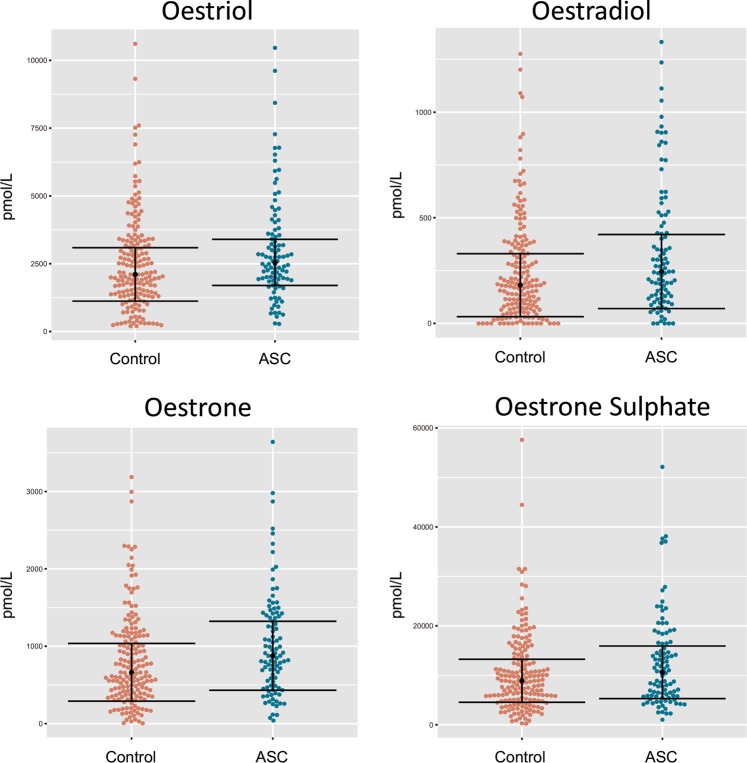
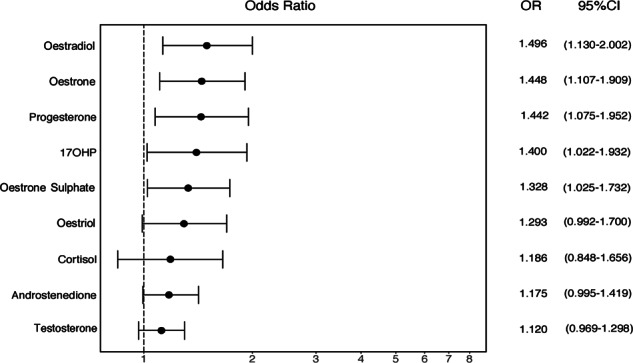
Elevated latent prenatal steroidogenic activity has been found in the amniotic fluid of autistic boys, based on measuring prenatal androgens and other steroid hormones. To date, it is unclear if other prenatal steroids also contribute to autism likelihood. Prenatal oestrogens need to be investigated, as they play a key role in synaptogenesis and corticogenesis during prenatal development, in both males and females. Here we test whether levels of prenatal oestriol, oestradiol, oestrone and oestrone sulphate in amniotic fluid are associated with autism, in the same Danish Historic Birth Cohort, in which prenatal androgens were measured, using univariate logistic regression (n = 98 cases, n = 177 controls). We also make a like-to-like comparison between the prenatal oestrogens and androgens. Oestradiol, oestrone, oestriol and progesterone each related to autism in univariate analyses after correction with false discovery rate. A comparison of standardised odds ratios showed that oestradiol, oestrone and progesterone had the largest effects on autism likelihood. These results for the first time show that prenatal oestrogens contribute to autism likelihood, extending the finding of elevated prenatal steroidogenic activity in autism. This likely affects sexual differentiation, brain development and function.
基于对产前雄激素和其他类固醇激素的测量,在患有自闭症男孩的羊水中发现了潜在的产前类固醇生成活性升高。迄今为止,尚不清楚其他产前类固醇是否也会增加患自闭症的可能性。产前雌激素需要进行研究,因为它们在男性和女性的产前发育过程中的突触形成和皮质形成中起着关键作用。在此,我们在同一个丹麦历史出生队列中,使用单变量逻辑回归(98例病例,177例对照),测试羊水中产前雌三醇、雌二醇、雌酮和硫酸雌酮水平是否与自闭症有关。我们还对产前雌激素和雄激素进行了同类比较。在校正错误发现率后的单变量分析中,雌二醇、雌酮、雌三醇和孕酮均与自闭症有关。标准化比值比的比较表明,雌二醇、雌酮和孕酮对自闭症可能性的影响最大。这些结果首次表明,产前雌激素会增加患自闭症的可能性,扩展了自闭症患者产前类固醇生成活性升高的发现。这可能会影响性别分化、大脑发育和功能。