Cousins Center for Psychoneuroimmunology and Department of Psychiatry and Biobehavioral Sciences, University of California, Los Angeles, UCLA Medical Plaza 300, Room 3156, Los Angeles, CA, 90095-7076, USA.
Emotion NeuroimaGinG (EGG)-Lab and Department of Neurology, Max Planck Institute for Cognitive and Brain Sciences, Stephanstrasse 1a, 04103, Leipzig, Germany.
Psychopharmacology (Berl). 2019 Oct;236(10):3063-3079. doi: 10.1007/s00213-019-05326-9. Epub 2019 Jul 29.
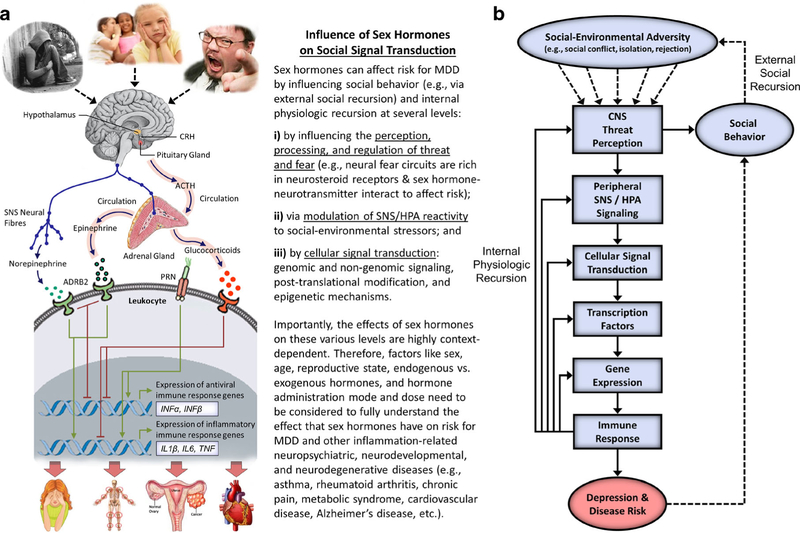
Social Signal Transduction Theory of Depression is a biologically plausible, multi-level theory that describes neural, physiologic, molecular, and genomic mechanisms that link experiences of social-environmental adversity with internal biological processes that drive depression pathogenesis, maintenance, and recurrence. Central to this theory is the hypothesis that interpersonal stressors involving social threat (e.g., social conflict, evaluation, rejection, isolation, and exclusion) upregulate inflammatory processes that can induce several depressive symptoms, including sad mood, anhedonia, fatigue, psychomotor retardation, and social-behavioral withdrawal. The original article describing this formulation (Psychol Bull 140:774-815, 2014) addressed critical questions involving depression onset and recurrence, as well as why depression is strongly predicted by early life stress and comorbid with anxiety disorders and certain physical disease conditions, such as asthma, rheumatoid arthritis, chronic pain, and cardiovascular disease. Here, we extend the theory to help explain sex differences in depression prevalence, which is a defining feature of this disorder. Central to this extension is research demonstrating that ovarian hormone fluctuations modulate women's susceptibility to stress, brain structure and function, and inflammatory activity and reactivity. These effects are evident at multiple levels and are highly context-dependent, varying as a function of several factors including sex, age, reproductive state, endogenous versus exogenous hormones, and hormone administration mode and dose. Together, these effects help explain why women are at greater risk for developing inflammation-related depressed mood and other neuropsychiatric, neurodevelopmental, and neurodegenerative disorders during the reproductive years, especially for those already at heightened risk for depression or in the midst of a hormonal transition period.
抑郁的社会信号转导理论是一个具有生物学合理性的多层次理论,它描述了将社会环境逆境的体验与驱动抑郁发病、维持和复发的内部生物学过程联系起来的神经、生理、分子和基因组机制。该理论的核心假设是,涉及社会威胁的人际压力源(例如社会冲突、评价、拒绝、隔离和排斥)会上调炎症过程,从而引发几种抑郁症状,包括悲伤情绪、快感缺失、疲劳、精神运动迟缓以及社会行为退缩。描述这一构想的原始文章(Psychol Bull 140:774-815, 2014)涉及到与抑郁发作和复发有关的关键问题,以及为什么抑郁与早期生活压力密切相关,并且与焦虑障碍和某些躯体疾病(如哮喘、类风湿性关节炎、慢性疼痛和心血管疾病)共病。在这里,我们扩展了该理论,以帮助解释抑郁患病率的性别差异,这是该疾病的一个显著特征。这一扩展的核心是研究表明,卵巢激素波动会调节女性对压力、大脑结构和功能以及炎症活动和反应性的易感性。这些影响在多个层面上是明显的,并且高度依赖于上下文,随着几个因素的变化而变化,包括性别、年龄、生殖状态、内源性和外源性激素以及激素给药方式和剂量。总之,这些影响有助于解释为什么女性在生殖期更容易因与炎症相关的抑郁情绪和其他神经精神、神经发育和神经退行性疾病而处于更高的风险中,尤其是那些已经处于更高的抑郁风险中或处于激素过渡阶段的女性。