Dietze Martijn M A, Branderhorst Woutjan, Kunnen Britt, Viergever Max A, de Jong Hugo W A M
Radiology and Nuclear Medicine, Utrecht University and University Medical Center Utrecht, P.O. Box 85500, 3508, Utrecht, GA, Netherlands.
Image Sciences Institute, Utrecht University and University Medical Center Utrecht, P.O. Box 85500, 3508, Utrecht, GA, Netherlands.
EJNMMI Phys. 2019 Jul 29;6(1):14. doi: 10.1186/s40658-019-0252-0.
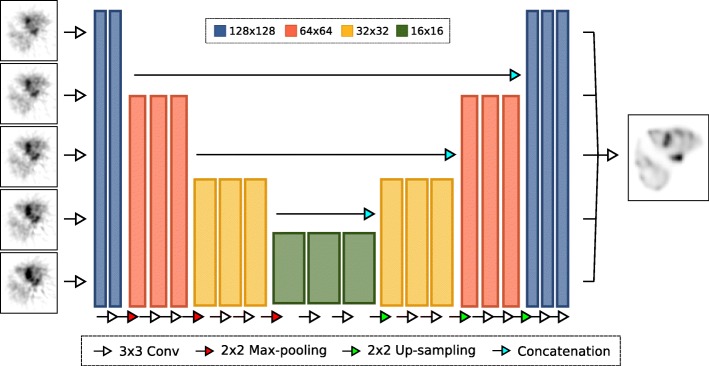
Monte Carlo-based iterative reconstruction to correct for photon scatter and collimator effects has been proven to be superior over analytical correction schemes in single-photon emission computed tomography (SPECT/CT), but it is currently not commonly used in daily clinical practice due to the long associated reconstruction times. We propose to use a convolutional neural network (CNN) to upgrade fast filtered back projection (FBP) image quality so that reconstructions comparable in quality to the Monte Carlo-based reconstruction can be obtained within seconds.
A total of 128 technetium-99m macroaggregated albumin pre-treatment SPECT/CT scans used to guide hepatic radioembolization were available. Four reconstruction methods were compared: FBP, clinical reconstruction, Monte Carlo-based reconstruction, and the neural network approach. The CNN generated reconstructions in 5 sec, whereas clinical reconstruction took 5 min and the Monte Carlo-based reconstruction took 19 min. The mean squared error of the neural network approach in the validation set was between that of the Monte Carlo-based and clinical reconstruction, and the lung shunting fraction difference was lower than 2 percent point. A phantom experiment showed that quantitative measures required in radioembolization were accurately retrieved from the CNN-generated reconstructions.
FBP with an image enhancement neural network provides SPECT reconstructions with quality close to that obtained with Monte Carlo-based reconstruction within seconds.
基于蒙特卡洛的迭代重建用于校正光子散射和准直器效应,已被证明在单光子发射计算机断层扫描(SPECT/CT)中优于解析校正方案,但由于相关的重建时间长,目前在日常临床实践中并不常用。我们建议使用卷积神经网络(CNN)来提升快速滤波反投影(FBP)图像质量,以便在数秒内获得质量与基于蒙特卡洛的重建相当的重建结果。
共有128例用于指导肝动脉放射性栓塞的99m锝大聚合白蛋白预处理SPECT/CT扫描可用。比较了四种重建方法:FBP、临床重建、基于蒙特卡洛的重建和神经网络方法。CNN在5秒内生成重建结果,而临床重建需要5分钟,基于蒙特卡洛的重建需要19分钟。验证集中神经网络方法的均方误差介于基于蒙特卡洛的重建和临床重建之间,肺分流分数差异低于2个百分点。体模实验表明,从CNN生成的重建结果中可以准确获取放射性栓塞所需的定量测量值。
具有图像增强神经网络的FBP可在数秒内提供质量与基于蒙特卡洛的重建相近的SPECT重建结果。