Siddiqui Muhammad U, Scalzitti David, Naeem Zunaira
Department of Medicine, Marshfield Clinic, Rice Lake, WI 54701, USA.
Department of Biostatistics, George Washington University, Washington, DC 20052, USA.
Cardiol Res Pract. 2019 Jul 7;2019:6419147. doi: 10.1155/2019/6419147. eCollection 2019.
Atrial fibrillation leads to increased risk of systemic embolism and stroke. To decrease these adverse events, anticoagulation is routinely prescribed. Nonvitamin K anticoagulants like apixaban and rivaroxaban are becoming popular and being used more frequently nowadays. We here compare the efficacy and safety of apixaban with those of warfarin.
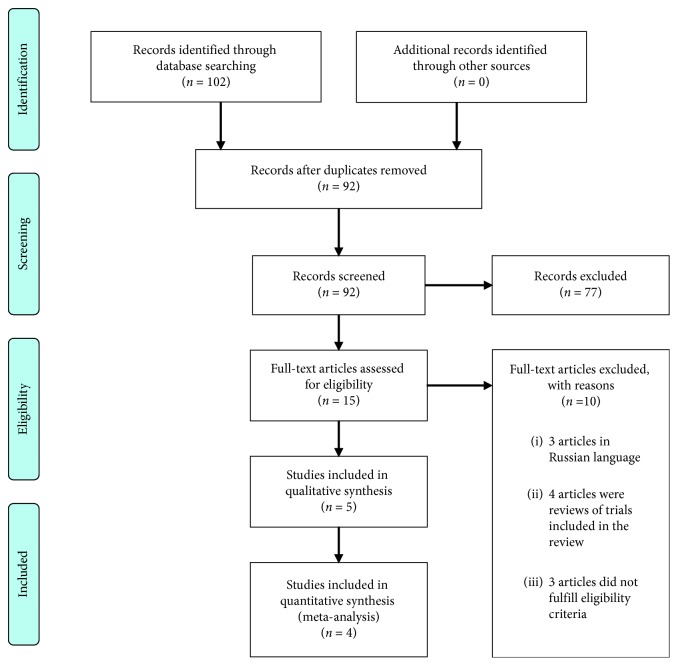
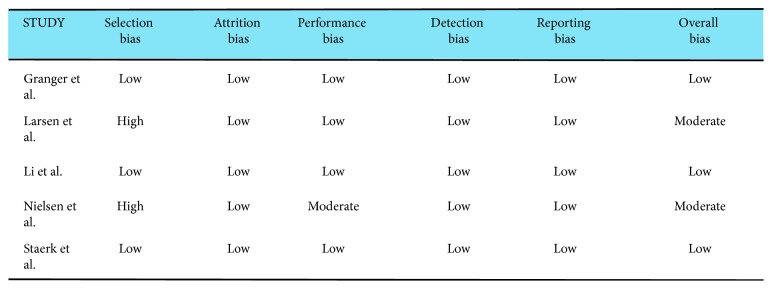
This systematic review aims to assess the efficacy and safety of apixaban compared to those of warfarin. Eligible participants were adults diagnosed with nonvalvular atrial fibrillation. The intervention was apixaban, and the comparator was warfarin. The primary efficacy endpoint is the first admission with systemic embolism or stroke, and the primary safety outcome is the occurrence of major bleeding. Relevant studies were searched in the Cochrane Central Register of Controlled Trials, MEDLINE, PubMed, and clinicaltrials.gov. After being independently reviewed by two authors, five articles were included in the systematic review. The risk of bias of included studies was assessed using the Cochrane risk of bias tool and SIGN methodology. The RevMan software was used to assess the effect size and perform meta-analysis.
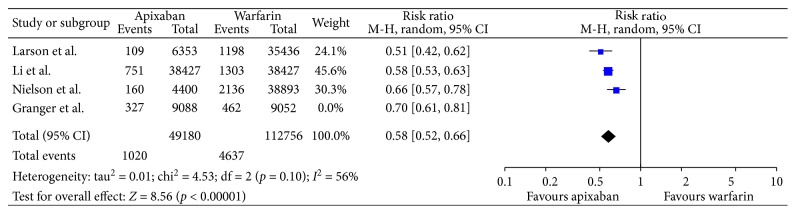
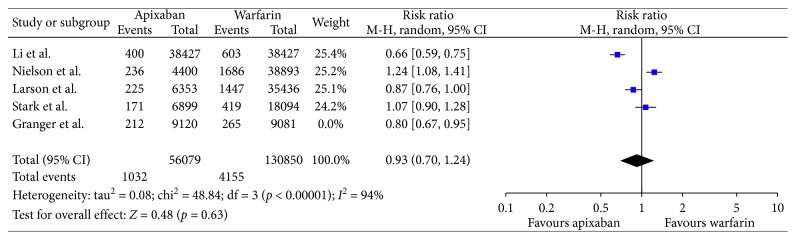
Apixaban was found to be superior to warfarin in terms of safety (RR 0.58; CI 0.52-0.66) but not superior to warfarin in terms of efficacy (RR 0.93; CI 0.70-1.24).
Apixaban is superior to warfarin in terms of safety, but no difference in efficacy is noted. The choice of anticoagulation should be individualized based on the risk factor profile of the patient.
心房颤动会增加全身性栓塞和中风的风险。为降低这些不良事件的发生几率,通常会开具抗凝药物。阿哌沙班和利伐沙班等非维生素K抗凝剂如今越来越受欢迎且使用更为频繁。我们在此比较阿哌沙班与华法林的疗效和安全性。
本系统评价旨在评估阿哌沙班与华法林相比的疗效和安全性。符合条件的参与者为被诊断患有非瓣膜性心房颤动的成年人。干预措施为阿哌沙班,对照药物为华法林。主要疗效终点是首次因全身性栓塞或中风入院,主要安全性结局是发生大出血。在Cochrane对照试验中央注册库、MEDLINE、PubMed和clinicaltrials.gov中检索相关研究。经两位作者独立评审后,五项研究被纳入本系统评价。使用Cochrane偏倚风险工具和SIGN方法评估纳入研究的偏倚风险。使用RevMan软件评估效应量并进行荟萃分析。
发现阿哌沙班在安全性方面优于华法林(风险比0.58;可信区间0.52 - 0.66),但在疗效方面并不优于华法林(风险比0.93;可信区间0.70 - 1.24)。
阿哌沙班在安全性方面优于华法林,但在疗效方面未发现差异。抗凝药物的选择应根据患者的风险因素情况进行个体化。