Hall Jaclyn, Cho Hee Deok, Maldonado-Molina Mildred, George Thomas J, Shenkman Elizabeth A, Salloum Ramzi G
Department of Health Outcomes and Biomedical Informatics, University of Florida College of Medicine, Gainesville, FL, USA.
Division of Hematology/Oncology, Department of Medicine, University of Florida College of Medicine, Gainesville, FL, USA.
Prev Med Rep. 2019 Jul 2;15:100935. doi: 10.1016/j.pmedr.2019.100935. eCollection 2019 Sep.
CVS, the largest US pharmacy chain, discontinued selling tobacco products in 2014; meanwhile, Family Dollar and Dollar General, the two largest dollar store chains, began selling tobacco in 2012 and 2013, respectively. The purpose of this study is to evaluate the differential change in tobacco retailer density (TRD) by rurality throughout 12 Southeastern US states.
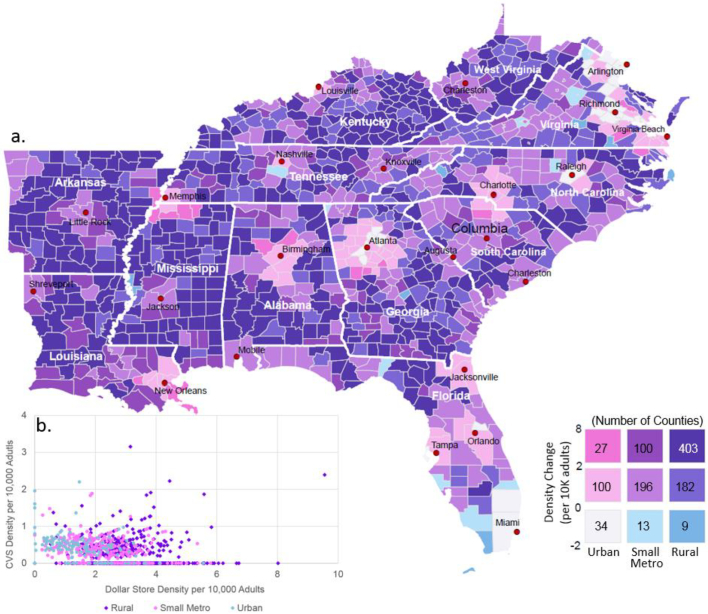
Tobacco retailer density was calculated for CVS and dollar store locations and combined to represent retailer density change before and after policy changes. Bivariate analyses were conducted to compare the corporate-initiated changes in county-level retailer density across rurality categories.
Findings suggest a statistically significant difference ( < 0.0001) between TRD effect and rurality. Urban counties together experienced a retailer density increase of 0.4 stores per 10 k adult population, while rural counties reported a TRD increase of 2.6-eight (8) times the increase in urban areas.
Recent corporate policy changes on tobacco sales have increased access to tobacco retailers in rural counties considerably more than in urban counties, contributing to further disparities. CVS pharmacies discontinuing tobacco sales caused a decrease in retail density in urban areas, and the decision of the dollar stores locations initiating tobacco sales resulted in a greater burden to rural and small-metro counties.
美国最大的连锁药店CVS于2014年停止销售烟草产品;与此同时,两大美元店连锁企业Family Dollar和Dollar General分别于2012年和2013年开始销售烟草。本研究的目的是评估美国东南部12个州农村地区烟草零售商密度(TRD)的差异变化。
计算CVS和美元店所在地的烟草零售商密度,并将其合并以代表政策变化前后的零售商密度变化。进行双变量分析以比较不同农村类别县级零售商密度的企业发起变化。
研究结果表明,TRD效应与农村地区之间存在统计学上的显著差异(<0.0001)。城市县每10000名成年人口的零售商密度共增加了0.4家商店,而农村县的TRD增加量是城市地区增加量的2.6至8倍。
近期烟草销售的企业政策变化使农村县相比城市县更容易获得烟草零售商,加剧了进一步的差距。CVS药店停止销售烟草导致城市地区零售密度下降,而美元店开始销售烟草的决定给农村和小都市县带来了更大的负担。