Su Jie, Telychko Mykola, Hu Pan, Macam Gennevieve, Mutombo Pingo, Zhang Hejian, Bao Yang, Cheng Fang, Huang Zhi-Quan, Qiu Zhizhan, Tan Sherman J R, Lin Hsin, Jelínek Pavel, Chuang Feng-Chuan, Wu Jishan, Lu Jiong
Department of Chemistry, National University of Singapore, 3 Science Drive 3, Singapore 117543, Singapore.
Centre for Advanced 2D Materials (CA2DM), National University of Singapore, 6 Science Drive 2, Singapore 117546, Singapore.
Sci Adv. 2019 Jul 26;5(7):eaav7717. doi: 10.1126/sciadv.aav7717. eCollection 2019 Jul.
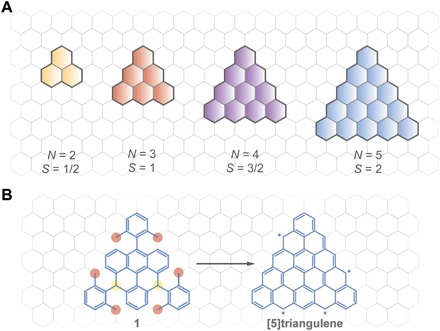
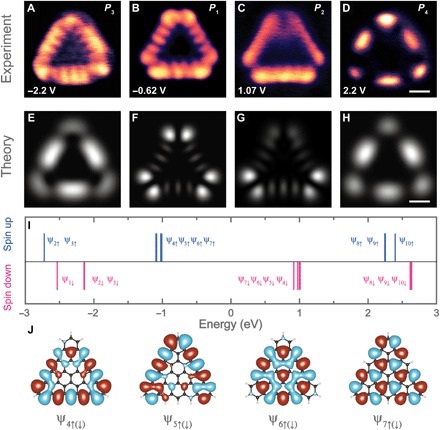
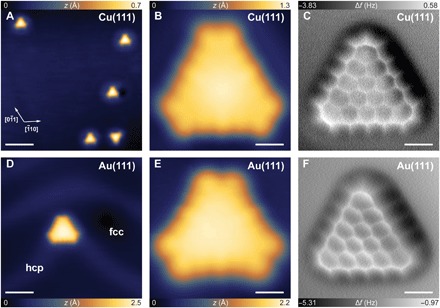
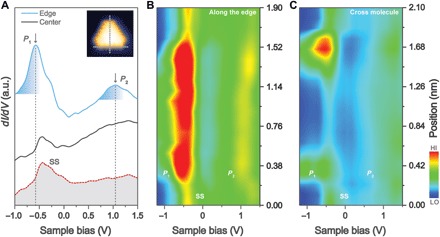
The zigzag-edged triangular graphene molecules (ZTGMs) have been predicted to host ferromagnetically coupled edge states with the net spin scaling with the molecular size, which affords large spin tunability crucial for next-generation molecular spintronics. However, the scalable synthesis of large ZTGMs and the direct observation of their edge states have been long-standing challenges because of the molecules' high chemical instability. Here, we report the bottom-up synthesis of π-extended [5]triangulene with atomic precision via surface-assisted cyclodehydrogenation of a rationally designed molecular precursor on metallic surfaces. Atomic force microscopy measurements unambiguously resolve its ZTGM-like skeleton consisting of 15 fused benzene rings, while scanning tunneling spectroscopy measurements reveal edge-localized electronic states. Bolstered by density functional theory calculations, our results show that [5]triangulenes synthesized on Au(111) retain the open-shell π-conjugated character with magnetic ground states.
锯齿状边缘的三角形石墨烯分子(ZTGMs)已被预测具有铁磁耦合的边缘态,其净自旋随分子尺寸缩放,这为下一代分子自旋电子学提供了至关重要的大自旋可调性。然而,由于分子的高化学不稳定性,大规模合成大型ZTGMs并直接观察其边缘态一直是长期存在的挑战。在此,我们报告了通过在金属表面对合理设计的分子前驱体进行表面辅助环脱氢反应,以原子精度自下而上合成π-扩展的[5]三角烯。原子力显微镜测量明确解析了其由15个稠合苯环组成的类似ZTGM的骨架,而扫描隧道光谱测量揭示了边缘局域电子态。在密度泛函理论计算的支持下,我们的结果表明在Au(111)上合成的[5]三角烯保留了具有磁性基态的开壳π共轭特性。