Department of Radiation Oncology, National Cancer Center Hospital, 5-1-1 Tsukiji, Chuo-ku, Tokyo, Japan.
Department of Pathology and Clinical Laboratories, National Cancer Center Hospital, 5-1-1 Tsukiji, Chuo-ku, Tokyo, Japan.
J Radiat Res. 2019 Nov 22;60(6):803-811. doi: 10.1093/jrr/rrz053.
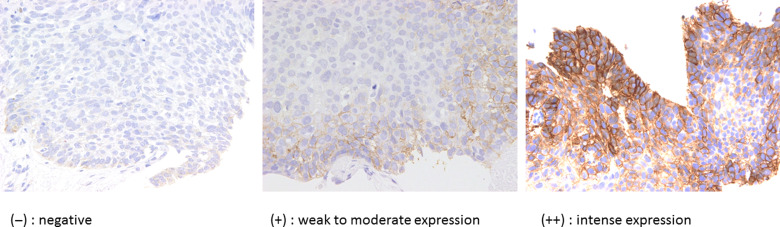
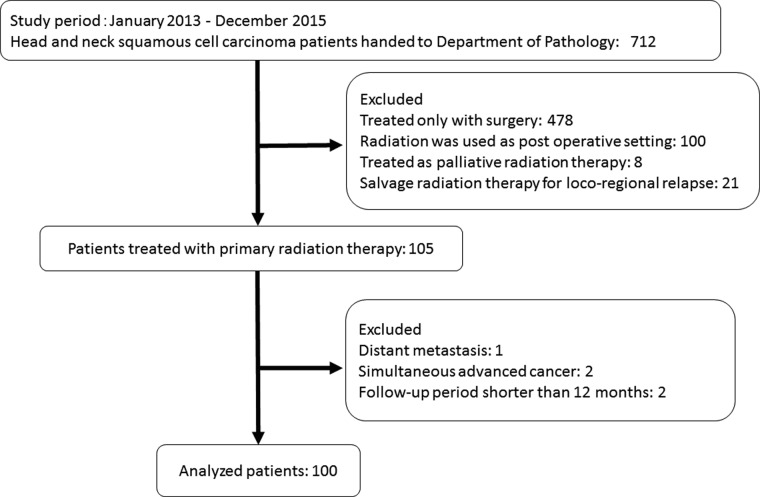
A reliable biomarker can contribute to appropriate treatment selection in the management of head and neck squamous cell carcinoma (HNSCC). Recently, epithelial cell adhesion molecule (EpCAM) was shown to have prognostic features in several malignancies. However, it remains to be elucidated whether EpCAM predicts prognosis of HNSCC after radiotherapy. Therefore, the prognostic potential of EpCAM in HNSCC patients treated by radiotherapy was investigated in this study. All HNSCCs patients examined between January 2013 and December 2015 were analyzed for the expression of EpCAM. One hundred HNSCC patients were identified who were treated by primary radiotherapy. Intense expression of EpCAM was found in 29 HNSCC patients. Two-year overall survival (OS) for patients with intense EpCAM expression was 62.2%, whereas it was 87.9% for those without (P = 0.011). In multivariate analysis, intense EpCAM expression was found to be an independent prognostic factors for OS (P = 0.036). Overall, EpCAM was found to be an independent prognostic factor for HNSCC.
可靠的生物标志物有助于对头颈部鳞状细胞癌(HNSCC)的治疗选择进行适当的管理。最近,上皮细胞黏附分子(EpCAM)在几种恶性肿瘤中表现出了预后特征。然而,EpCAM 是否能预测 HNSCC 患者放疗后的预后仍有待阐明。因此,本研究旨在探讨 EpCAM 对接受放疗的 HNSCC 患者的预后预测潜力。分析了 2013 年 1 月至 2015 年 12 月期间所有接受检查的 HNSCC 患者的 EpCAM 表达情况。确定了 100 名接受原发性放疗的 HNSCC 患者。在 29 名 HNSCC 患者中发现 EpCAM 表达强烈。EpCAM 表达强烈的患者 2 年总生存率(OS)为 62.2%,而 EpCAM 表达不强烈的患者为 87.9%(P=0.011)。多因素分析显示,EpCAM 表达强烈是 OS 的独立预后因素(P=0.036)。总的来说,EpCAM 是 HNSCC 的一个独立预后因素。