School of Physiology, Pharmacology and Neuroscience, Biomedical Sciences Building, University Walk, Bristol BS8 1TD, United Kingdom.
School of Biochemistry, Biomedical Sciences Building, University Walk, Bristol BS8 1TD, United Kingdom.
J Mol Cell Cardiol. 2019 Oct;135:22-30. doi: 10.1016/j.yjmcc.2019.07.012. Epub 2019 Jul 27.
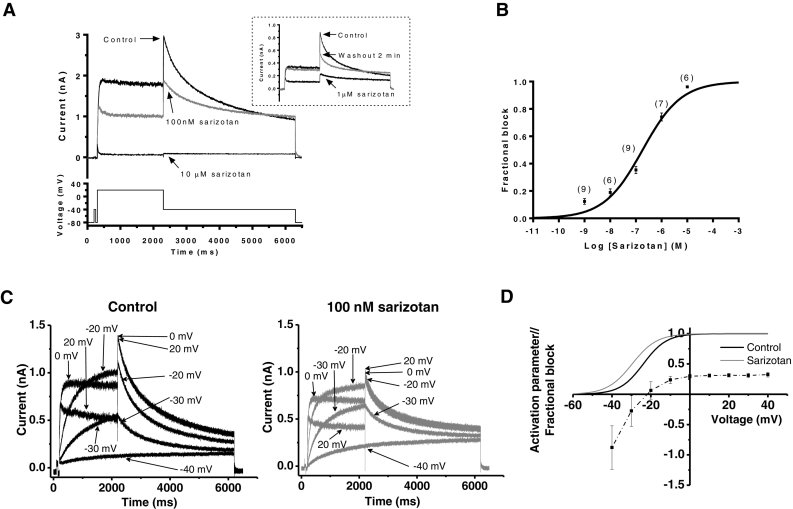
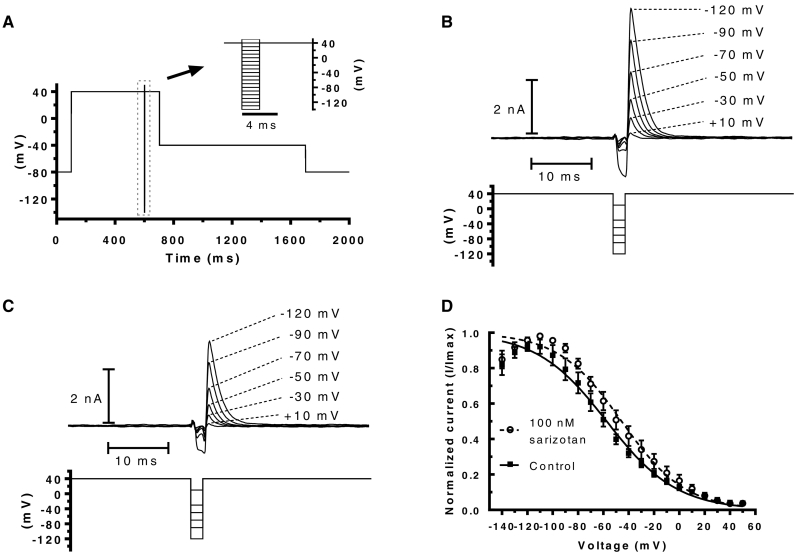
Rett Syndrome (RTT) is an X-linked neurodevelopmental disorder associated with respiratory abnormalities and, in up to ~40% of patients, with prolongation of the cardiac QT interval. QT prolongation calls for cautious use of drugs with a propensity to inhibit hERG channels. The STARS trial has been undertaken to investigate the efficacy of sarizotan, a 5-HT receptor agonist, at correcting RTT respiratory abnormalities. The present study investigated whether sarizotan inhibits hERG potassium channels and prolongs ventricular repolarization. Whole-cell patch-clamp measurements were made at 37 °C from hERG-expressing HEK293 cells. Docking analysis was conducted using a recent cryo-EM structure of hERG. Sarizotan was a potent inhibitor of hERG current (I; IC of 183 nM) and of native ventricular I from guinea-pig ventricular myocytes. 100 nM and 1 μM sarizotan prolonged ventricular action potential (AP) duration (APD) by 14.1 ± 3.3% (n = 6) and 29.8 ± 3.1% (n = 5) respectively and promoted AP triangulation. High affinity I inhibition by sarizotan was contingent upon channel gating and intact inactivation. Mutagenesis experiments and docking analysis implicated F557, S624 and Y652 residues in sarizotan binding, with weaker contribution from F656. In conclusion, sarizotan inhibits I/I, accessing key binding residues on channel gating. This action and consequent ventricular AP prolongation occur at concentrations relevant to those proposed to treat breathing dysrhythmia in RTT. Sarizotan should only be used in RTT patients with careful evaluation of risk factors for QT prolongation.
雷特综合征(RTT)是一种 X 连锁神经发育障碍,与呼吸异常有关,在多达约 40%的患者中,与心脏 QT 间期延长有关。QT 间期延长需要谨慎使用有抑制 hERG 通道倾向的药物。STARS 试验旨在研究 5-HT 受体激动剂沙利佐坦纠正 RTT 呼吸异常的疗效。本研究旨在研究沙利佐坦是否抑制 hERG 钾通道并延长心室复极。在 37°C 下从表达 hERG 的 HEK293 细胞中进行全细胞膜片钳测量。使用 hERG 的最近冷冻电镜结构进行对接分析。沙利佐坦是 hERG 电流(I)的有效抑制剂(IC 为 183 nM),也是豚鼠心室肌细胞中原发性心室 I 的抑制剂。100 nM 和 1 µM 沙利佐坦分别使心室动作电位(AP)持续时间(APD)延长 14.1±3.3%(n=6)和 29.8±3.1%(n=5),并促进 AP 三角化。沙利佐坦对 I 的高亲和力抑制取决于通道门控和完整的失活。突变实验和对接分析表明 F557、S624 和 Y652 残基参与了沙利佐坦的结合,F656 的贡献较弱。总之,沙利佐坦抑制 I/I,可进入通道门控的关键结合残基。这种作用以及随后的心室 AP 延长发生在与拟用于治疗 RTT 呼吸节律障碍的浓度相关的浓度下。只有在仔细评估 QT 间期延长的危险因素后,才应将沙利佐坦用于 RTT 患者。