Noel Samantha J, Olijhoek Dana W, Mclean Farran, Løvendahl Peter, Lund Peter, Højberg Ole
Department of Animal Science, AU-Foulum, Aarhus University, DK-8830 Tjele, Denmark.
Department of Molecular Biology and Genetics, AU-Foulum, Aarhus University, DK-8830 Tjele, Denmark.
Animals (Basel). 2019 Jul 29;9(8):498. doi: 10.3390/ani9080498.
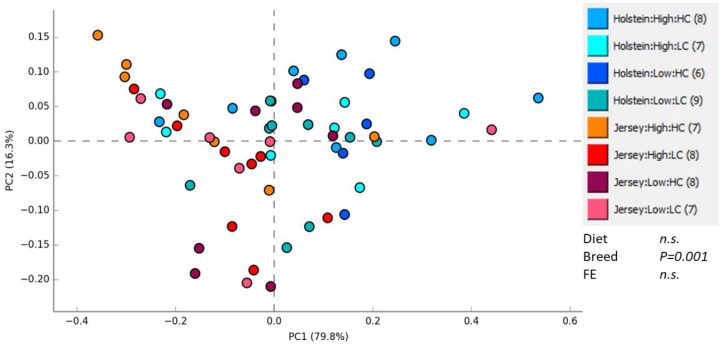
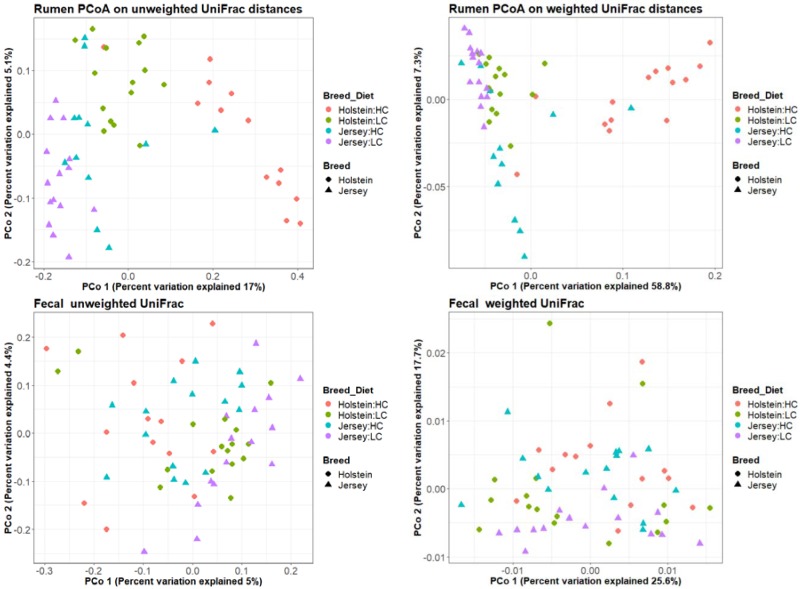
Identifying factors that influence the composition of the microbial population in the digestive system of dairy cattle will be key in regulating these populations to reduce greenhouse gas emissions. In this study, we analyzed rumen and fecal samples from five high residual feed intake (RFI) Holstein cows, five low RFI Holstein cows, five high RFI Jersey cows and five low RFI Jersey cows, fed either a high-concentrate diet (expected to reduce methane emission) or a high-forage diet. Bacterial communities from both the rumen and feces were profiled using Illumina sequencing on the 16S rRNA gene. Rumen archaeal communities were profiled using Terminal-Restriction Fragment Length Polymorphism (T-RFLP) targeting the mcrA gene. The rumen methanogen community was influenced by breed but not by diet or RFI. The rumen bacterial community was influenced by breed and diet but not by RFI. The fecal bacterial community was influenced by individual animal variation and, to a lesser extent, by breed and diet but not by RFI. Only the bacterial community correlated with methane production. Community differences seen in the rumen were reduced or absent in feces, except in the case of animal-to-animal variation, where differences were more pronounced. The two cattle breeds had different levels of response to the dietary intervention; therefore, it may be appropriate to individually tailor methane reduction strategies to each cattle breed.
确定影响奶牛消化系统微生物种群组成的因素,对于调控这些种群以减少温室气体排放至关重要。在本研究中,我们分析了五头高残余采食量(RFI)的荷斯坦奶牛、五头低RFI的荷斯坦奶牛、五头高RFI的泽西奶牛和五头低RFI的泽西奶牛的瘤胃和粪便样本,这些奶牛分别饲喂高浓缩日粮(预计可减少甲烷排放)或高粗饲料日粮。使用Illumina测序技术对16S rRNA基因进行分析,以确定瘤胃和粪便中的细菌群落。使用针对mcrA基因的末端限制性片段长度多态性(T-RFLP)技术分析瘤胃古细菌群落。瘤胃产甲烷菌群落受品种影响,但不受日粮或RFI影响。瘤胃细菌群落受品种和日粮影响,但不受RFI影响。粪便细菌群落受个体动物差异影响,在较小程度上受品种和日粮影响,但不受RFI影响。只有细菌群落与甲烷产生相关。除了动物个体差异更为明显的情况外,瘤胃中观察到的群落差异在粪便中减少或不存在。这两个奶牛品种对日粮干预的反应水平不同;因此,可能适合针对每个奶牛品种单独制定甲烷减排策略。