Campbell Bronwyn E, Hassan Mohammad Mahmudul, Moore Robert J, Olchowy Timothy, Ranjbar Shahab, Soust Martin, Ramirez-Garzon Orlando, Al Jassim Rafat, Alawneh John I
School of Science, RMIT University, Bundoora, Melbourne, VIC 3068, Australia.
School of Veterinary Science, The University of Queensland, Gatton, QLD 4343, Australia.
Animals (Basel). 2024 Nov 27;14(23):3437. doi: 10.3390/ani14233437.
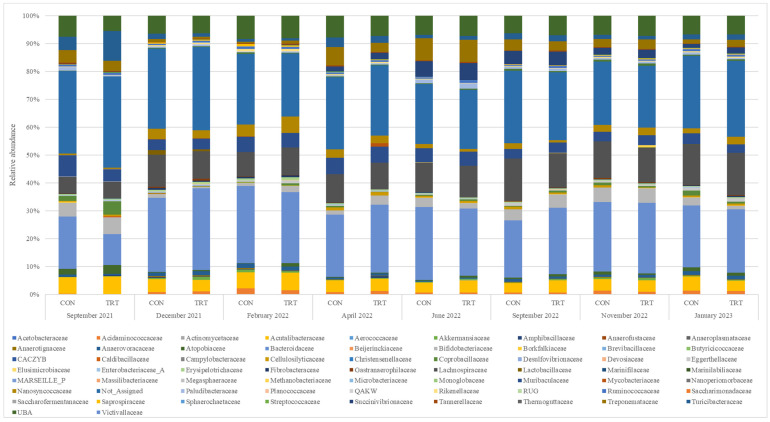
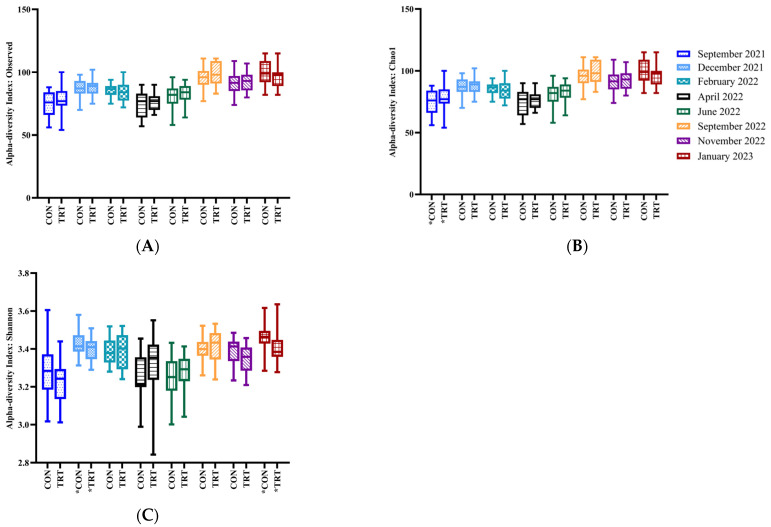
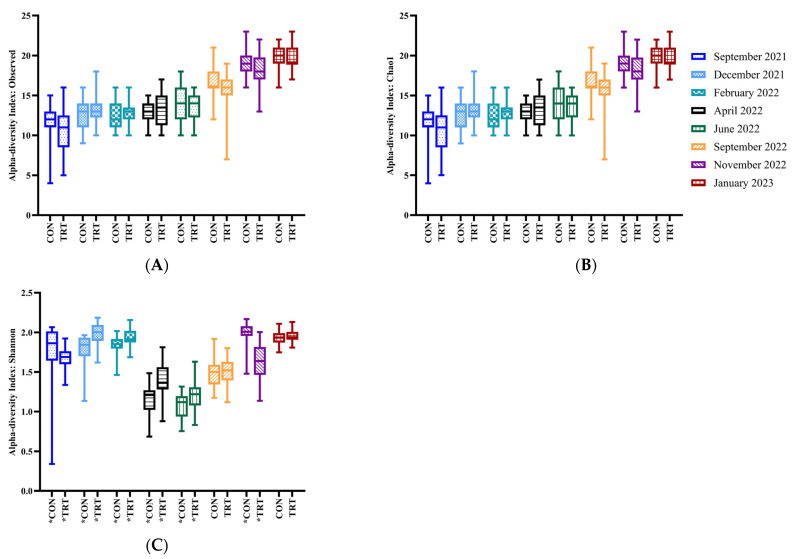
The rumen microbiota of dairy cows plays a crucial role in fermenting fibrous material, essential for nutrient extraction and overall productivity, detoxification of anti-nutritional toxic compounds, synthesis of vital nutrients, and is essential for optimal animal health. This study investigated the impact of -, -, and -based direct-fed microbial (DFM) supplementation on dairy cows' faecal microbial composition and diversity. The study was carried out on a commercial dairy farm using 50 Holstein-Friesian cows randomly assigned into control (CON) and treatment (TRT) groups. Faecal samples were collected directly from the rectum every two months from September 2021 to January 2023. The bacterial 16S rRNA gene and fungal ITS-1 regions were amplified, sequenced, and analysed. Microbial diversity was assessed through alpha- and beta-diversity metrics. Linear discriminant analysis effect size (LEfSe) was performed to identify which taxa were driving the changes seen in the microbiota over time and treatment. were the most prevalent bacterial family, followed by and in both CON and TRT cows. , , and were the dominant three fungal phyla in the faeces of both CON and TRT cows. Bacterial genera was abundant in the CON and in the TRT groups. Fungal taxa _incertae_sedis and were absent in the faeces of TRT cows. Significant temporal and specific taxonomic differences were observed between the CON and TRT groups. The study's findings underscore the dynamic nature of microbial communities and the importance of targeted dietary interventions. Further research is necessary to elucidate these microbial shifts, long-term impacts, and functional implications, aiming to optimise ruminant nutrition and enhance dairy cow performance.
奶牛的瘤胃微生物群在纤维物质发酵中起着关键作用,这对于营养物质的提取和整体生产力、抗营养有毒化合物的解毒、重要营养物质的合成至关重要,并且对动物的最佳健康状态也必不可少。本研究调查了基于-、-和-的直接投喂微生物(DFM)补充剂对奶牛粪便微生物组成和多样性的影响。该研究在一个商业奶牛场进行,使用50头荷斯坦-弗里生奶牛随机分为对照组(CON)和处理组(TRT)。从2021年9月至2023年1月,每两个月直接从直肠采集粪便样本。对细菌16S rRNA基因和真菌ITS-1区域进行扩增、测序和分析。通过α-和β-多样性指标评估微生物多样性。进行线性判别分析效应大小(LEfSe)以确定哪些分类群导致了微生物群随时间和处理的变化。在CON组和TRT组奶牛中,是最普遍的细菌科,其次是和。在CON组和TRT组奶牛的粪便中,、和是占主导地位的三个真菌门。细菌属在CON组中丰富,在TRT组中丰富。TRT组奶牛的粪便中不存在真菌分类未定和。在CON组和TRT组之间观察到显著的时间和特定分类差异。该研究的结果强调了微生物群落的动态性质以及有针对性的饮食干预的重要性。有必要进一步研究以阐明这些微生物变化、长期影响和功能意义,旨在优化反刍动物营养并提高奶牛性能。