Department of Disease Control, Faculty of Infectious Tropical Diseases, London School of Hygiene and Tropical Medicine, Keppel Street, London, UK.
Department of Public Health Sciences, Karolinska Institutet, Nobels väg 6, Solna and Alfred Nobels Allé 8, Huddinge, Stockholm, Sweden.
Health Policy Plan. 2019 Sep 1;34(7):544-552. doi: 10.1093/heapol/czz068.
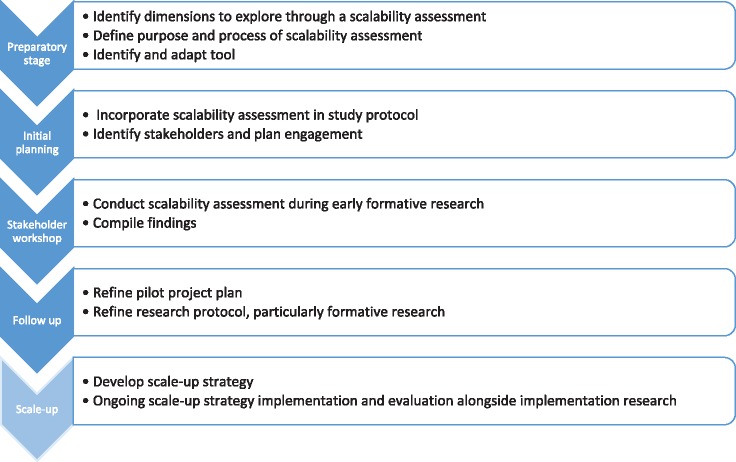
Public health interventions should be designed with scale in mind, and researchers and implementers must plan for scale-up at an early stage. Yet, there is limited awareness among researchers of the critical value of considering scalability and relatively limited empirical evidence on assessing scalability, despite emerging methodological guidance. We aimed to integrate scalability considerations in the design of a study to evaluate a multi-component intervention to reduce unnecessary caesarean sections in low- and middle-income countries. First, we reviewed and synthesized existing scale up frameworks to identify relevant dimensions and available scalability assessment tools. Based on these, we defined our scalability assessment process and adapted existing tools for our study. Here, we document our experience and the methodological challenges we encountered in integrating a scalability assessment in our study protocol. These include: achieving consensus on the purpose of a scalability assessment; and identifying the optimal timing of such an assessment, moving away from the concept of a one-off assessment at the start of a project. We also encountered tensions between the need to establish the proof of principle, and the need to design an innovation that would be fit-for-scale. Particularly for complex interventions, scaling up may warrant rigorous research to determine an efficient and effective scaling-up strategy. We call for researchers to better incorporate scalability considerations in pragmatic trials through greater integration of impact and process evaluation, more stringent definition and measurement of scale-up objectives and outcome evaluation plans that allow for comparison of effects at different stages of scale-up.
公共卫生干预措施的设计应着眼于规模,研究人员和实施人员必须在早期阶段规划规模扩大。然而,尽管出现了新的方法指导,研究人员对考虑可扩展性的重要性以及评估可扩展性的相对有限的经验证据的认识有限。我们旨在将可扩展性考虑因素纳入一项研究的设计中,以评估一项多组件干预措施,以减少中低收入国家不必要的剖宫产。首先,我们回顾和综合了现有的扩展框架,以确定相关维度和可用的可扩展性评估工具。在此基础上,我们定义了我们的可扩展性评估过程,并为我们的研究调整了现有的工具。在这里,我们记录了我们在研究方案中整合可扩展性评估所遇到的经验和方法学挑战。这些挑战包括:就可扩展性评估的目的达成共识;以及确定此类评估的最佳时机,避免在项目开始时进行一次性评估的概念。我们还在需要确定原理的证明和需要设计适合规模的创新之间存在紧张关系。特别是对于复杂的干预措施,扩大规模可能需要进行严格的研究,以确定一种高效和有效的扩大规模策略。我们呼吁研究人员通过更紧密地结合影响和过程评估、更严格地定义和衡量扩大规模目标以及允许比较扩大规模不同阶段效果的结果评估计划,在实用试验中更好地纳入可扩展性考虑因素。