Department of Physiology, University of California, San Francisco, San Francisco, CA 94158.
Department of Biochemistry, University of Utah, Salt Lake City, UT 84132.
Mol Biol Cell. 2019 Aug 1;30(17):2097-2104. doi: 10.1091/mbc.E16-10-0709.
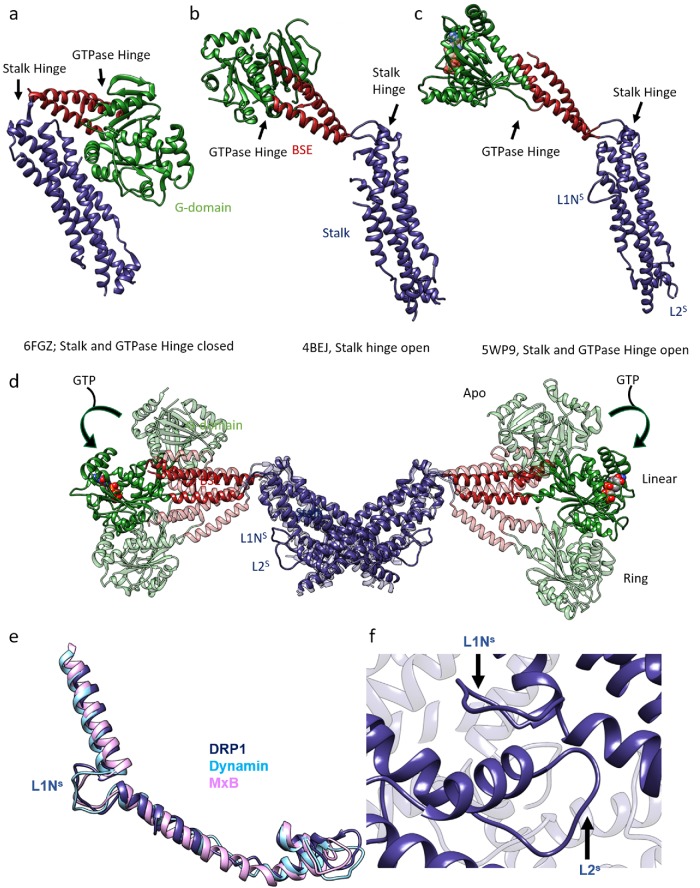
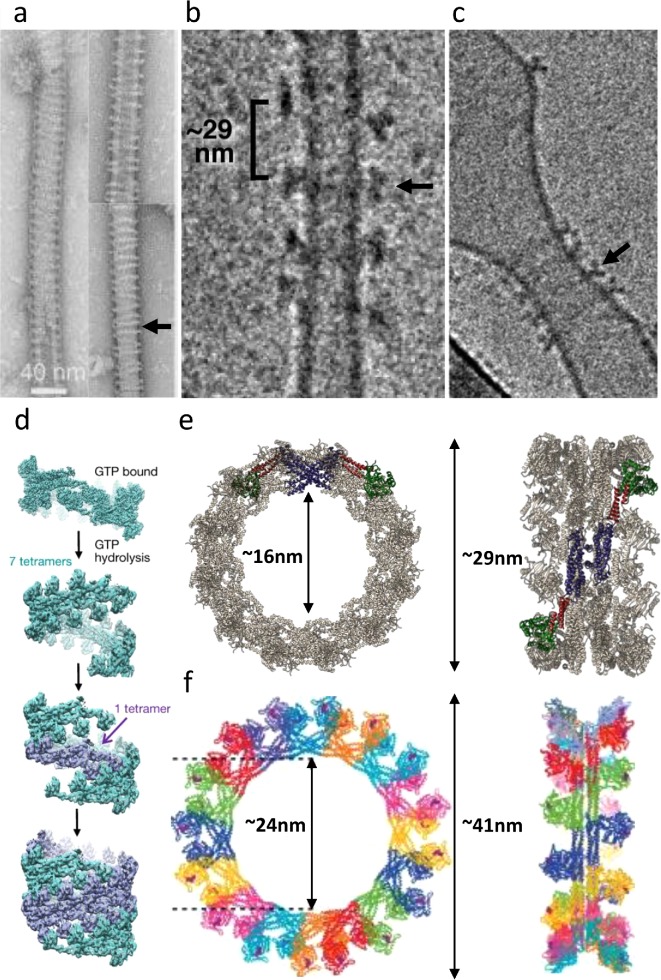
Cells have evolved diverse protein-based machinery to reshape, cut, or fuse their membrane-delimited compartments. Dynamin superfamily proteins are principal components of this machinery and use their ability to hydrolyze GTP and to polymerize into helices and rings to achieve these goals. Nucleotide-binding, hydrolysis, and exchange reactions drive significant conformational changes across the dynamin family, and these changes alter the shape and stability of supramolecular dynamin oligomers, as well as the ability of dynamins to bind receptors and membranes. Mutations that interfere with the conformational repertoire of these enzymes, and hence with membrane fission, exist in several inherited human diseases. Here, we discuss insights from new x-ray crystal structures and cryo-EM reconstructions that have enabled us to infer some of the allosteric dynamics for these proteins. Together, these studies help us to understand how dynamins perform mechanical work, as well as how specific mutants of dynamin family proteins exhibit pathogenic properties.
细胞已经进化出多种基于蛋白质的机制来重塑、切割或融合其膜限定的隔室。GTP 酶超家族蛋白是该机制的主要组成部分,它们利用水解 GTP 和聚合形成螺旋和环的能力来实现这些目标。核苷酸结合、水解和交换反应驱动整个 GTP 酶超家族发生显著的构象变化,这些变化改变了超分子 GTP 酶寡聚体的形状和稳定性,以及 GTP 酶结合受体和膜的能力。在几种遗传性人类疾病中存在干扰这些酶构象范围的突变,从而干扰膜分裂。在这里,我们讨论了来自新的 X 射线晶体结构和冷冻电镜重构的见解,这些见解使我们能够推断出这些蛋白质的一些变构动力学。这些研究共同帮助我们理解 GTP 酶如何进行机械功,以及 GTP 酶家族蛋白的特定突变体如何表现出致病性。