Department of Pediatrics, Saint Louis Children's Hospital, Saint Louis, MO, USA.
Pediatric Epilepsy Team, Regional Neurology Services, Department of Child Neurology, Children's Hospital Colorado, Denver, CO, USA.
BMC Med Educ. 2019 Jul 31;19(1):293. doi: 10.1186/s12909-019-1732-6.
Providing appropriate levels of autonomy to resident physicians is an important facet of graduate medical education, allowing learners to progress toward the ultimate goal of independent practice. While studies have identified the importance of autonomy to the development of resident physicians, less is known about resident perspectives on their "lived experiences" with autonomy and ways in which clinical educators either promote or undermine it. The current study aims to provide an empirically based practical framework based on resident perspectives through which supervising physicians can attempt to more adequately foster resident physician autonomy.
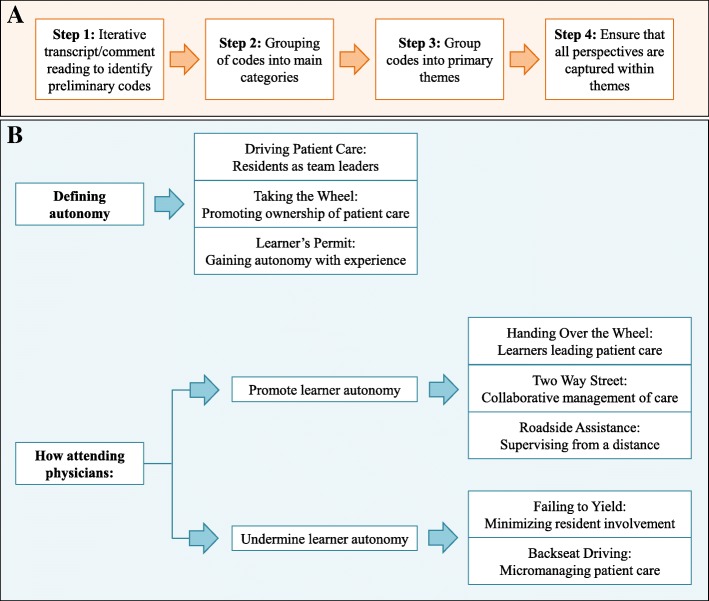
Residents completed open ended surveys followed by facilitated group discussions of their perspectives on autonomy. Qualitative thematic analysis identified key themes in resident definitions of autonomy and how clinical educators either promote or undermine resident autonomy during supervision. Fifty-nine resident physicians representing six different specialties from two institutions participated.
Learners felt that autonomy was critical to their development as independent physicians. Leading the approach to care, a sense of ownership for patients, and receiving appropriate levels of supervision were identified as key components of autonomy. Attending physicians who promoted this active involvement with patient care were felt to have a strong positive influence on resident autonomy. Autonomy was undermined when decisions were micromanaged and resident input in decision-making process was minimized.
Fostering autonomy is a critical aspect of medical education. Allowing residents to take the lead in the delivery of patient care while supporting them as important members of the health care team can help to promote resident autonomy in the clinical setting.
为住院医师提供适当程度的自主权是住院医师规范化培训的一个重要方面,使学习者能够朝着独立实践的最终目标迈进。虽然研究已经确定了自主权对住院医师发展的重要性,但对于住院医师对自主权的“实际体验”以及临床教育者促进或破坏自主权的方式知之甚少。本研究旨在通过住院医师的观点提供一个基于经验的实用框架,以便监督医生能够尝试更充分地培养住院医师的自主权。
住院医师完成开放式调查,然后对他们对自主权的看法进行小组讨论。定性主题分析确定了住院医师对自主权的定义中的关键主题,以及临床教育者在监督过程中如何促进或破坏住院医师的自主权。来自两个机构的六个不同专业的 59 名住院医师参与了这项研究。
学习者认为自主权对他们作为独立医生的发展至关重要。主导治疗方法、对患者的所有权感以及获得适当水平的监督被确定为自主权的关键组成部分。提倡这种积极参与患者护理的主治医生被认为对住院医师的自主权产生了强烈的积极影响。当决策被微观管理且决策过程中对住院医师的意见最小化时,自主权就会受到破坏。
培养自主权是医学教育的一个关键方面。允许住院医师在提供患者护理方面发挥主导作用,同时支持他们作为医疗团队的重要成员,可以帮助促进临床环境中的住院医师自主权。