Dave Jayshree, Paul John, Johnson Julie, Hutchinson Jane, Phiri Glenn, Dave Asha, Verlander Neville, Carrington David
Consultant Microbiologist, Public Health Laboratory London, National Infection Service, Public Health England, London, UK
Honorary Clinical Professor, Brighton and Sussex Medical School, Department of Global Health and Infection, University of Sussex, Falmer, Brighton, UK.
BJGP Open. 2019 Jul 23;3(2). doi: 10.3399/bjgpopen18X101639. Print 2019 Jul.
National guidelines for sexually transmitted infections (STIs) in primary care exists but their management is uncertain.
To assess the management of STIs against national standards in primary care.
DESIGN & SETTING: A questionnaire based study in London and Brighton. The survey was conducted in 2015 following reorganisation of sexual health services in England.
Questionnaires were sent to GPs in London and Brighton about testing for STIs, treatment for gonorrhoea, specialist advice, and referral services.
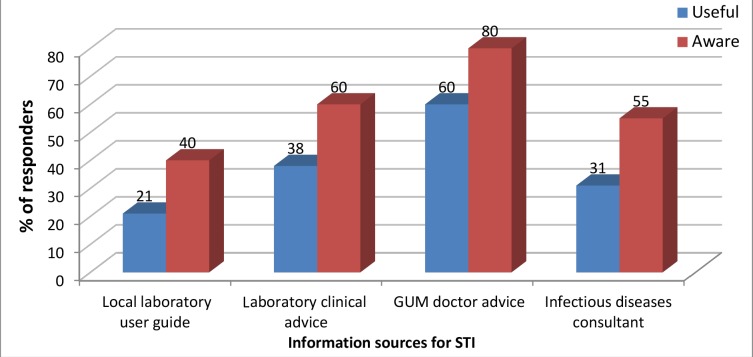
Of 119 GPs who responded, most expressed confidence in treating chlamydia ( = 105/119, 88%), trichomonas ( = 81/119, 68%), and herpes ( = 82/119, 69%) but not gonorrhoea ( = 32/119, 27%). Most referred cases of syphilis ( = 92/119, 77%) and genital warts (83/119, 70%) to genito-urinary medicine (GUM) as per guidance. Most GPs tested for gonorrhoea on patient request ( = 95/119, 80%), in tandem with chlamydia screening ( = 89/119, 75%), because of high risk status ( = 85/119, 71%) and genital symptoms ( = 108/119, 91%). Some GPs ( = 22/119, 18%) sampled urine for culture, 53/119 (45%) provided high vaginal swabs (HVS), and 28/119 (24%) provided self-taken vulvovaginal swabs (STVVS) for culture. These samples are not appropriate for gonococcal culture and not processed in the laboratory. Urethral swabs for men and endocervical swabs (ECS) are recommended for gonococcus culture. Over half ( = 60/102, 59%) of GPs did not treat gonorrhoea but some prescribed cefixime, ciprofloxacin, or azithromycin. Eighty-seven per cent ( = 104/119) sought advice from GUM, and 83/103 (81%) referred gonorrhoea nucleic acid amplification test (NAAT)-positive patients.
There is scope for improvement of STIs management in primary care to ensure that patients are optimally investigated, treated, and referred.
基层医疗中存在性传播感染(STIs)的国家指南,但其管理尚不确定。
评估基层医疗中STIs的管理是否符合国家标准。
在伦敦和布莱顿进行的一项基于问卷的研究。该调查于2015年在英格兰性健康服务重组后开展。
向伦敦和布莱顿的全科医生发送问卷,询问有关STIs检测、淋病治疗、专家建议和转诊服务的情况。
在119名回复问卷的全科医生中,大多数对治疗衣原体感染(105/119,88%)、滴虫感染(81/119,68%)和疱疹感染(82/119,69%)有信心,但对淋病治疗(32/119,27%)信心不足。大多数医生按照指南将梅毒(92/119,77%)和尖锐湿疣(83/119,70%)病例转诊至泌尿生殖医学科(GUM)。大多数全科医生根据患者要求检测淋病(95/119,80%),同时进行衣原体筛查(89/119,75%),因为患者处于高风险状态(85/119,71%)以及有生殖器症状(108/119,91%)。一些全科医生(22/119,18%)采集尿液进行培养,53/119(45%)提供高阴道拭子(HVS),28/119(24%)提供自行采集的阴道拭子(STVVS)用于培养。这些样本不适合用于淋球菌培养,也不在实验室进行处理。推荐男性尿道拭子和女性宫颈拭子(ECS)用于淋球菌培养。超过一半(60/102,59%)的全科医生不治疗淋病,但一些医生开具头孢克肟、环丙沙星或阿奇霉素。87%(104/119)的医生向泌尿生殖医学科寻求建议,83/103(81%)的医生转诊淋病核酸扩增检测(NAAT)阳性患者。
基层医疗中STIs的管理有改进空间,以确保患者得到最佳的检查、治疗和转诊。