Seo Hyeon Kook, Park Jae Yeol, Chang Joon Ha, Dae Kyun Sung, Noh Myoung-Sub, Kim Sung-Soo, Kang Chong-Yun, Zhao Kejie, Kim Sangtae, Yuk Jong Min
Department of Materials Science and Engineering, Korea Advanced Institute of Science and Technology (KAIST), Daejeon, 34141, Republic of Korea.
KU-KIST Graduate School of Converging Science and Technology, Korea University, Seoul, 02841, Republic of Korea.
Nat Commun. 2019 Jul 31;10(1):3428. doi: 10.1038/s41467-019-11361-z.
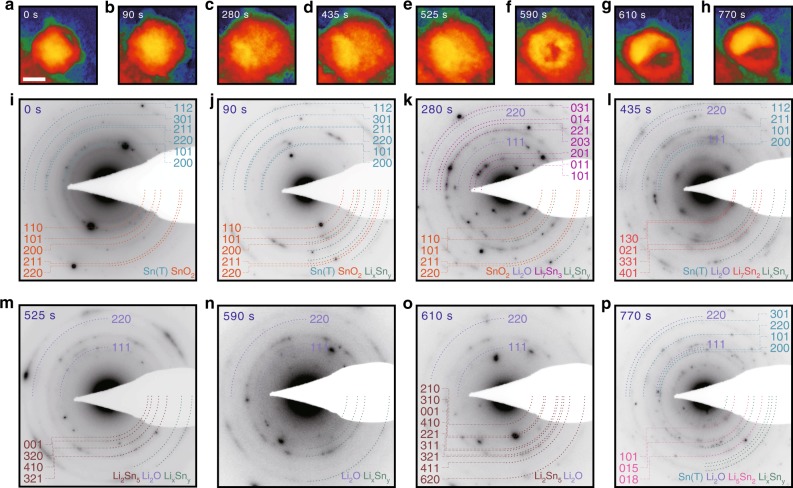
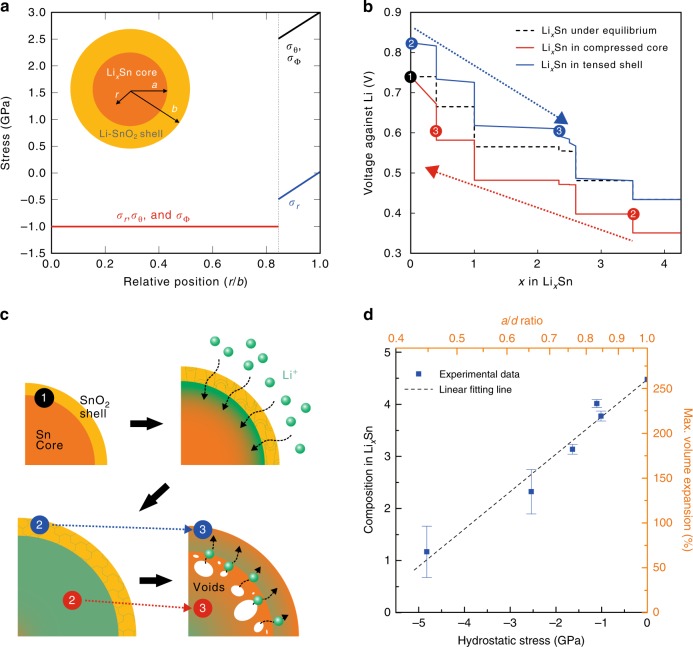
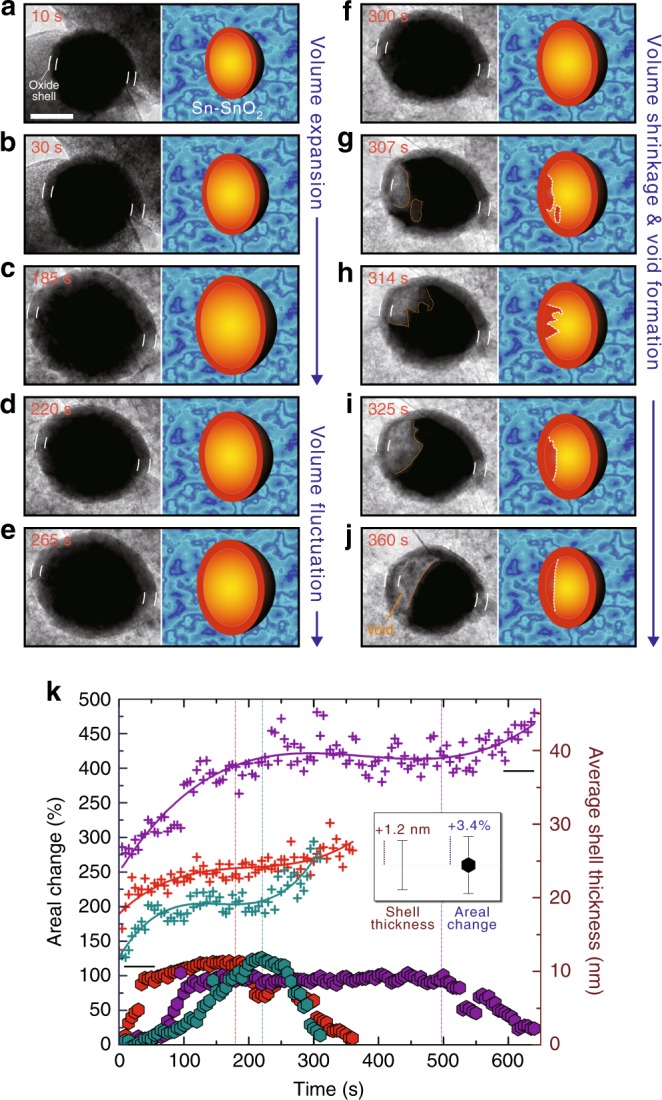
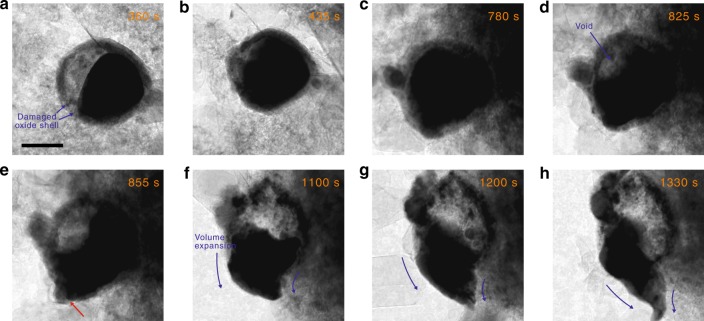
The stress inevitably imposed during electrochemical reactions is expected to fundamentally affect the electrochemistry, phase behavior and morphology of electrodes in service. Here, we show a strong stress-composition coupling in lithium binary alloys during the lithiation of tin-tin oxide core-shell nanoparticles. Using in situ graphene liquid cell electron microscopy imaging, we visualise the generation of a non-uniform composition field in the nanoparticles during lithiation. Stress models based on density functional theory calculations show that the composition gradient is proportional to the applied stress. Based on this coupling, we demonstrate that we can directionally control the lithium distribution by applying different stresses to lithium alloy materials. Our results provide insights into stress-lithium electrochemistry coupling at the nanoscale and suggest potential applications of lithium alloy nanoparticles.
电化学反应过程中不可避免地产生的应力预计会从根本上影响服役电极的电化学、相行为和形态。在此,我们展示了在锡-氧化锡核壳纳米颗粒锂化过程中锂二元合金中存在强烈的应力-成分耦合。使用原位石墨烯液体池电子显微镜成像,我们观察到锂化过程中纳米颗粒内产生了不均匀的成分场。基于密度泛函理论计算的应力模型表明,成分梯度与施加的应力成正比。基于这种耦合,我们证明可以通过对锂合金材料施加不同应力来定向控制锂的分布。我们的结果为纳米尺度下的应力-锂电化学耦合提供了见解,并暗示了锂合金纳米颗粒的潜在应用。