Department of Electrical & Computer Engineering, University of California, Los Angeles, California, 90095, USA.
California NanoSystems Institute, Los Angeles, California, 90095, USA.
Sci Rep. 2019 Jul 31;9(1):11088. doi: 10.1038/s41598-019-47193-6.
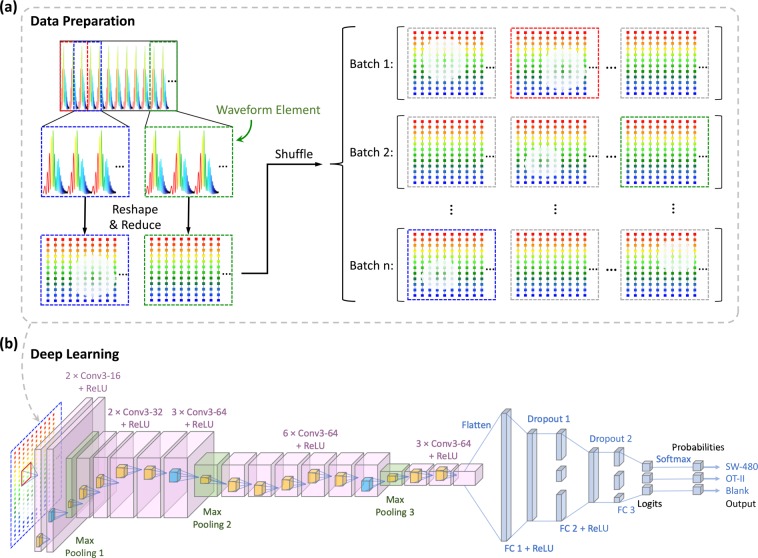
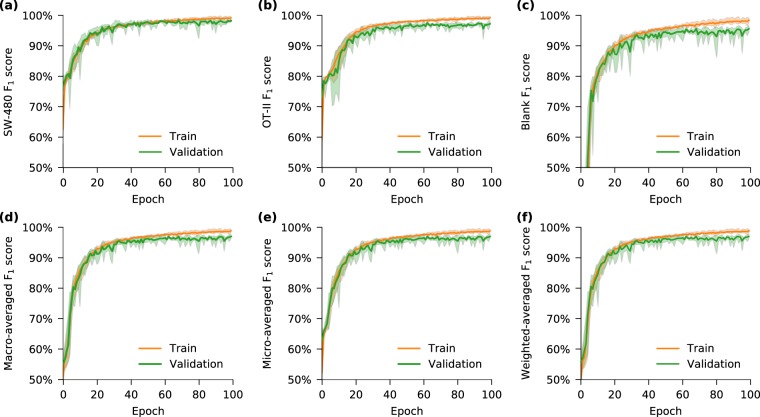
Deep learning has achieved spectacular performance in image and speech recognition and synthesis. It outperforms other machine learning algorithms in problems where large amounts of data are available. In the area of measurement technology, instruments based on the photonic time stretch have established record real-time measurement throughput in spectroscopy, optical coherence tomography, and imaging flow cytometry. These extreme-throughput instruments generate approximately 1 Tbit/s of continuous measurement data and have led to the discovery of rare phenomena in nonlinear and complex systems as well as new types of biomedical instruments. Owing to the abundance of data they generate, time-stretch instruments are a natural fit to deep learning classification. Previously we had shown that high-throughput label-free cell classification with high accuracy can be achieved through a combination of time-stretch microscopy, image processing and feature extraction, followed by deep learning for finding cancer cells in the blood. Such a technology holds promise for early detection of primary cancer or metastasis. Here we describe a new deep learning pipeline, which entirely avoids the slow and computationally costly signal processing and feature extraction steps by a convolutional neural network that directly operates on the measured signals. The improvement in computational efficiency enables low-latency inference and makes this pipeline suitable for cell sorting via deep learning. Our neural network takes less than a few milliseconds to classify the cells, fast enough to provide a decision to a cell sorter for real-time separation of individual target cells. We demonstrate the applicability of our new method in the classification of OT-II white blood cells and SW-480 epithelial cancer cells with more than 95% accuracy in a label-free fashion.
深度学习在图像和语音识别与合成方面取得了惊人的成果。在有大量可用数据的问题中,它优于其他机器学习算法。在测量技术领域,基于光的时间拉伸的仪器在光谱学、光学相干断层扫描和成像流动细胞术方面建立了记录实时测量吞吐量。这些极端吞吐量的仪器产生大约 1 Tbit/s 的连续测量数据,并导致在非线性和复杂系统中发现稀有现象以及新型生物医学仪器。由于它们产生的数据丰富,时间拉伸仪器非常适合深度学习分类。以前,我们已经表明,通过时间拉伸显微镜、图像处理和特征提取的组合,可以实现高通量的无标记细胞分类,具有高精度,然后通过深度学习在血液中发现癌细胞。这项技术有望实现原发性癌症或转移的早期检测。在这里,我们描述了一种新的深度学习管道,该管道完全避免了通过卷积神经网络对测量信号直接操作而进行的信号处理和特征提取步骤,该神经网络速度较慢且计算成本高。计算效率的提高使得可以进行低延迟推断,并且使该管道适合通过深度学习进行细胞分选。我们的神经网络对细胞进行分类所需的时间不到几毫秒,足以快速为细胞分选器提供决策,以实时分离单个目标细胞。我们证明了我们的新方法在分类 OT-II 白细胞和 SW-480 上皮癌细胞方面的适用性,以无标记的方式实现了超过 95%的准确性。