Department of Emergency Medicine, Olive View-UCLA Medical Center, Sylmar.
David Geffen School of Medicine at University of California Los Angeles.
Clin Infect Dis. 2019 Aug 1;69(Suppl 1):S23-S32. doi: 10.1093/cid/ciz396.
Within the last decade, methicillin-resistant Staphylococcus aureus (MRSA) has emerged as a frequent cause of purulent skin and soft tissue infections. New therapeutic options are being investigated for these infections.
We report an integrated analysis of 2 randomized, controlled studies involving omadacycline, a novel aminomethylcycline, and linezolid for the treatment of acute bacterial skin and skin structure infections (ABSSSI). Omadacycline in Acute Skin and Skin Structure Infections Study 1 (OASIS-1) initiated patients on intravenous omadacycline or linezolid, with the option to transition to an oral formulation after day 3. OASIS-2 was an oral-only study of omadacycline versus linezolid.
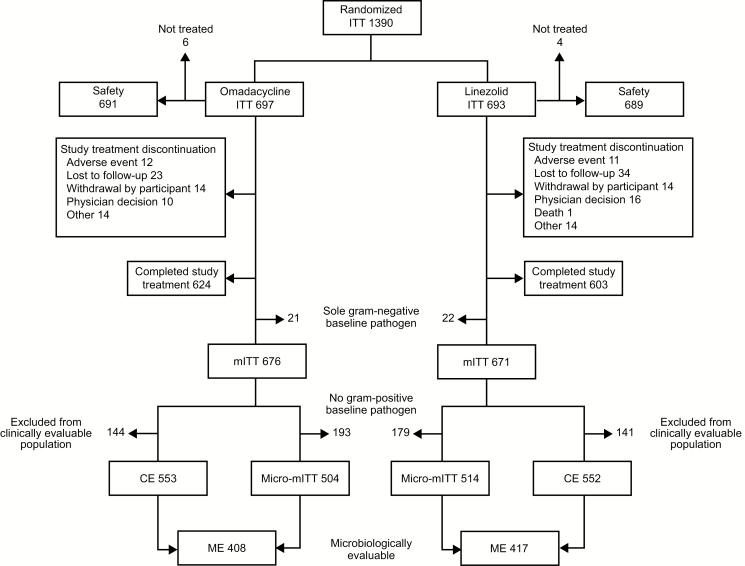
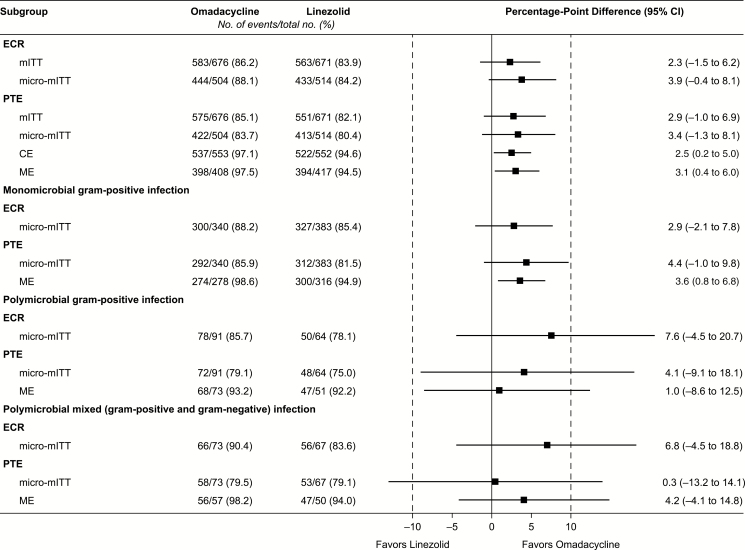
In total, 691 patients received omadacycline and 689 patients received linezolid. Infection types included wound infection in 46.8% of patients, cellulitis/erysipelas in 30.5%, and major abscess in 22.7%. Pathogens were identified in 73.2% of patients. S. aureus was detected in 74.7% and MRSA in 32.4% of patients in whom a pathogen was identified. Omadacycline was noninferior to linezolid using the Food and Drug Administration primary endpoint of early clinical response (86.2% vs 83.9%; difference 2.3, 95% confidence interval -1.5 to 6.2) and using the European Medicines Agency primary endpoint of investigator-assessed clinical response at the posttreatment evaluation. Clinical responses were similar across different infection types and infections caused by different pathogens. Treatment-emergent adverse events, mostly described as mild or moderate, were reported by 51.1% of patients receiving omadacycline and 41.2% of those receiving linezolid.
Omadacycline was effective and safe in ABSSSI.
NCT02378480 and NCT02877927.
在过去十年中,耐甲氧西林金黄色葡萄球菌(MRSA)已成为脓性皮肤和软组织感染的常见病因。目前正在研究新的治疗选择。
我们报告了两项涉及 omadacycline(一种新型氨甲基环素)和利奈唑胺治疗急性细菌性皮肤和皮肤结构感染(ABSSSI)的随机对照研究的综合分析。急性皮肤和皮肤结构感染研究 1(OASIS-1)中,患者开始接受静脉注射 omadacycline 或利奈唑胺治疗,第 3 天可选择转为口服制剂。OASIS-2 是一项 omadacycline 与利奈唑胺的口服单药比较研究。
共有 691 例患者接受 omadacycline 治疗,689 例患者接受利奈唑胺治疗。感染类型包括 46.8%的患者为伤口感染,30.5%的患者为蜂窝织炎/丹毒,22.7%的患者为大脓肿。73.2%的患者可鉴定出病原体。在可鉴定病原体的患者中,74.7%的患者检测出金黄色葡萄球菌,32.4%的患者检测出耐甲氧西林金黄色葡萄球菌。使用美国食品和药物管理局(FDA)早期临床反应的主要终点(86.2%对 83.9%;差值 2.3,95%置信区间-1.5 至 6.2)和欧洲药品管理局(EMA)基于治疗后评估的临床医生评估的主要终点,omadacycline 均不劣于利奈唑胺。不同感染类型和不同病原体引起的感染的临床反应相似。接受 omadacycline 治疗的患者中有 51.1%和接受利奈唑胺治疗的患者中有 41.2%报告出现治疗期出现的不良事件,主要为轻度或中度。
omadacycline 对 ABSSSI 有效且安全。
NCT02378480 和 NCT02877927。