Department of Botany and Plant Sciences, University of California, Riverside, CA, 92521, USA.
Department of Soil and Crop Sciences, Colorado State University, Fort Collins, CO, 80523, USA.
Theor Appl Genet. 2019 Nov;132(11):3079-3087. doi: 10.1007/s00122-019-03407-z. Epub 2019 Jul 31.
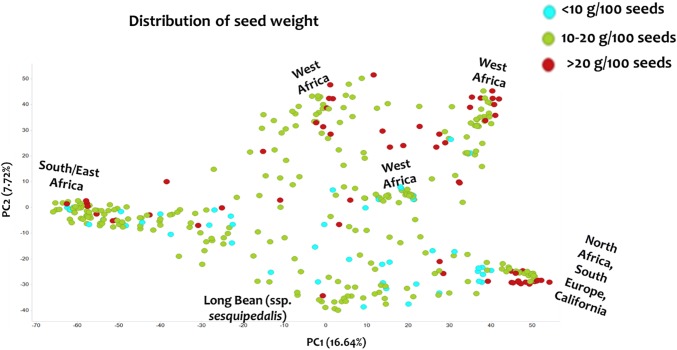
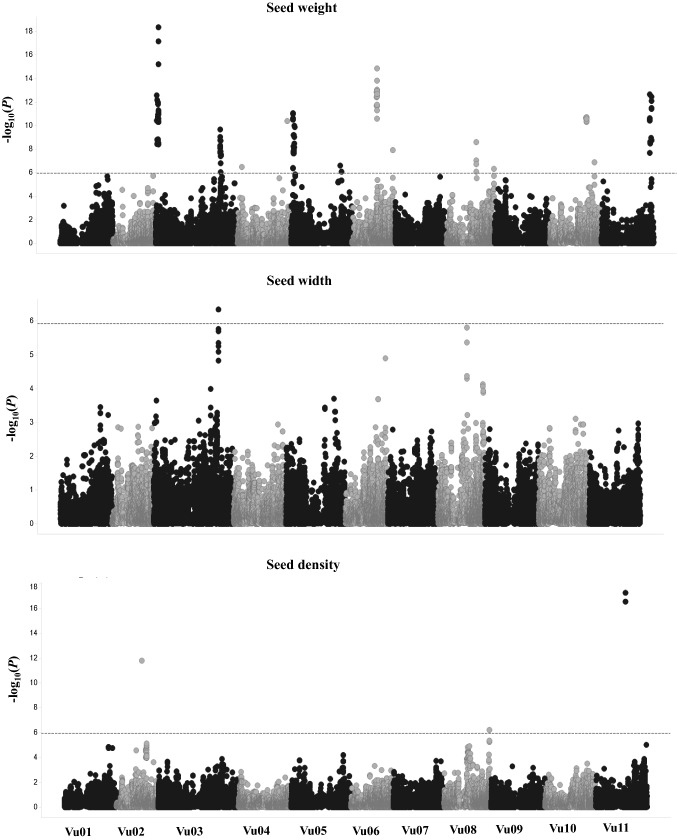
This paper combined GWAS, meta-analysis and sequence homology comparison with common bean to identify regions associated with seed size variation in domesticated cowpea. Seed size is an important trait for yield and commercial value in dry-grain cowpea. Seed size varies widely among different cowpea accessions, and the genetic basis of such variation is not yet well understood. To better decipher the genetic basis of seed size, a genome-wide association study (GWAS) and meta-analysis were conducted on a panel of 368 cowpea diverse accessions from 51 countries. Four traits, including seed weight, length, width and density were evaluated across three locations. Using 51,128 single nucleotide polymorphisms covering the cowpea genome, 17 loci were identified for these traits. One locus was common to weight, width and length, suggesting pleiotropy. By integrating synteny-based analysis with common bean, six candidate genes (Vigun05g036000, Vigun05g039600, Vigun05g204200, Vigun08g217000, Vigun11g187000, and Vigun11g191300) which are implicated in multiple functional categories related to seed size such as endosperm development, embryo development, and cell elongation were identified. These results suggest that a combination of GWAS meta-analysis with synteny comparison in a related plant is an efficient approach to identify candidate gene (s) for complex traits in cowpea. The identified loci and candidate genes provide useful information for improving cowpea varieties and for molecular investigation of seed size.
本文结合 GWAS、荟萃分析和与普通菜豆的序列同源性比较,鉴定与栽培豇豆种子大小变异相关的区域。种子大小是干粒豇豆产量和商业价值的重要性状。不同豇豆品种之间的种子大小差异很大,其变异的遗传基础尚不清楚。为了更好地破译种子大小的遗传基础,对来自 51 个国家的 368 个豇豆多样性品种进行了全基因组关联研究(GWAS)和荟萃分析。在三个地点评估了四个性状,包括种子重量、长度、宽度和密度。使用覆盖豇豆基因组的 51128 个单核苷酸多态性,鉴定了这些性状的 17 个位点。一个位点与重量、宽度和长度共定位,表明存在多效性。通过整合基于同线性的分析与普通菜豆,鉴定了 6 个候选基因(Vigun05g036000、Vigun05g039600、Vigun05g204200、Vigun08g217000、Vigun11g187000 和 Vigun11g191300),这些基因涉及与种子大小相关的多个功能类别,如胚乳发育、胚胎发育和细胞伸长。这些结果表明,在相关植物中结合 GWAS 荟萃分析和同线性比较是鉴定豇豆复杂性状候选基因的有效方法。鉴定的基因座和候选基因为改良豇豆品种和分子研究种子大小提供了有用信息。