Department of General Internal Medicine and Psychosomatics, Heidelberg University, Heidelberg, Germany.
Health Expect. 2019 Oct;22(5):1089-1099. doi: 10.1111/hex.12941. Epub 2019 Jul 31.
Decisional regret during or after medical treatments is linked to significant distress. Regret affects not only patients but also caregivers having an active or passive role during decision making. The Decision Regret Scale (DRS) is a self-report measure for regret in patients after treatment decisions. However, practical and psychometrically robust instruments assessing regret in caregivers are lacking.
To develop and validate a caregiver version of the DRS (Decision Regret Scale for Caregivers [DRS-C]).
Psychometric validation based on a web survey.
361 caregivers of deceased German people/patients with cancer.
Besides structural validity and test-retest reliability, we evaluated measurement invariance accounting for gender, age and closeness of relationship, and tested hypotheses on convergent/discriminant validity.
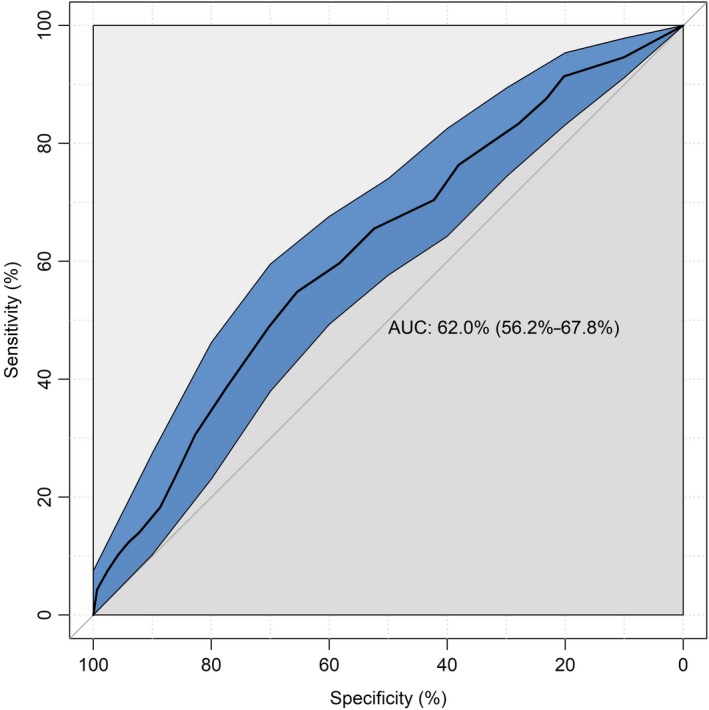
Forty-five per cent of all caregivers demonstrated decision regret. Confirmatory factor analyses strongly supported the unidimensional structure of the DRS-C and pointed to strict invariance. The DRS-C demonstrated very good internal consistency (α = 0.83, 95% CI [0.81, 0.86]) and test-retest reliability (ICC [A,1] = 0.73, 95% CI [0.59, 0.83]) along with sound convergent/discriminant validity. Concerning responsiveness, DRS-C scores remained stable over a 12-week period in 83.3% of all caregivers. Receiver operating characteristic analysis yielded a cut point of 43 for the identification of significant decision regret (AUC = 0.62, 95% CI [0.56, 0.68]).
The lack of a gold standard instrument prevented us from examining the criterion validity and determining a minimally important difference. Nevertheless, the DRS-C provides valid and reliable information regarding caregiver regret following medical decisions. Above all, it captures a crucial aspect of the treatment experience in caregivers.
医疗治疗过程中或之后的决策后悔与明显的痛苦有关。后悔不仅影响患者,还影响在决策过程中扮演主动或被动角色的护理人员。决策后悔量表(DRS)是一种用于衡量治疗后患者决策后悔的自我报告量表。然而,缺乏实用且心理测量可靠的评估护理人员后悔的工具。
开发和验证护理人员版决策后悔量表(DRS-C)。
基于网络调查的心理测量验证。
361 名德国癌症死亡患者/患者的护理人员。
除了结构有效性和重测信度外,我们还评估了性别、年龄和关系密切程度的测量不变性,并测试了收敛/区别有效性的假设。
45%的护理人员表现出决策后悔。验证性因素分析强烈支持 DRS-C 的单维结构,并指出严格不变性。DRS-C 表现出非常好的内部一致性(α=0.83,95%置信区间[0.81,0.86])和重测信度(ICC[A,1]=0.73,95%置信区间[0.59,0.83]),以及良好的收敛/区别有效性。关于反应性,83.3%的护理人员在 12 周的时间内,DRS-C 评分保持稳定。受试者工作特征分析得出 43 分作为识别显著决策后悔的分界点(AUC=0.62,95%置信区间[0.56,0.68])。
缺乏金标准工具使我们无法检验效标效度并确定最小重要差异。尽管如此,DRS-C 提供了关于医疗决策后护理人员后悔的有效和可靠信息。最重要的是,它捕捉到了护理人员治疗体验的一个重要方面。