Department of Epidemiology, Harvard T.H. Chan School of Public Health, Boston, MA, USA.
Department of Chronic Diseases and Ageing, Norwegian Institute of Public Health, Oslo, Norway.
Int J Epidemiol. 2019 Oct 1;48(5):1665-1672. doi: 10.1093/ije/dyz170.
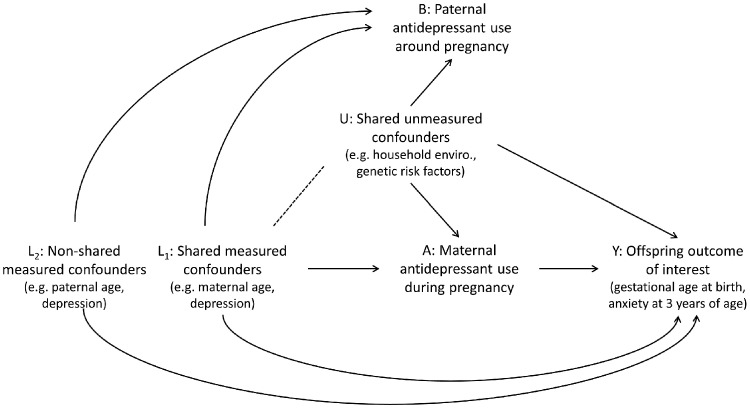
Maternal antidepressant use in pregnancy has been associated with both shorter gestational length and child anxiety. We employed paternal antidepressant use as a negative-control exposure to indirectly assess whether confounding by genetic or shared familial environmental factors associated with depression may explain these associations.
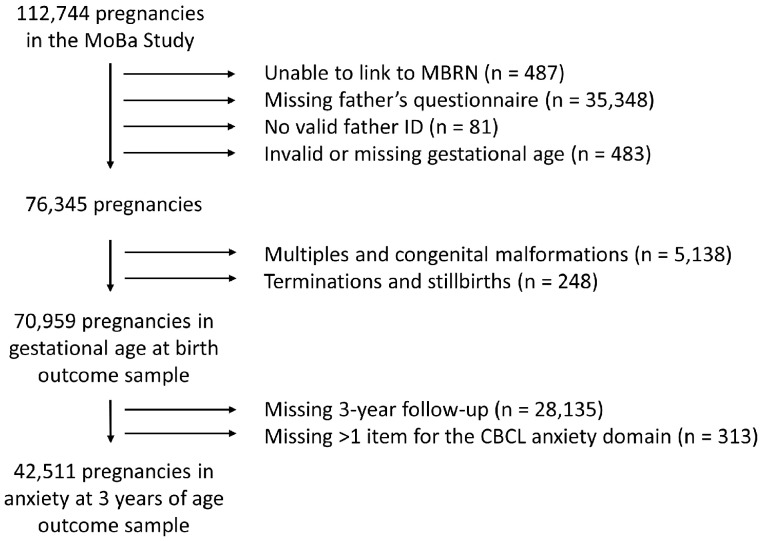
The study sample came from the population-based Norwegian Mother and Child Cohort Study (MoBa) that recruited participants from 1999 to 2008. We included 70 959 families where the father completed a questionnaire about medication use in the 6 months prior to pregnancy. In 42 511 infants who completed the 3-year follow-up, we computed Z-scores for the anxiety domain of the Child Behavior Checklist. We used linear and logistic regression to assess the association between paternal antidepressant use, gestational age at birth and child anxiety.
Antidepressants were used by 1.1% (n = 755) of fathers. Paternal antidepressant use was not associated with gestational age at birth [β = 0.63 days, 95% confidence interval (CI) -1.56, 0.31] whereas it was positively associated with a child anxiety symptom Z-score and high anxiety symptoms (odds ratio 1.33, 95% CI 0.90, 1.97) in unadjusted analyses. This association was attenuated when controlling for maternal and paternal history of depression and other measured factors (odds ratio 1.14, 95% CI 0.76, 1.69).
These results support the suggested effect of maternal use of antidepressants in pregnancy on shorter gestation; however, they suggest familial confounding could explain the association between maternal use of antidepressants and anxiety traits in the offspring.
母亲在怀孕期间使用抗抑郁药与妊娠时间缩短和儿童焦虑有关。我们使用父亲使用抗抑郁药作为阴性对照暴露,以间接评估与抑郁相关的遗传或共同家庭环境因素是否会混淆这些关联。
研究样本来自基于人群的挪威母亲和儿童队列研究(MoBa),该研究于 1999 年至 2008 年招募参与者。我们纳入了 70959 个家庭,这些家庭的父亲在怀孕前 6 个月完成了一份关于药物使用的问卷。在完成 3 年随访的 42511 名婴儿中,我们计算了儿童行为检查表焦虑域的 Z 分数。我们使用线性和逻辑回归来评估父亲使用抗抑郁药、出生时的胎龄和儿童焦虑之间的关系。
1.1%(n=755)的父亲使用了抗抑郁药。父亲使用抗抑郁药与出生时的胎龄无关[β=0.63 天,95%置信区间(CI)-1.56,0.31],但在未调整的分析中,与儿童焦虑症状 Z 分数和高焦虑症状呈正相关(优势比 1.33,95%CI 0.90,1.97)。当控制母亲和父亲的抑郁史以及其他测量因素时,这种关联减弱(优势比 1.14,95%CI 0.76,1.69)。
这些结果支持了母亲在怀孕期间使用抗抑郁药与妊娠时间缩短之间的关联,但表明家族性混杂可能解释了母亲使用抗抑郁药与后代焦虑特征之间的关联。