Shan Hongyun, Li Fei, Zhang Jun, Wang Hui, Li Jiong
Ministry of Education -Shanghai Key Laboratory of Children's Environmental Health, Xin Hua Hospital Affiliated to Shanghai Jiao Tong University School of Medicine, Shanghai, China.
Department of Clinical Medicine, Aarhus University, Aarhus, Denmark.
Front Pediatr. 2021 Sep 6;9:671631. doi: 10.3389/fped.2021.671631. eCollection 2021.
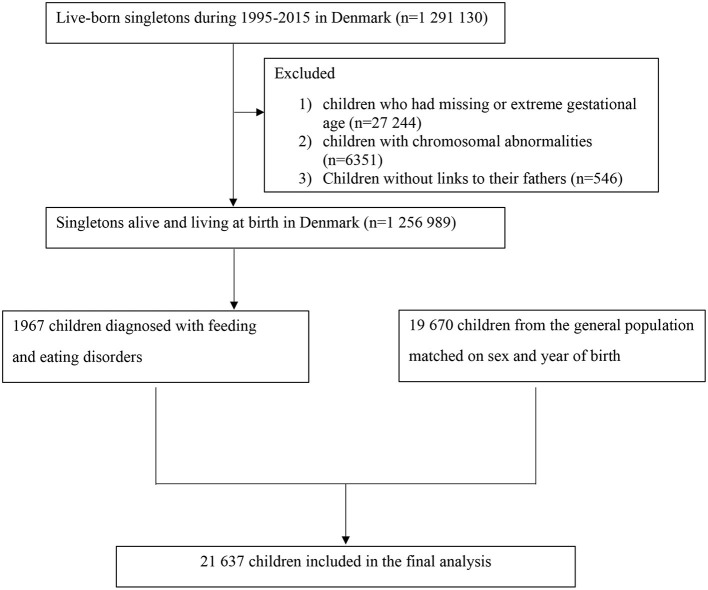
There are limited data concerning the long-term mental health of children with feeding and eating disorder (FED). We aimed to investigate whether children with FED are at greater risks of developing emotional/behavioral disorders with onset usually during childhood, attention-deficit/hyperactivity disorder (ADHD), autism spectrum disorder (ASD), and intellectual disability (ID). We conducted a population-based cohort study, including all singleton births in Denmark from January 1, 1995, to December 31, 2015. For each child diagnosed with FED, 10 age- and sex-matched controls who did not meet the criteria for FED were randomly selected from the general population. Associations were estimated with Cox regression modes adjusting for other perinatal and maternal factors, and sibling analyses were performed for controlling potential confounding by shared familial (genetic or environmental) factors. Of the 1,256,989 individuals in the cohort, there were 1967 (53.4% girls) children diagnosed with FED. Children with FED had higher risks for clinically diagnosed emotional/behavioral disorders with onset usually in childhood (hazard ratio [HR], 2.78; 95% CI, 2.34-3.31), ADHD (HR, 1.74; 95% CI, 1.33-2.26), ASD (HR, 3.05; 95% CI, 2.36-3.94), and ID (HR, 6.38; 95% CI, 4.48-9.11), compared with matched controls. Girls with FED are at greater risks for emotional/behavioral disorders and ID, but not ADHD and ASD. Alike, in sibling analysis, increased rates are also observed for other neurodevelopmental disorders, but not for ADHD. Children with FED are associated with substantially increased risks of emotional/behavioral disorders, ADHD, ASD, and ID. This study highlights the importance of carefully monitoring neurodevelopmental disorders in children with FED.
关于患有喂养和饮食障碍(FED)儿童的长期心理健康状况,相关数据有限。我们旨在调查患有FED的儿童是否更有可能患上通常在童年期起病的情绪/行为障碍、注意力缺陷多动障碍(ADHD)、自闭症谱系障碍(ASD)和智力障碍(ID)。我们开展了一项基于人群的队列研究,纳入了1995年1月1日至2015年12月31日在丹麦出生的所有单胎婴儿。对于每一名被诊断为FED的儿童,从普通人群中随机选取10名年龄和性别匹配且不符合FED标准的对照。采用Cox回归模型估计关联,并对其他围产期和母亲因素进行调整,同时进行同胞分析以控制潜在的家族(遗传或环境)因素造成的混杂。在该队列的1256989名个体中,有1967名(53.4%为女孩)儿童被诊断为FED。与匹配的对照相比,患有FED的儿童临床上被诊断为通常在童年期起病的情绪/行为障碍(风险比[HR],2.78;95%置信区间[CI],2.34 - 3.31)、ADHD(HR,1.74;95% CI,1.33 - 2.26)、ASD(HR,3.05;95% CI,2.36 - 3.94)和ID(HR,6.38;95% CI,4.48 - 9.11)的风险更高。患有FED的女孩患情绪/行为障碍和ID的风险更高,但患ADHD和ASD的风险并非如此。同样,在同胞分析中,其他神经发育障碍的发生率也有所增加,但ADHD并非如此。患有FED的儿童与情绪/行为障碍、ADHD、ASD和ID的风险大幅增加有关。这项研究强调了仔细监测患有FED儿童神经发育障碍的重要性。