From the Department of Psychology (Casement), University of Oregon, Eugene, Oregon; and Department of Psychiatry, University of Pittsburgh (Goldstein, Merranko, Gratzmiller, Franzen), Pittsburgh, Pennsylvania.
Psychosom Med. 2019 Nov/Dec;81(9):782-790. doi: 10.1097/PSY.0000000000000737.
Sleep disruption contributes to the pathophysiology of mental disorders, particularly bipolar illness, but the biobehavioral mechanisms of this relationship are insufficiently understood. This study evaluated sleep duration, timing, and variability as prospective predictors of parasympathetic nervous system activity during rest and social stress in adolescents with bipolar disorder, reflecting sleep-related interference in stress regulatory systems that may confer vulnerability to mood episodes.
Participants were adolescents with bipolar disorder (n = 22) and healthy adolescents (n = 27). Sleep duration and timing were measured by actigraphy for 1 week before a laboratory social stress task, during which high-frequency heart rate variability (HF-HRV) was indexed using electrocardiography. Multilevel models were used to evaluate group, sleep characteristics, and their interactions as predictors of initial HF-HRV and change in HF-HRV during rest and stress.
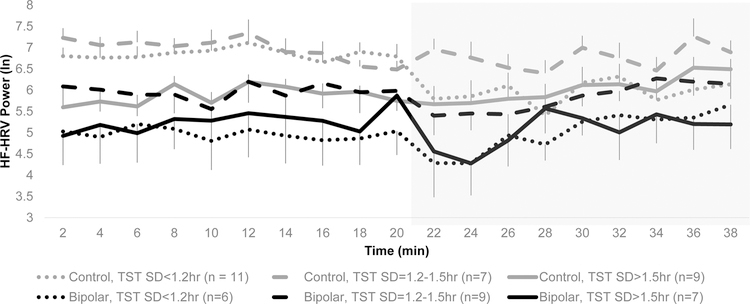
Associations between group and changes in HF-HRV during stress were moderated by sleep duration mean (z = 2.24, p = .025) and variability (z = -2.78, p = .006). There were also main effects of mean sleep duration on initial HF-HRV during rest (z = -5.37, p < .001) and stress (z = -2.69, p = .007). Follow-up analyses indicated that, in bipolar adolescents during stress, shorter and longer sleep durations were associated with lower initial HF-HRV (z = -5.44, p < .001), and greater variability in sleep duration was associated with less change in HF-HRV (z = -2.18, p = .029).
Sleep durations that are relatively short or long, which are characteristic of mood episodes, are associated with parasympathetic vulnerability to social stress in adolescents with bipolar disorder. Obtaining regular sleep of moderate duration may favorably affect responses to stress in bipolar youth.
睡眠障碍是精神障碍(尤其是双相情感障碍)发病机制的一个组成部分,但这一关系的生物行为学机制尚未得到充分理解。本研究评估了睡眠时长、时间和变异性,作为双相情感障碍青少年在静息和社会应激期间副交感神经系统活动的前瞻性预测指标,反映了与睡眠相关的应激调节系统干扰,这可能导致情绪发作的易感性。
参与者为双相情感障碍青少年(n = 22)和健康青少年(n = 27)。在实验室社会应激任务前一周,通过活动记录仪测量睡眠时长和时间,在该任务期间,通过心电图记录高频心率变异性(HF-HRV)。使用多层模型评估组间差异、睡眠特征及其相互作用,作为静息和应激期间初始 HF-HRV 以及 HF-HRV 变化的预测指标。
在应激期间 HF-HRV 变化的组间关联受到睡眠时长均值(z = 2.24,p =.025)和变异性(z = -2.78,p =.006)的调节。睡眠时长均值也对静息时初始 HF-HRV (z = -5.37,p <.001)和应激时初始 HF-HRV (z = -2.69,p =.007)有主要影响。进一步的分析表明,在双相情感障碍青少年中,睡眠时长较短和较长与初始 HF-HRV 降低相关(z = -5.44,p <.001),睡眠时长变异性较大与 HF-HRV 变化较小相关(z = -2.18,p =.029)。
与情绪发作相关的相对较短或较长的睡眠时长与双相情感障碍青少年对社会应激的副交感神经易感性有关。获得适度时长的规律睡眠可能有利于双相青少年对压力的反应。