Suppr超能文献

青春期晚期男性的晚睡倾向预示着两年后对奖励的神经反应性及酒精依赖。

Eveningness among late adolescent males predicts neural reactivity to reward and alcohol dependence 2 years later.

作者信息

Hasler Brant P, Casement Melynda D, Sitnick Stephanie L, Shaw Daniel S, Forbes Erika E

机构信息

University of Pittsburgh School of Medicine, Department of Psychiatry, 3811 O'Hara Street, Pittsburgh, PA 15213, United States.

University of Pittsburgh School of Medicine, Department of Psychiatry, 3811 O'Hara Street, Pittsburgh, PA 15213, United States; University of Oregon, Department of Psychology, 1451 Onyx Street, Eugene, OR 97403, United States.

出版信息

Behav Brain Res. 2017 Jun 1;327:112-120. doi: 10.1016/j.bbr.2017.02.024. Epub 2017 Feb 28.

Abstract

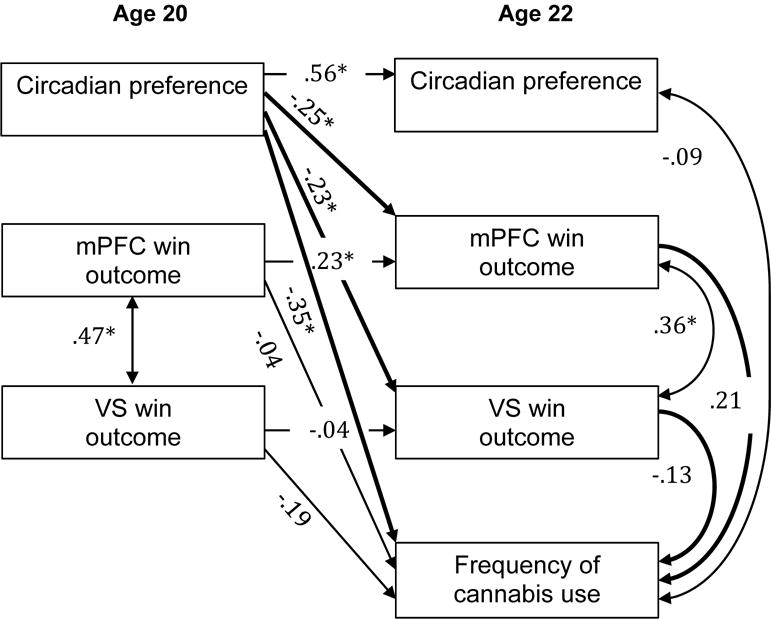
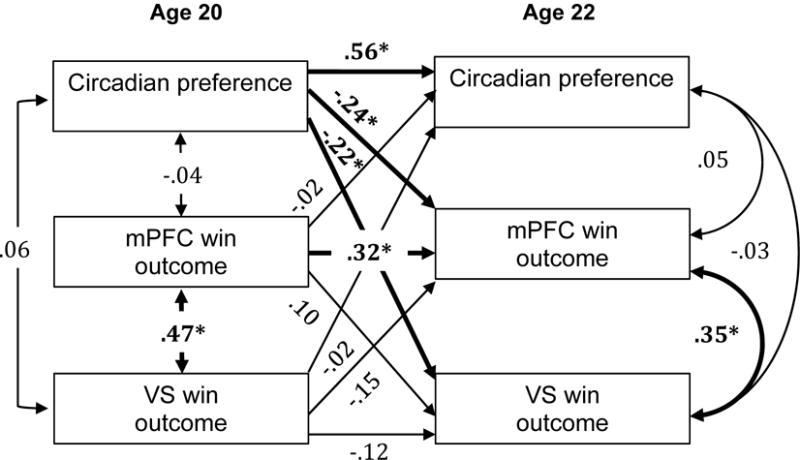
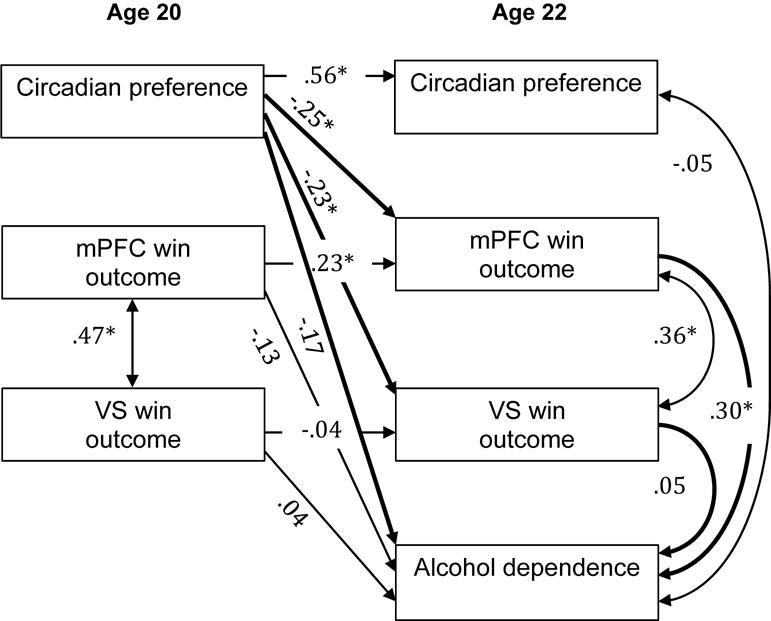
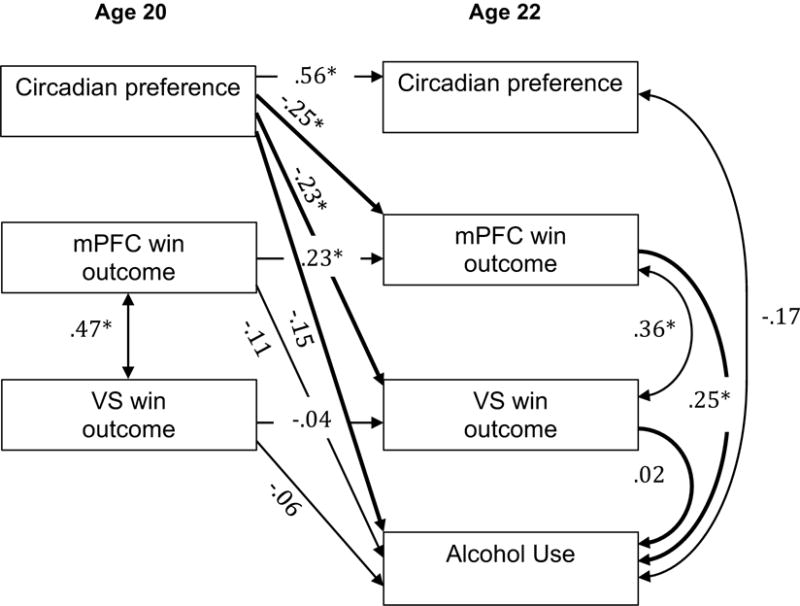
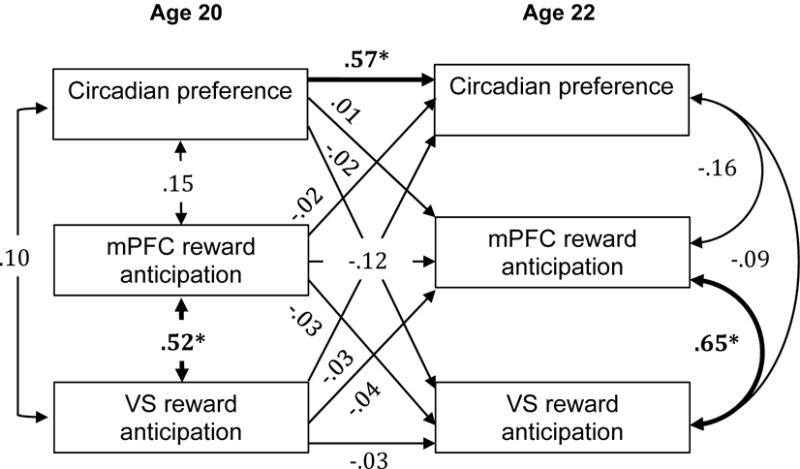
Eveningness, a preference for later sleep-wake timing, is linked to altered reward function, which may explain a consistent association with substance abuse. Notably, the extant literature rests largely on cross-sectional data, yet both eveningness and reward function show developmental changes. We examined whether circadian preference during late adolescence predicted the neural response to reward 2 years later. A sample of 93 males reported circadian preference and completed a monetary reward fMRI paradigm at ages 20 and 22. Primary analyses examined longitudinal paths from circadian preference to medial prefrontal cortex (mPFC) and ventral striatal (VS) reward responses. We also explored whether reward responses mediated longitudinal associations between circadian preference and alcohol dependence, frequency of alcohol use, and/or frequency of cannabis use. Age 20 eveningness was positively associated with age 22 mPFC and VS responses to win, but not associated with age 22 reactivity to reward anticipation. Age 20 eveningness was indirectly related to age 22 alcohol dependence via age 22 mPFC response to win. Our findings provide novel evidence that altered reward-related brain function could underlie associations between eveningness and alcohol use problems. Eveningness may be an under-recognized but modifiable risk factor for reward-related problems such as mood and substance use disorders.

摘要

晚睡倾向,即偏好较晚的睡眠-清醒时间,与奖赏功能改变有关,这可能解释了其与物质滥用之间的持续关联。值得注意的是,现有文献很大程度上基于横断面数据,然而晚睡倾向和奖赏功能都呈现出发育变化。我们研究了青春期后期的昼夜节律偏好是否能预测两年后对奖赏的神经反应。93名男性样本报告了昼夜节律偏好,并在20岁和22岁时完成了一项金钱奖赏功能磁共振成像范式。主要分析考察了从昼夜节律偏好到内侧前额叶皮质(mPFC)和腹侧纹状体(VS)奖赏反应的纵向路径。我们还探讨了奖赏反应是否介导了昼夜节律偏好与酒精依赖、饮酒频率和/或大麻使用频率之间的纵向关联。20岁时的晚睡倾向与22岁时mPFC和VS对获胜的反应呈正相关,但与22岁时对奖赏预期的反应性无关。20岁时的晚睡倾向通过22岁时mPFC对获胜的反应与22岁时的酒精依赖间接相关。我们的研究结果提供了新的证据,表明奖赏相关脑功能改变可能是晚睡倾向与酒精使用问题之间关联的基础。晚睡倾向可能是一个未被充分认识但可改变的与奖赏相关问题的风险因素,如情绪和物质使用障碍。
相似文献

1
Eveningness among late adolescent males predicts neural reactivity to reward and alcohol dependence 2 years later.
Behav Brain Res. 2017 Jun 1;327:112-120. doi: 10.1016/j.bbr.2017.02.024. Epub 2017 Feb 28.
3
Life stress in adolescence predicts early adult reward-related brain function and alcohol dependence.
Soc Cogn Affect Neurosci. 2015 Mar;10(3):416-23. doi: 10.1093/scan/nsu061. Epub 2014 May 1.
4
An altered neural response to reward may contribute to alcohol problems among late adolescents with an evening chronotype.
Psychiatry Res. 2013 Dec 30;214(3):357-64. doi: 10.1016/j.pscychresns.2013.08.005. Epub 2013 Oct 18.
5
Preliminary Evidence That Circadian Alignment Predicts Neural Response to Monetary Reward in Late Adolescent Drinkers.
Front Neurosci. 2022 Feb 16;16:803349. doi: 10.3389/fnins.2022.803349. eCollection 2022.
6
8
The relation between gray matter volume and the use of alcohol, tobacco, cocaine and cannabis in male polysubstance users.
Drug Alcohol Depend. 2018 Jun 1;187:186-194. doi: 10.1016/j.drugalcdep.2018.03.010. Epub 2018 Apr 15.
10
Brain reactivity to alcohol and cannabis marketing during sobriety and intoxication.
Addict Biol. 2017 May;22(3):823-832. doi: 10.1111/adb.12351. Epub 2016 Jan 14.

引用本文的文献

3
Adolescent circadian rhythm disruption increases reward and risk-taking.
Front Neurosci. 2024 Dec 16;18:1478508. doi: 10.3389/fnins.2024.1478508. eCollection 2024.
5
What Keeps Night Owls Well During the Week? Sleep Onset Consistency as a Moderator Between Morningness-Eveningness and Adolescent Development.
Behav Sleep Med. 2025 Jan-Feb;23(1):92-104. doi: 10.1080/15402002.2024.2412331. Epub 2024 Oct 6.
6
Disrupted Circadian Rhythms and Substance Use Disorders: A Narrative Review.
Clocks Sleep. 2024 Aug 19;6(3):446-467. doi: 10.3390/clockssleep6030030.
8
Sleep-Related Predictors of Risk for Alcohol Use and Related Problems in Adolescents and Young Adults.
Alcohol Res. 2024 Mar 14;44(1):02. doi: 10.35946/arcr.v44.1.02. eCollection 2024.
9
The Role of Cannabis and The Endocannabinoid System in Sleep Regulation and Cognition: A Review of Human and Animal Studies.
Behav Sleep Med. 2024 Mar 3;22(2):217-233. doi: 10.1080/15402002.2023.2232497. Epub 2023 Jul 3.
10
Development of morning-eveningness in adolescence: implications for brain development and psychopathology.
J Child Psychol Psychiatry. 2023 Mar;64(3):449-460. doi: 10.1111/jcpp.13718. Epub 2022 Nov 3.

本文引用的文献

1
Bright-light intervention induces a dose-dependent increase in striatal response to risk in healthy volunteers.
Neuroimage. 2016 Oct 1;139:37-43. doi: 10.1016/j.neuroimage.2016.06.024. Epub 2016 Jun 16.
3
Circadian preference links to depression in general adult population.
J Affect Disord. 2015 Dec 1;188:143-8. doi: 10.1016/j.jad.2015.08.061. Epub 2015 Sep 1.
4
Circadian typology and the Alternative Five-Factor Model of personality.
Int J Psychol. 2016 Oct;51(5):332-9. doi: 10.1002/ijop.12170. Epub 2015 May 12.
5
Anticipatory reward processing in addicted populations: a focus on the monetary incentive delay task.
Biol Psychiatry. 2015 Mar 1;77(5):434-44. doi: 10.1016/j.biopsych.2014.08.020. Epub 2014 Sep 10.
6
Eveningness is associated with higher risk-taking, independent of sex and personality.
Psychol Rep. 2014 Dec;115(3):932-47. doi: 10.2466/19.12.PR0.115c28z5.
7
Sleep and circadian contributions to adolescent alcohol use disorder.
Alcohol. 2015 Jun;49(4):377-87. doi: 10.1016/j.alcohol.2014.06.010. Epub 2014 Nov 7.
8
Chronotype predicts positive affect rhythms measured by ecological momentary assessment.
Chronobiol Int. 2015 Apr;32(3):376-84. doi: 10.3109/07420528.2014.983602. Epub 2014 Nov 20.
9
Circadian preference and trait impulsivity, sensation-seeking and response inhibition in healthy young adults.
Chronobiol Int. 2015 Mar;32(2):235-41. doi: 10.3109/07420528.2014.965313. Epub 2014 Oct 6.
10
Time-of-day differences and short-term stability of the neural response to monetary reward: a pilot study.
Psychiatry Res. 2014 Oct 30;224(1):22-7. doi: 10.1016/j.pscychresns.2014.07.005. Epub 2014 Jul 21.

文献AI研究员

20分钟写一篇综述,助力文献阅读效率提升50倍。

立即体验

用中文搜PubMed

大模型驱动的PubMed中文搜索引擎

马上搜索

文档翻译

学术文献翻译模型,支持多种主流文档格式。

立即体验