The Knowledge Center for Multimorbidity and Chronic Conditions, Slagelse Hospital (NSR), Slagelse, Region Zealand, Denmark.
Institute for Public Health, University of Copenhagen, Copenhagen, Denmark.
PLoS One. 2019 Aug 1;14(8):e0214183. doi: 10.1371/journal.pone.0214183. eCollection 2019.
People with multimorbidity have reduced functional capacity, lower quality of life, higher mortality rates and use healthcare resources more intensively than healthy people or those with a single chronic condition. Multimorbidity was defined as the coexistence of two or more chronic conditions in the same person. The aim of this study was to explore associations between multimorbidity and use of healthcare services and the impact of socioeconomic status on utilization of hospitalizations and bed days.
The study population included all individuals aged 16 years and older who lived in the Capital Region of Denmark on January 1st, 2012. Data on chronic conditions, use of healthcare services and demographics were obtained from Danish national administrative and health registries. Zero-inflated models were used to calculate anticipated annual use of hospitalizations and bed days.
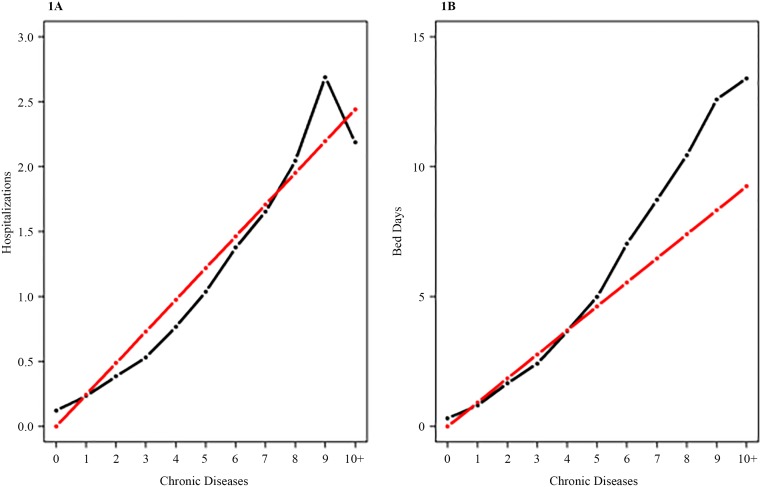
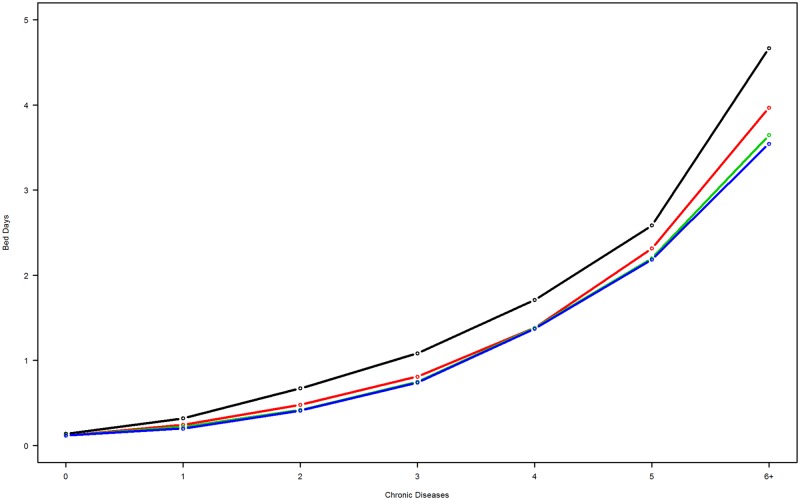
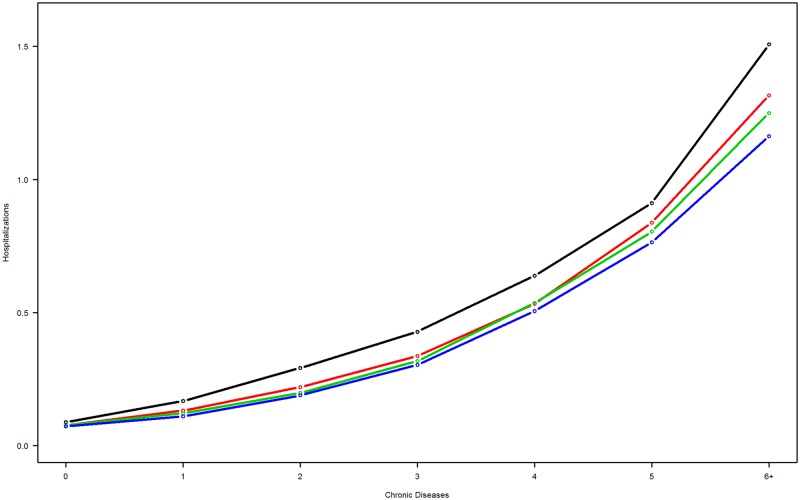
The study population comprised 1,397,173 individuals; the prevalence of multimorbidity was 22%. Prevalence was inversely related to educational attainment. For people with multimorbidity, utilization of hospitalizations and bed days increased approximately linearly with the number of chronic conditions. However, a steep increase in utilization of bed days was observed between five and six or more chronic conditions. An educational gradient in hospitalization rates and use of bed days was observed regardless of the number of chronic conditions. Educational attainment was strongly associated with healthcare utilization.
Multimorbidity was associated with a significant increase in utilization of all healthcare services in Denmark. In addition, a socioeconomic gradient was observed in utilization of hospitalizations and bed days.
患有多种疾病的人群其功能能力下降,生活质量较低,死亡率较高,并且比健康人群或患有单一慢性疾病的人群更密集地使用医疗保健资源。多种疾病被定义为同一人同时存在两种或多种慢性疾病。本研究旨在探讨多种疾病与医疗服务使用之间的关联,以及社会经济地位对住院和床位使用的影响。
研究人群包括 2012 年 1 月 1 日居住在丹麦首都地区的所有 16 岁及以上的个体。慢性疾病、医疗服务使用和人口统计学数据来自丹麦国家行政和健康登记处。使用零膨胀模型计算预期的年住院和床位使用量。
研究人群包括 1397173 人,多种疾病的患病率为 22%。患病率与教育程度呈反比。对于患有多种疾病的人群,住院和床位使用量随慢性疾病数量的增加呈近似线性增加。然而,在五种或更多慢性疾病之间,床位使用量急剧增加。无论慢性疾病数量如何,住院率和床位使用量都存在教育程度梯度。教育程度与医疗保健的利用密切相关。
在丹麦,多种疾病与所有医疗保健服务的使用显著增加相关。此外,还观察到住院和床位使用方面存在社会经济梯度。