Guo Hui, Hosseini-Moghaddam Seyed M, Hodge William
Department of Epidemiology and Biostatistics, Schulich School of Medicine and Dentistry, Western University, London, ON, Canada.
Toronto General Hospital, University of Toronto, Toronto, ON, Canada.
BMC Ophthalmol. 2019 Aug 1;19(1):167. doi: 10.1186/s12886-019-1165-3.
The aim of this study was to compare the postoperative corneal biomechanical properties between small incision lenticule extraction (SMILE) and other corneal refractive surgeries.
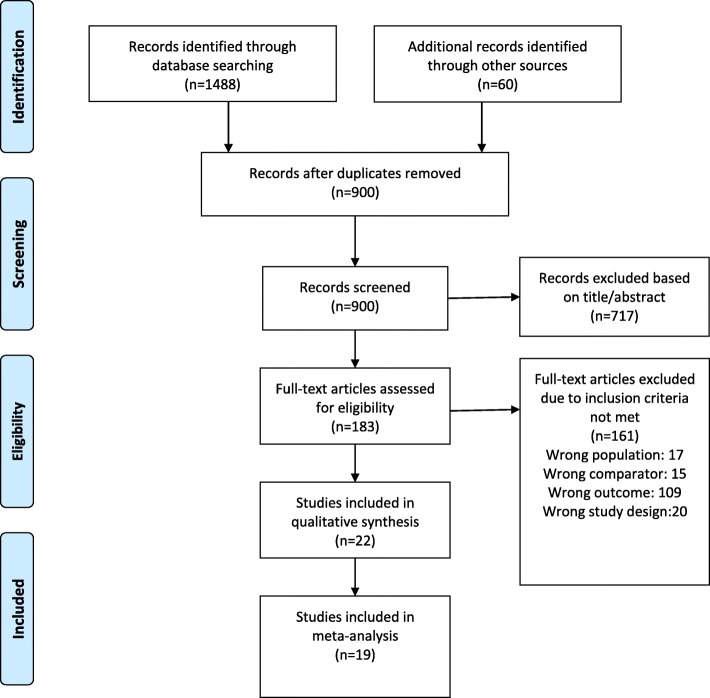
A systematic review and meta-analysis were conducted. Articles from January 2005, to April 2019, were identified searching PubMed, EMBASE, Web of Science, and International Clinical Trials Registry Platform. Studies that compared SMILE with other corneal refractive surgeries on adult myopia patients and evaluated corneal biomechanics were included. Multiple effect sizes in each study were combined. Random-effects model was conducted in the meta-analysis.
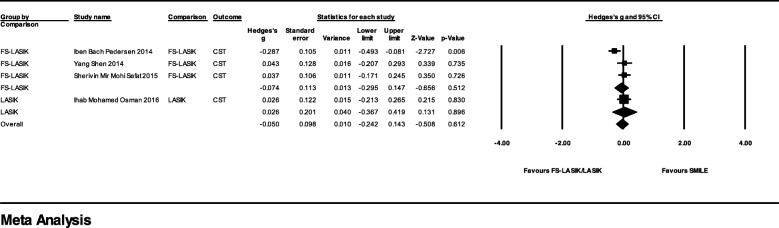
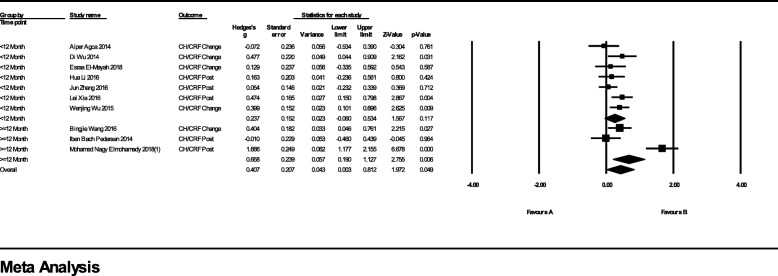
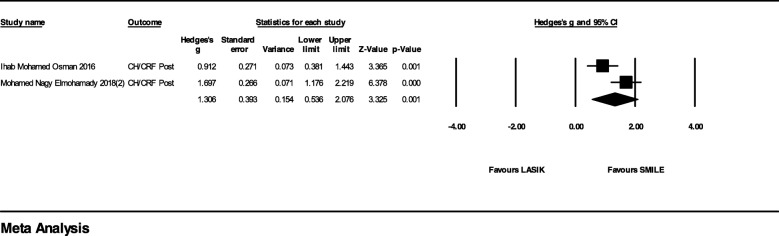
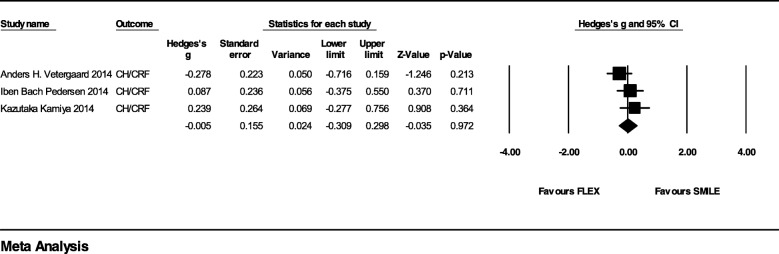
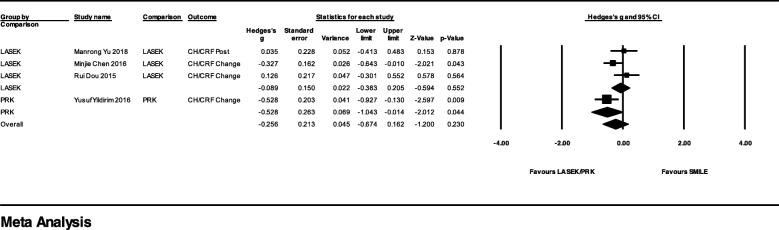
Twenty-two studies were included: 5 randomized controlled trials (RCTs), 9 prospective and 6 retrospective cohort studies, and 2 cross-sectional studies. Using the combined effect of corneal hysteresis (CH) and corneal resistance factor (CRF), which were obtained from ocular response analyzer (ORA), the pooled Hedges' g of SMILE versus femtosecond laser-assisted in situ keratomileusis (FS-LASIK) was 0.41 (95% CI, 0.00 to 0.81; p = 0.049; I = 78%), versus LASIK was 1.31 (95% CI, 0.54 to 2.08; p < 0.001; I = 77%), versus femtosecond lenticule extraction (FLEX) was - 0.01 (95% CI, - 0.31 to 0.30; p = 0.972; I = 20%), and versus the group of photorefractive keratectomy (PRK) and laser-assisted sub-epithelial keratectomy (LASEK) was - 0.26 (95% CI, - 0.67 to 0.16; p = 0.230; I = 54%). The summary score of Corvis ST (CST) after SMILE was comparable to FS-LASIK/LASIK with the pooled Hedges' g = - 0.05 (95% CI, - 0.24 to 0.14; p = 0.612, I = 55%).
In terms of preserving corneal biomechanical strength after surgeries, SMILE was superior to either FS-LASIK or LASIK, while comparable to FLEX or PRK/LASEK group based on the results from ORA. More studies are needed to apply CST on evaluating corneal biomechanics after refractive surgeries.
本研究旨在比较小切口基质透镜切除术(SMILE)与其他角膜屈光手术术后的角膜生物力学特性。
进行了一项系统评价和荟萃分析。通过检索PubMed、EMBASE、科学网和国际临床试验注册平台,确定了2005年1月至2019年4月的文章。纳入了比较SMILE与其他角膜屈光手术治疗成年近视患者并评估角膜生物力学的研究。对每项研究中的多个效应量进行合并。荟萃分析采用随机效应模型。
纳入22项研究:5项随机对照试验(RCT)、9项前瞻性队列研究、6项回顾性队列研究和2项横断面研究。使用从眼反应分析仪(ORA)获得的角膜滞后(CH)和角膜阻力因子(CRF)的合并效应,SMILE与飞秒激光原位角膜磨镶术(FS-LASIK)相比的合并Hedges' g为0.41(95%CI,0.00至0.81;p = 0.049;I = 78%),与LASIK相比为1.31(95%CI,0.54至2.08;p < 0.001;I = 77%),与飞秒基质透镜切除术(FLEX)相比为-0.01(95%CI,-0.31至0.30;p = 0.972;I = 20%),与准分子激光角膜切削术(PRK)和激光辅助上皮下角膜磨镶术(LASEK)组相比为-0.26(95%CI,-0.67至0.16;p = 0.230;I = 54%)。SMILE术后Corvis ST(CST)的汇总评分与FS-LASIK/LASIK相当,合并Hedges' g = -0.05(95%CI,-0.24至0.14;p = 0.612,I = 55%)。
就术后保留角膜生物力学强度而言,基于ORA的结果,SMILE优于FS-LASIK或LASIK,而与FLEX或PRK/LASEK组相当。需要更多研究将CST应用于评估屈光手术后的角膜生物力学。