Laboratory of Τumor Cell Βiology, Medical School, University of Crete, Heraklion, Greece.
Department of Biochemistry, Medical School, University of Crete, Voutes, 70013, Heraklion, Crete, Greece.
Breast Cancer Res. 2019 Aug 1;21(1):86. doi: 10.1186/s13058-019-1166-4.
Circulating tumor cells (CTCs) are important for metastatic dissemination of cancer. They can provide useful information, regarding biological features and tumor heterogeneity; however, their detection and characterization are difficult due to their limited number in the bloodstream and their mesenchymal characteristics. Therefore, new biomarkers are needed to address these questions.
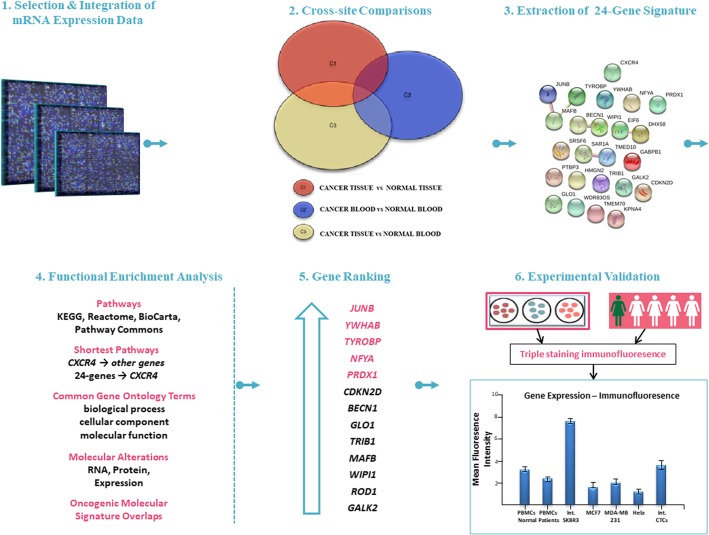
Bioinformatics functional enrichment analysis revealed a subgroup of 24 genes, potentially overexpressed in CTCs. Among these genes, the chemokine receptor CXCR4 plays a central role. After prioritization according to the CXCR4 corresponding pathways, five molecules (JUNB, YWHAB, TYROBP, NFYA, and PRDX1) were selected for further analysis in biological samples. The SKBR3, MDA-MB231, and MCF7 cell lines, as well as PBMCs from normal (n = 10) blood donors, were used as controls to define the expression pattern of all the examined molecules. Consequently, 100 previously untreated metastatic breast cancer (mBC) patients (n = 100) were analyzed using the following combinations of antibodies: CK (cytokeratin)/CXCR4/JUNB, CK/NFYA/ΥWHΑΒ (14-3-3), and CK/TYROBP/PRDX1. A threshold value for every molecule was considered the mean expression in normal PBMCs.
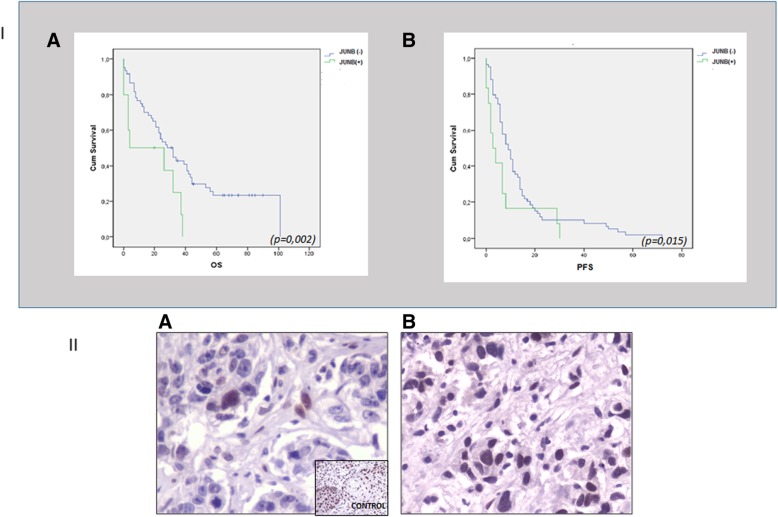
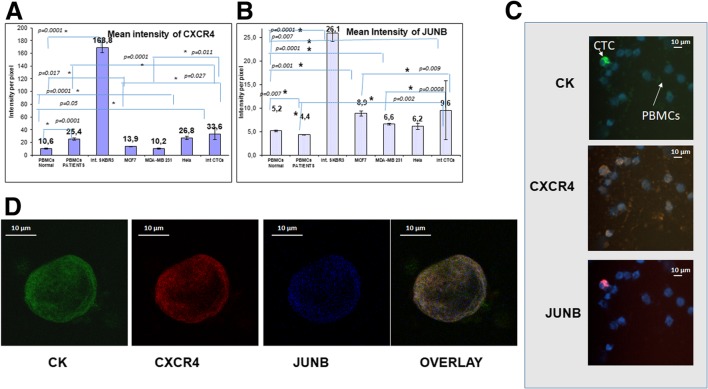
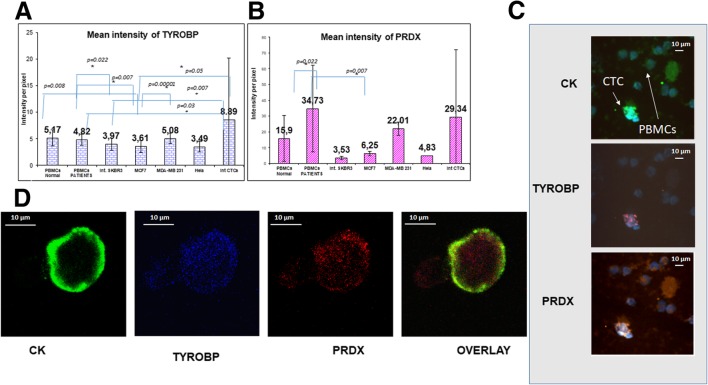
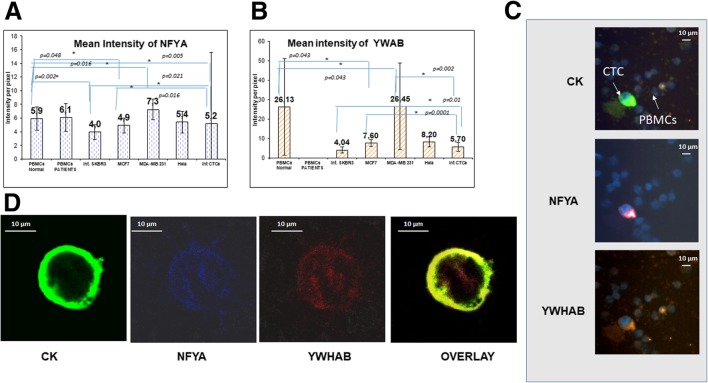
Quantification of CXCR4 revealed overexpression of the receptor in SKBR3 and in CTCs, following the subsequent scale (SKBR3>CTCs>Hela>MCF7>MDA-MB231). JUNB was also overexpressed in CTCs (SKBR3>CTCs>MCF7>MDA-MB231>Hela). According to the defined threshold for each molecule, CXCR4-positive CTCs were identified in 90% of the patients with detectable tumor cells in their blood. In addition, 65%, 75%, 14.3%, and 12.5% of the patients harbored JUNB-, TYROBP-, NFYA-, and PRDX-positive CTCs, respectively. Conversely, none of the patients revealed YWHAB-positive CTCs. Interestingly, JUNB expression in CTCs was phenotypically and statistically enhanced compared to patients' blood cells (p = 0.002) providing a possible new biomarker for CTCs. Furthermore, the detection of JUNB-positive CTCs in patients was associated with poorer PFS (p = 0.015) and OS (p = 0.002). Moreover, JUNB staining of 11 primary and 4 metastatic tumors from the same cohort of patients revealed a dramatic increase of JUNB expression in metastasis.
CXCR4, JUNB, and TYROBP were overexpressed in CTCs, but only the expression of JUNB was associated with poor prognosis, providing a new biomarker and a potential therapeutic target for the elimination of CTCs.
循环肿瘤细胞(CTCs)对于癌症的转移扩散很重要。它们可以提供有关生物学特征和肿瘤异质性的有用信息;然而,由于其在血液中的数量有限且具有间质特征,因此难以检测和表征。因此,需要新的生物标志物来解决这些问题。
生物信息学功能富集分析显示,有一组 24 个基因可能在 CTC 中过表达。在这些基因中,趋化因子受体 CXCR4 起着核心作用。根据 CXCR4 相应途径进行优先级排序后,选择了五个分子(JUNB、YWHAB、TYROBP、NFYA 和 PRDX1)用于进一步分析生物样本。SKBR3、MDA-MB231 和 MCF7 细胞系以及来自正常(n=10)血液供体的 PBMC 被用作对照,以定义所有检查分子的表达模式。随后,对 100 名先前未经治疗的转移性乳腺癌(mBC)患者(n=100)进行了分析,使用以下抗体组合:CK(细胞角蛋白)/CXCR4/JUNB、CK/NFYA/ΥWHΑΒ(14-3-3)和 CK/TYROBP/PRDX1。每个分子的阈值被认为是正常 PBMC 中的平均表达。
CXCR4 的定量显示,受体在 SKBR3 和 CTC 中过表达,随后的比例为(SKBR3>CTCs>Hela>MCF7>MDA-MB231)。JUNB 在 CTC 中也过表达(SKBR3>CTCs>MCF7>MDA-MB231>Hela)。根据每个分子定义的阈值,在 90%的可检测到肿瘤细胞的患者血液中发现了 CXCR4 阳性 CTCs。此外,分别有 65%、75%、14.3%和 12.5%的患者存在 JUNB-、TYROBP-、NFYA-和 PRDX-阳性 CTCs。相反,没有患者显示 YWHAB 阳性 CTCs。有趣的是,与患者的血细胞相比,JUNB 在 CTCs 中的表达在表型和统计学上均增强(p=0.002),为 CTCs 提供了一个可能的新生物标志物。此外,JUNB 阳性 CTCs 在患者中的检测与较差的 PFS(p=0.015)和 OS(p=0.002)相关。此外,对同一队列的 11 个原发性和 4 个转移性肿瘤的 JUNB 染色显示,转移中 JUNB 表达明显增加。
CXCR4、JUNB 和 TYROBP 在 CTCs 中过表达,但只有 JUNB 的表达与不良预后相关,为消除 CTCs 提供了一个新的生物标志物和潜在的治疗靶点。