Total Healthcare Center, Kangbuk Samsung Hospital, School of Medicine, Sungkyunkwan University, Seoul, Korea.
Center for Cohort Studies, Total Healthcare Center, Kangbuk Samsung Hospital, School of Medicine, Sungkyunkwan University, Seoul, Korea.
J Korean Med Sci. 2019 Aug 5;34(30):e199. doi: 10.3346/jkms.2019.34.e199.
Recent studies have indicated the significant association between non-alcoholic fatty liver disease (NAFLD) and depression. However, there is ongoing debate on whether the risk for depression is actually related with the presence and severity of NAFLD. Thus, this study was conducted to investigate the association between depression and NAFLD evaluated by diverse modalities.
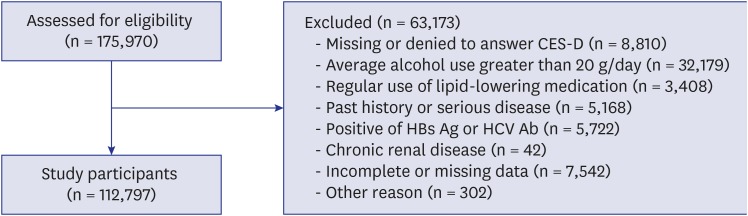
A total of 112,797 participants from the Korean general population were enrolled. The study participants were categorized into three groups according to degree of NAFLD evaluated by ultrasonography, fatty liver index (FLI) and fibrosis-4 score (FIB-4). Depression was defined as a score of Center for Epidemiological Studies-Depression (CES-D) ≥ 16, and the odd ratios (ORs) and 95% confidence interval (CI) for depression (adjusted ORs [95% CI]) were assessed by multiple logistic regression analyses.
In the unadjusted model, the presence and severity of NAFLD was not significantly associated with depressive symptoms. However, in the fully adjusted model, ORs for depression increased in proportion to the degree of ultrasonographically detected NAFLD (mild fatty liver: 1.14 [1.06-1.22]; and moderate to severe fatty liver: 1.32 [1.17-1.48]). An association was also observed between depression and FLI (30 ≤ FLI < 60: 1.06 [0.98-1.15]; FLI ≥ 60: 1.15 [1.02-1.29]).
The presence and severity of NAFLD is significantly associated with depressive symptoms. In addition, this association was more distinct after adjusting for covariates including age, gender and insulin resistance. This finding indicates the necessity of further study evaluating the incidental relationship of depression with NAFLD.
最近的研究表明,非酒精性脂肪性肝病(NAFLD)与抑郁症之间存在显著关联。然而,关于抑郁症的风险是否实际上与 NAFLD 的存在和严重程度有关,目前仍存在争议。因此,本研究旨在通过多种方式评估 NAFLD 与抑郁症之间的关联。
共纳入 112797 名来自韩国普通人群的研究对象。根据超声、脂肪性肝病指数(FLI)和纤维化-4 评分(FIB-4)评估的 NAFLD 程度,将研究对象分为三组。抑郁症定义为中心流行病学研究抑郁量表(CES-D)评分≥16,采用多因素逻辑回归分析评估抑郁症的比值比(OR)和 95%置信区间(95%CI)。
在未调整模型中,NAFLD 的存在和严重程度与抑郁症状无显著相关性。然而,在完全调整模型中,超声检测到的 NAFLD 程度与抑郁的 OR 呈比例增加(轻度脂肪肝:1.14 [1.06-1.22];中度至重度脂肪肝:1.32 [1.17-1.48])。FLI 与抑郁之间也存在关联(30≤FLI<60:1.06 [0.98-1.15];FLI≥60:1.15 [1.02-1.29])。
NAFLD 的存在和严重程度与抑郁症状显著相关。此外,在调整年龄、性别和胰岛素抵抗等混杂因素后,这种相关性更为明显。这一发现表明,需要进一步研究评估抑郁症与 NAFLD 之间的偶然关系。