Department of Physiology, Louisiana State University Health Sciences Center, New Orleans, LA 70112, USA.
Department of Biochemistry and The Proteomic Core Facility, Louisiana State University Health Sciences Center, New Orleans, LA 70112, USA.
Int J Mol Sci. 2019 Jul 11;20(14):3401. doi: 10.3390/ijms20143401.
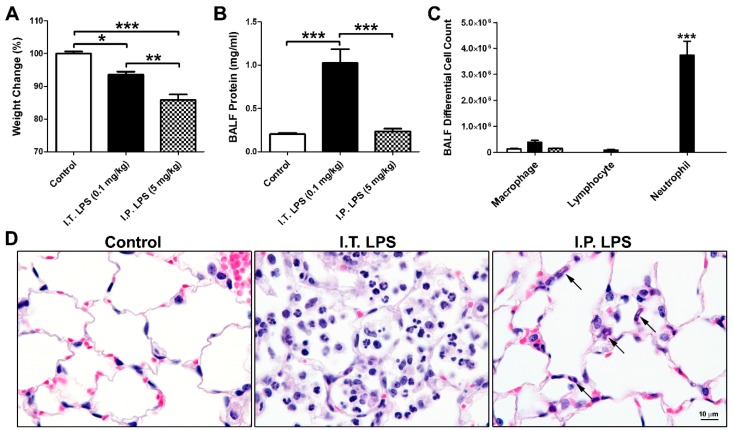
The pathogenic mechanisms of acute lung injury due to direct and indirect pulmonary insults are incompletely understood. Using an unbiased, discovery and quantitative proteomic approach, we examined bronchoalveolar lavage fluid (BALF) proteome following lipopolysaccharide (LPS)-induced direct and indirect lung injury in mice. A total of 1017 proteins were both identified and quantitated in BALF from control, intratracheal (I.T., direct) and intraperitoneal (I.P., indirect) LPS-treated mice. The two LPS groups shared 13 up-regulated and 22 down-regulated proteins compared to the control group. Ingenuity pathway analysis revealed that acute-phase response signaling was activated by both I.T. and I.P. LPS; however, the magnitude of activation was much greater in the I.T. LPS group. Intriguingly, two canonical signaling pathways, liver X receptor/retinoid X receptor activation, and the production of nitric oxide and reactive oxygen species in macrophages, were activated by I.T. but suppressed by I.P. LPS. Cxcl15 (also known as lungkine) was also up-regulated by I.T. but down-regulated by I.P. LPS. In conclusion, our quantitative discovery-based proteomic approach identified commonalities, as well as significant differences in BALF protein expression profiles between LPS-induced direct and indirect lung injury, and importantly, LPS-induced indirect lung injury resulted in suppression of select components of lung innate immunity.
直接和间接肺损伤导致急性肺损伤的发病机制尚不完全清楚。我们采用无偏倚、发现和定量蛋白质组学方法,研究了脂多糖(LPS)诱导的小鼠直接和间接肺损伤后支气管肺泡灌洗液(BALF)中的蛋白质组。在来自对照、气管内(I.T.,直接)和腹腔内(I.P.,间接)LPS 处理的小鼠的 BALF 中,共鉴定和定量了 1017 种蛋白质。与对照组相比,这两个 LPS 组共有 13 种上调蛋白和 22 种下调蛋白。IPA 分析显示,I.T.和 I.P. LPS 均可激活急性期反应信号通路;但 I.T. LPS 组的激活程度要大得多。有趣的是,两种经典信号通路,即肝 X 受体/视黄酸 X 受体激活和巨噬细胞中一氧化氮和活性氧的产生,被 I.T. LPS 激活,但被 I.P. LPS 抑制。Cxcl15(也称为肺激肽)也被 I.T. LPS 上调,但被 I.P. LPS 下调。总之,我们的基于定量发现的蛋白质组学方法鉴定了 LPS 诱导的直接和间接肺损伤之间 BALF 蛋白表达谱的共同特征,以及显著差异,重要的是,LPS 诱导的间接肺损伤导致肺固有免疫的某些成分被抑制。