Department of Swine Infectious Diseases, Shanghai Veterinary Research Institute, Chinese Academy of Agricultural Science, Shanghai, PR China.
Department of Virology, Immunobiology and Parasitology (VIP), The National Veterinary Institute (SVA), Uppsala, Sweden.
PLoS Negl Trop Dis. 2019 Aug 2;13(8):e0007601. doi: 10.1371/journal.pntd.0007601. eCollection 2019 Aug.
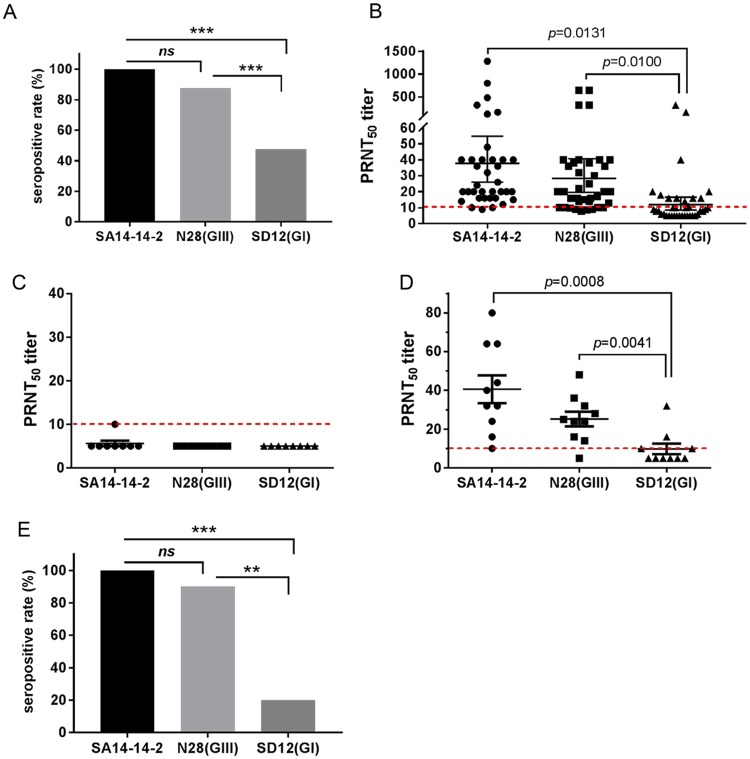
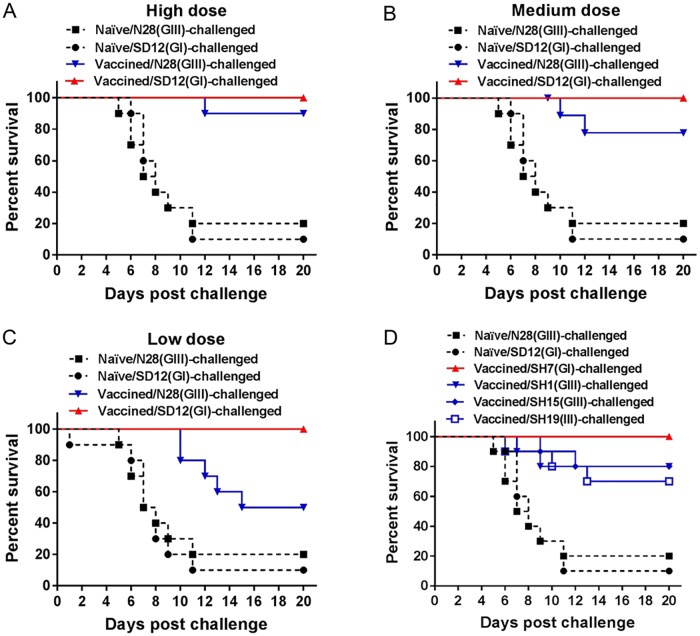
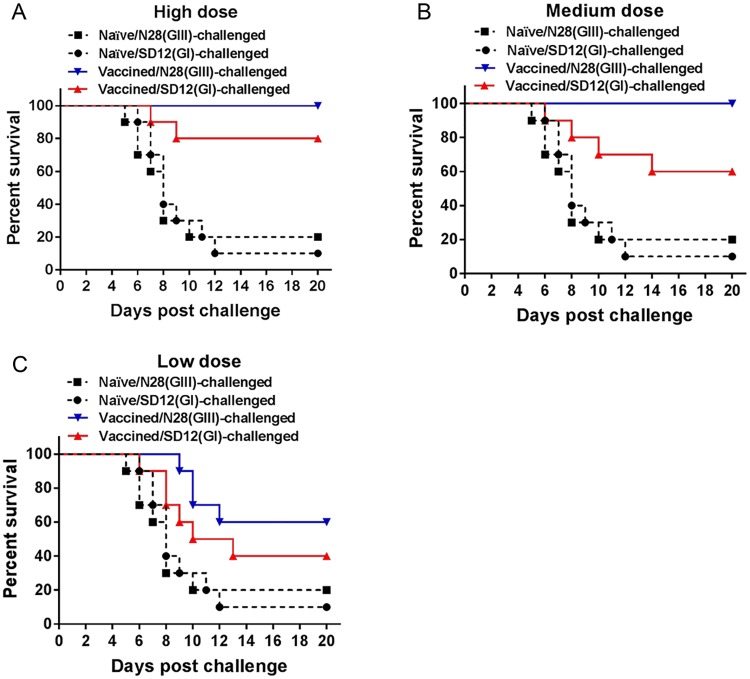
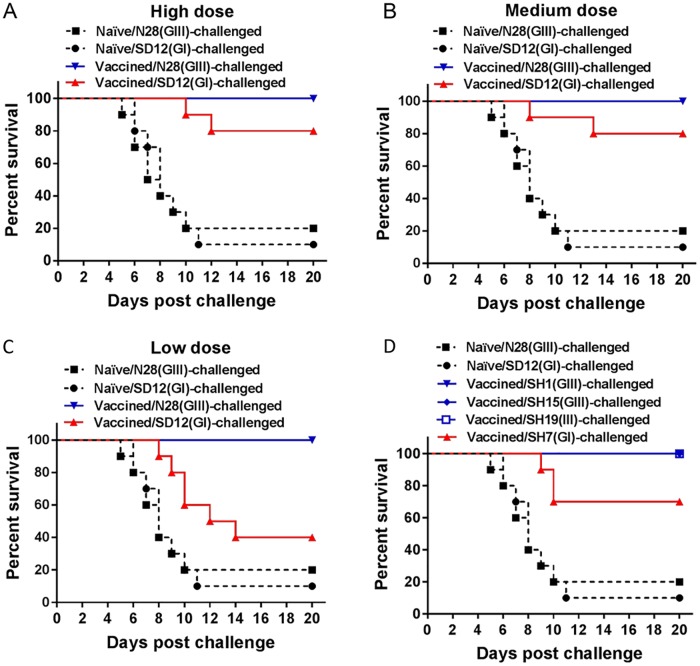
Genotype III (GIII) Japanese encephalitis virus (JEV) predominance has gradually been replaced by genotype I (GI) over the last 20 years in many Asian countries. This genotype shift raises concerns about the protective efficacy of Japanese encephalitis (JE) vaccines, as all of the currently licensed JE vaccines are derived from GIII strains. In this study, we conducted vaccination-challenge protection assays to evaluate the cross-protective efficacy of GI- or GIII-derived vaccines against the challenge of a heterologous genotype using a mouse challenge model. Titration of the neutralizing antibodies elicited by SA14-14-2 live-attenuated JE vaccine (SA14-14-2 vaccine), a GIII-derived vaccine, indicated that the titer of neutralizing antibodies specific to heterologous genotype GI stain was significantly lower than that specific to homologous genotype GIII strain in both pigs and mice immunized with the SA14-14-2 vaccine. Vaccination of mice with SA14-14-2 vaccine or a GIII-inactivated vaccine at high and medium doses completely protected vaccinated mice against challenge with the homologous genotype GIII strains, but failed to provide the vaccinated mice complete protection against the challenge of heterologous genotype GI strains. The protection rates against GI strain challenge were 60%-80%, showing that these vaccines were partially protective against GI strain challenge. Additionally, vaccination of mice with a GI-inactivated vaccine conferred 100% protection against the challenge of homologous genotype GI strains, but 50%-90% protection against the challenge of heterologous genotype GIII strains, showing a reduced protective efficacy of a GI-derived vaccine against GIII strain challenge. Overall, these observations demonstrated a partial cross-protection between GI and GIII strains and suggested a potential need for new JE vaccine strategies, including options like a bivalent vaccine, to control both genotype infection.
在过去的 20 年中,在许多亚洲国家,基因型 III(GIII)日本脑炎病毒(JEV)逐渐被基因型 I(GI)所取代。这种基因型转变引起了人们对日本脑炎(JE)疫苗保护效力的关注,因为所有目前获得许可的 JE 疫苗均源自 GIII 株。在这项研究中,我们使用小鼠攻毒模型进行了疫苗接种-攻毒保护试验,以评估 GI 或 GIII 衍生疫苗对异源基因型攻毒的交叉保护效力。对减毒活疫苗 SA14-14-2(SA14-14-2 疫苗)诱导的中和抗体滴度进行滴定,结果表明,在接种 SA14-14-2 疫苗的猪和小鼠中,针对异源基因型 GI 株的中和抗体滴度明显低于针对同源基因型 GIII 株的中和抗体滴度。用 SA14-14-2 疫苗或高、中剂量的 GIII 灭活疫苗对小鼠进行免疫接种可完全保护接种小鼠免受同源基因型 GIII 株的攻毒,但不能为接种小鼠提供针对异源基因型 GI 株攻毒的完全保护。针对 GI 株攻毒的保护率为 60%-80%,表明这些疫苗对 GI 株攻毒具有部分保护作用。此外,用 GI 灭活疫苗对小鼠进行免疫接种可 100%抵抗同源基因型 GI 株的攻毒,但对异源基因型 GIII 株的攻毒的保护率为 50%-90%,表明 GI 衍生疫苗对 GIII 株攻毒的保护效力降低。总体而言,这些观察结果表明 GI 和 GIII 株之间存在部分交叉保护作用,并提示可能需要新的 JE 疫苗策略,包括二价疫苗等选择,以控制两种基因型的感染。