• 文献检索
  • 文档翻译
  • 深度研究
  • 学术资讯
  • Suppr Zotero 插件Zotero 插件
  • 邀请有礼
  • 套餐&价格
  • 历史记录
应用&插件
Suppr Zotero 插件Zotero 插件浏览器插件Mac 客户端Windows 客户端微信小程序
定价
高级版会员购买积分包购买API积分包
服务
文献检索文档翻译深度研究API 文档MCP 服务
关于我们
关于 Suppr公司介绍联系我们用户协议隐私条款
关注我们

Suppr 超能文献

核心技术专利:CN118964589B侵权必究
粤ICP备2023148730 号-1Suppr @ 2026

文献检索

告别复杂PubMed语法,用中文像聊天一样搜索,搜遍4000万医学文献。AI智能推荐,让科研检索更轻松。

立即免费搜索

文件翻译

保留排版,准确专业,支持PDF/Word/PPT等文件格式,支持 12+语言互译。

免费翻译文档

深度研究

AI帮你快速写综述,25分钟生成高质量综述,智能提取关键信息,辅助科研写作。

立即免费体验

机器人辅助中耳入路在人工耳蜗植入术中的应用:首例人体研究。

Robotic middle ear access for cochlear implantation: First in man.

机构信息

Department of Otorhinolaryngology, Head and Neck Surgery, Inselspital, Bern University Hospital, University of Bern, Bern, Switzerland.

Hearing Research Laboratory, ARTORG Center for Biomedical Engineering Research, University of Bern, Bern, Switzerland.

出版信息

PLoS One. 2019 Aug 2;14(8):e0220543. doi: 10.1371/journal.pone.0220543. eCollection 2019.

DOI:10.1371/journal.pone.0220543
PMID:31374092
原文链接:https://pmc.ncbi.nlm.nih.gov/articles/PMC6677292/
Abstract

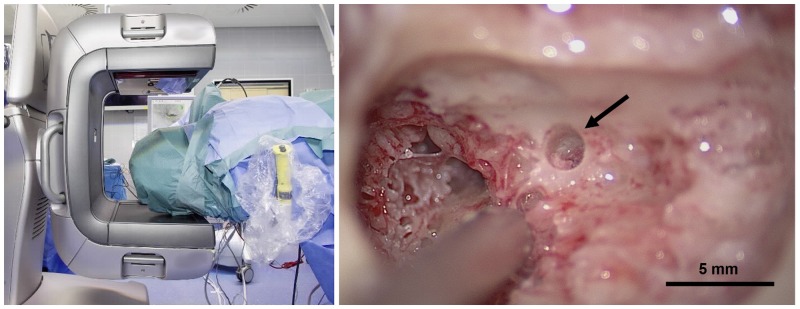
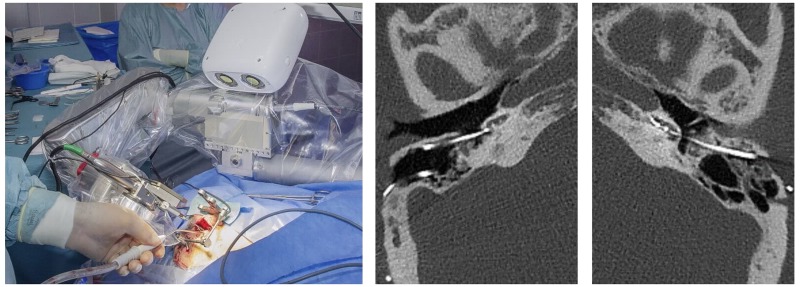
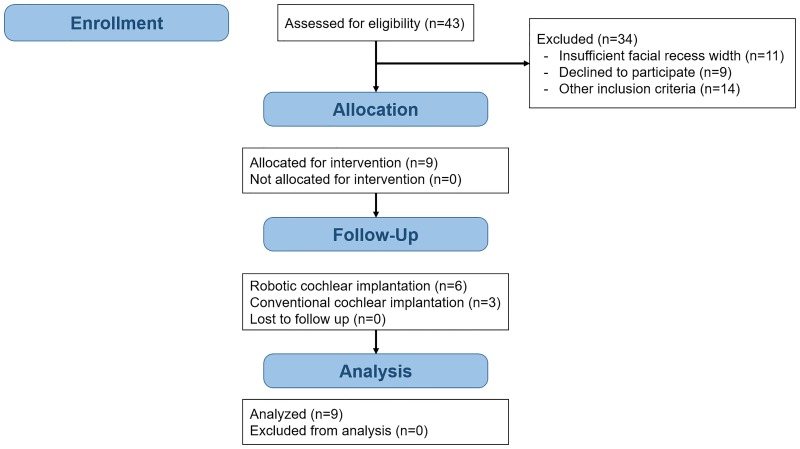
To demonstrate the feasibility of robotic middle ear access in a clinical setting, nine adult patients with severe-to-profound hearing loss indicated for cochlear implantation were included in this clinical trial. A keyhole access tunnel to the tympanic cavity and targeting the round window was planned based on preoperatively acquired computed tomography image data and robotically drilled to the level of the facial recess. Intraoperative imaging was performed to confirm sufficient distance of the drilling trajectory to relevant anatomy. Robotic drilling continued toward the round window. The cochlear access was manually created by the surgeon. Electrode arrays were inserted through the keyhole tunnel under microscopic supervision via a tympanomeatal flap. All patients were successfully implanted with a cochlear implant. In 9 of 9 patients the robotic drilling was planned and performed to the level of the facial recess. In 3 patients, the procedure was reverted to a conventional approach for safety reasons. No change in facial nerve function compared to baseline measurements was observed. Robotic keyhole access for cochlear implantation is feasible. Further improvements to workflow complexity, duration of surgery, and usability including safety assessments are required to enable wider adoption of the procedure.

摘要

为了在临床环境中证明机器人中耳入路的可行性,本临床试验纳入了 9 名因重度至极重度听力损失而需要人工耳蜗植入的成年患者。根据术前获得的计算机断层扫描图像数据,规划了通向鼓室的钥匙孔样通道,并通过机器人钻孔至面神经隐窝水平。术中进行影像学检查以确认钻孔轨迹与相关解剖结构之间有足够的距离。机器人继续向圆窗方向钻孔。外科医生手动完成耳蜗入路。在显微镜的监督下,通过鼓室切开术将电极阵列通过钥匙孔隧道插入。所有患者均成功植入人工耳蜗。在 9 例患者中,机器人钻孔均按计划完成至面神经隐窝水平。出于安全原因,有 3 例患者的手术恢复为传统方法。与基线测量值相比,面神经功能无变化。机器人钥匙孔入路用于人工耳蜗植入是可行的。需要进一步改进工作流程的复杂性、手术持续时间和可用性,包括安全性评估,以实现该手术的更广泛应用。
https://cdn.ncbi.nlm.nih.gov/pmc/blobs/b1b5/6677292/a0a1881ed0f2/pone.0220543.g003.jpg
https://cdn.ncbi.nlm.nih.gov/pmc/blobs/b1b5/6677292/ba90bee6b784/pone.0220543.g001.jpg
https://cdn.ncbi.nlm.nih.gov/pmc/blobs/b1b5/6677292/743aeb54fb5b/pone.0220543.g002.jpg
https://cdn.ncbi.nlm.nih.gov/pmc/blobs/b1b5/6677292/a0a1881ed0f2/pone.0220543.g003.jpg
https://cdn.ncbi.nlm.nih.gov/pmc/blobs/b1b5/6677292/ba90bee6b784/pone.0220543.g001.jpg
https://cdn.ncbi.nlm.nih.gov/pmc/blobs/b1b5/6677292/743aeb54fb5b/pone.0220543.g002.jpg
https://cdn.ncbi.nlm.nih.gov/pmc/blobs/b1b5/6677292/a0a1881ed0f2/pone.0220543.g003.jpg

相似文献

1
Robotic middle ear access for cochlear implantation: First in man.机器人辅助中耳入路在人工耳蜗植入术中的应用:首例人体研究。
PLoS One. 2019 Aug 2;14(8):e0220543. doi: 10.1371/journal.pone.0220543. eCollection 2019.
2
In vitro accuracy evaluation of image-guided robot system for direct cochlear access.体外直接耳蜗入路图像引导机器人系统准确性评估
Otol Neurotol. 2013 Sep;34(7):1284-90. doi: 10.1097/MAO.0b013e31829561b6.
3
Robotic cochlear implantation: feasibility of a multiport approach in an ex vivo model.机器人辅助人工耳蜗植入:体外模型中多端口方法的可行性
Eur Arch Otorhinolaryngol. 2019 May;276(5):1283-1289. doi: 10.1007/s00405-019-05318-7. Epub 2019 Feb 9.
4
Robotic cochlear implantation in post-meningitis ossified cochlea.机器人辅助人工耳蜗植入术治疗脑膜炎后骨化耳蜗
Am J Otolaryngol. 2023 Jan-Feb;44(1):103668. doi: 10.1016/j.amjoto.2022.103668. Epub 2022 Oct 22.
5
True keyhole cochlear implant surgery.真正的锁孔耳蜗植入手术。
Am J Otolaryngol. 2023 Jul-Aug;44(4):103926. doi: 10.1016/j.amjoto.2023.103926. Epub 2023 May 22.
6
Robotic cochlear implantation: surgical procedure and first clinical experience.机器人辅助人工耳蜗植入:手术过程及首次临床经验。
Acta Otolaryngol. 2017 Apr;137(4):447-454. doi: 10.1080/00016489.2017.1278573. Epub 2017 Feb 1.
7
Comparison of the Surgical Techniques and Robotic Techniques for Cochlear Implantation in Terms of the Trajectories Toward the Inner Ear.内耳入路的手术技术与机器人技术在手术路径方面的比较。
J Int Adv Otol. 2020 Apr;16(1):3-7. doi: 10.5152/iao.2020.8113.
8
Population Statistics Approach for Safety Assessment in Robotic Cochlear Implantation.用于机器人人工耳蜗植入安全评估的人口统计学方法
Otol Neurotol. 2017 Jun;38(5):759-764. doi: 10.1097/MAO.0000000000001357.
9
Clinical validation study of percutaneous cochlear access using patient-customized microstereotactic frames.经患者定制微立体定向框架行经皮耳蜗入路的临床验证研究。
Otol Neurotol. 2010 Jan;31(1):94-9. doi: 10.1097/MAO.0b013e3181c2f81a.
10
Implantation of the completely ossified cochlea: an image-guided approach.完全骨化耳蜗的植入:一种图像引导的方法。
Otol Neurotol. 2013 Apr;34(3):522-5. doi: 10.1097/MAO.0b013e31827d8aa0.

引用本文的文献

1
Retrospective evaluation of Facial nerve monitoring to prevent nerve damage during robotic drilling in the largest series of patients undergoing the HEARO-procedure.在接受HEARO手术的最大规模患者系列中,对面神经监测进行回顾性评估,以预防机器人钻孔过程中的神经损伤。
PLoS One. 2025 Jun 26;20(6):e0326614. doi: 10.1371/journal.pone.0326614. eCollection 2025.
2
Microsurgical Robotic System for Myringoplasty: Feasibility Study.用于鼓膜成形术的显微外科机器人系统:可行性研究。
Laryngoscope Investig Otolaryngol. 2025 May 24;10(3):e70169. doi: 10.1002/lio2.70169. eCollection 2025 Jun.
3
Training and validation of a deep learning U-net architecture general model for automated segmentation of inner ear from CT.

本文引用的文献

1
Medical robotics-Regulatory, ethical, and legal considerations for increasing levels of autonomy.医疗机器人——自主程度不断提高的监管、伦理和法律考虑因素。
Sci Robot. 2017 Mar 15;2(4). doi: 10.1126/scirobotics.aam8638.
2
Cochlear Implant Insertion Depth Prediction: A Temporal Bone Accuracy Study.人工耳蜗植入深度预测:颞骨准确性研究。
Otol Neurotol. 2018 Dec;39(10):e996-e1001. doi: 10.1097/MAO.0000000000002034.
3
Instrument flight to the inner ear.经内耳飞行的仪器
训练和验证深度学习 U 形网络架构通用模型,以实现 CT 内耳自动分割。
Eur Radiol Exp. 2024 Sep 12;8(1):104. doi: 10.1186/s41747-024-00508-3.
4
Objective evaluation, using computed tomography, of round window access for cochlear implantation.使用计算机断层扫描对人工耳蜗植入的圆窗入路进行客观评估。
Eur Arch Otorhinolaryngol. 2024 Dec;281(12):6367-6376. doi: 10.1007/s00405-024-08873-w. Epub 2024 Aug 4.
5
Pull-Out Strength of Orthodontic Miniscrews in the Temporal Bone.正畸微螺钉在颞骨中的拔出力。
J Otolaryngol Head Neck Surg. 2024 Jan-Dec;53:19160216241248669. doi: 10.1177/19160216241248669.
6
On the interdependence of insertion forces, insertion speed, and lubrication: Aspects to consider when testing cochlear implant electrodes.插入力、插入速度和润滑之间的相互关系:测试人工耳蜗电极时需要考虑的方面。
PLoS One. 2024 Jan 24;19(1):e0295121. doi: 10.1371/journal.pone.0295121. eCollection 2024.
7
A Five-Decade Text Mining Analysis of Cochlear Implant Research: Where We Started and Where We Are Heading.五十年来人工耳蜗植入研究的文本挖掘分析:我们从哪里开始,又将走向何方。
Medicina (Kaunas). 2023 Oct 24;59(11):1891. doi: 10.3390/medicina59111891.
8
Audiological outcomes of robot-assisted cochlear implant surgery.机器人辅助人工耳蜗植入手术的听力学结果。
Eur Arch Otorhinolaryngol. 2023 Oct;280(10):4433-4444. doi: 10.1007/s00405-023-07961-7. Epub 2023 Apr 12.
9
CochleRob: Parallel-Serial Robot to Position a Magnetic Actuator around a Patient's Head for Intracochlear Microrobot Navigation.CochleRob:一种用于将磁驱动器放置在患者头部周围的串并混联机器人,以实现耳蜗内微机器人导航。
Sensors (Basel). 2023 Mar 9;23(6):2973. doi: 10.3390/s23062973.
10
A Self-Configuring Deep Learning Network for Segmentation of Temporal Bone Anatomy in Cone-Beam CT Imaging.用于锥形束 CT 成像中颞骨解剖结构分割的自配置深度学习网络。
Otolaryngol Head Neck Surg. 2023 Oct;169(4):988-998. doi: 10.1002/ohn.317. Epub 2023 Mar 8.
Sci Robot. 2017 Mar 15;2(4). doi: 10.1126/scirobotics.aal4916.
4
The accuracy of image-based safety analysis for robotic cochlear implantation.基于图像的机器人耳蜗植入安全性分析的准确性。
Int J Comput Assist Radiol Surg. 2019 Jan;14(1):83-92. doi: 10.1007/s11548-018-1834-3. Epub 2018 Aug 2.
5
Neuromonitoring During Robotic Cochlear Implantation: Initial Clinical Experience.机器人辅助耳蜗植入术中的神经监测:初步临床经验。
Ann Biomed Eng. 2018 Oct;46(10):1568-1581. doi: 10.1007/s10439-018-2094-7. Epub 2018 Jul 26.
6
Long-term outcomes of cochlear implantation in patients with high-frequency hearing loss.高频听力损失患者人工耳蜗植入的长期疗效
Laryngoscope. 2018 Aug;128(8):1939-1945. doi: 10.1002/lary.27073. Epub 2018 Jan 13.
7
Quality of Life and Cost-Effectiveness of Cochlear Implants: A Narrative Review.人工耳蜗的生活质量与成本效益:一项叙述性综述
Audiol Neurootol. 2017;22(4-5):236-258. doi: 10.1159/000481767. Epub 2017 Dec 21.
8
[Bilateral cochlear implants].[双侧人工耳蜗植入]
HNO. 2017 Jul;65(7):561-570. doi: 10.1007/s00106-017-0370-8.
9
Minimally invasive, multi-port approach to the lateral skull base: a first in vitro evaluation.微创多端口入路至侧颅底:首次体外评估
Int J Comput Assist Radiol Surg. 2017 May;12(5):889-895. doi: 10.1007/s11548-017-1533-5. Epub 2017 Feb 14.
10
Population Statistics Approach for Safety Assessment in Robotic Cochlear Implantation.用于机器人人工耳蜗植入安全评估的人口统计学方法
Otol Neurotol. 2017 Jun;38(5):759-764. doi: 10.1097/MAO.0000000000001357.