Department of Radiation Oncology, Columbia University Medical Center, New York, 10032, USA.
Department of Urology, Columbia University Medical Center, New York, 10032, USA.
Radiat Oncol. 2019 Aug 2;14(1):136. doi: 10.1186/s13014-019-1346-5.
Multiple phase I-II clinical trials have reported on the efficacy and safety of prostate stereotactic body radiotherapy (SBRT) for the treatment of prostate cancer. However, few have reported outcomes for prostate SBRT using periprostatic hydrogel spacer (SpaceOAR; Augmenix). Herein, we report safety and efficacy outcomes from our institutional prostate SBRT experience with SpaceOAR placement.
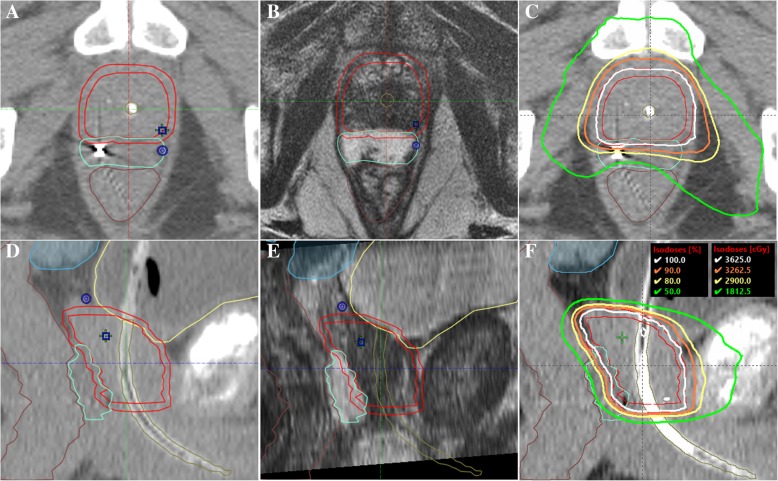
Fifty men with low- or intermediate-risk prostate cancer treated at a single institution with linear accelerator-based SBRT to 3625 cGy in 5 fractions, with or without androgen deprivation therapy (ADT) were included. All patients underwent SpaceOAR and fiducial marker placement followed by pre-treatment MRI. Toxicity assessments were conducted at least weekly while on treatment, 1 month after treatment, and every follow-up visit thereafter. Post-treatment PSA measurements were obtained 4 months after SBRT, followed by every 3-6 months thereafter. Acute toxicity was documented per RTOG criteria.
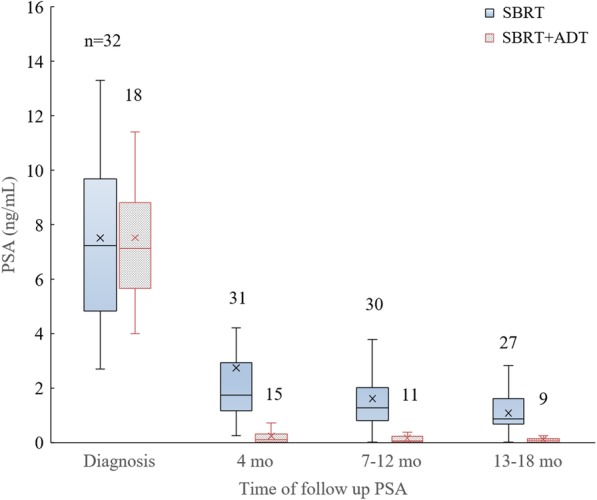
Median follow up time was 20 (range 4-44) months. Median PSA at time of diagnosis was 7.4 (2.7-19.5) ng/ml. Eighteen men received 6 months of ADT for unfavorable intermediate risk disease. No PSA failures were recorded. Median PSA was 0.9 ng/mL at 20 months; 0.08 and 1.32 ng/mL in men who did and did not receive ADT, respectively. Mean prostate-rectum separation achieved with SpaceOAR was 9.6 ± 4 mm at the prostate midgland. No grade ≥ 3 GU or GI toxicity was recorded. During treatment, 30% of men developed new grade 2 GU toxicity (urgency or dysuria). These symptoms were present in 30% of men at 1 month and in 12% of men at 1 year post-treatment. During treatment, GI toxicity was limited to grade 1 symptoms (16%), although 4% of men developed grade 2 symptoms during the first 4 weeks after SBRT. All GI symptoms were resolving by the 1 month post-treatment assessment and no acute or late rectal toxicity was reported > 1 month after treatment.
Periprostatic hydrogel placement followed by prostate SBRT resulted in minimal GI toxicity, and favorable early oncologic outcomes. These results indicate that SBRT with periprostatic spacer is a well-tolerated, safe, and convenient treatment option for localized prostate cancer.
多项 I 期至 II 期临床试验已经报道了前列腺立体定向体部放疗(SBRT)治疗前列腺癌的疗效和安全性。然而,很少有研究报道使用前列腺周围水凝胶间隔物(SpaceOAR;Augmenix)进行前列腺 SBRT 的结果。在此,我们报告了我们机构使用 SpaceOAR 进行前列腺 SBRT 的安全性和疗效结果。
50 名低危或中危前列腺癌患者在一家机构接受基于直线加速器的 SBRT 治疗,给予 3625cGy 剂量,分 5 次给予,同时给予或不给予雄激素剥夺治疗(ADT)。所有患者均接受 SpaceOAR 和基准标记放置,然后进行治疗前 MRI。在治疗期间、治疗后 1 个月以及此后的每次随访中至少每周进行一次毒性评估。在 SBRT 后 4 个月进行前列腺特异性抗原(PSA)检测,此后每 3-6 个月进行一次。急性毒性按照 RTOG 标准进行记录。
中位随访时间为 20 个月(范围 4-44 个月)。诊断时中位 PSA 为 7.4(2.7-19.5)ng/ml。18 名男性因不利的中危疾病接受了 6 个月的 ADT。未记录到 PSA 失败。中位 PSA 在 20 个月时为 0.9ng/mL;未接受 ADT 和接受 ADT 的男性分别为 0.08 和 1.32ng/mL。使用 SpaceOAR 实现的前列腺-直肠分离在前列腺中叶的平均值为 9.6±4mm。未记录到任何≥3 级的 GU 或 GI 毒性。在治疗期间,30%的男性出现新的 2 级 GU 毒性(尿急或排尿困难)。在治疗后 1 个月时,30%的男性存在这些症状,在治疗后 1 年时,12%的男性存在这些症状。在治疗期间,GI 毒性仅限于 1 级症状(16%),尽管有 4%的男性在 SBRT 后 4 周内出现 2 级症状。所有的 GI 症状在治疗后 1 个月评估时都在缓解,并且在治疗后 1 个月以上没有报告急性或迟发性直肠毒性。
前列腺周围水凝胶放置后进行前列腺 SBRT 导致的 GI 毒性最小,早期肿瘤学结果良好。这些结果表明,前列腺周围间隔物的 SBRT 是一种耐受良好、安全且方便的局部前列腺癌治疗选择。