Vascular Patterning Laboratory, Center for Cancer Biology, VIB, Leuven B-3000, Belgium.
Vascular Patterning Laboratory, Center for Cancer Biology, Department of Oncology, KU Leuven, Leuven B-3000, Belgium.
Development. 2019 Aug 27;146(16):dev181024. doi: 10.1242/dev.181024.
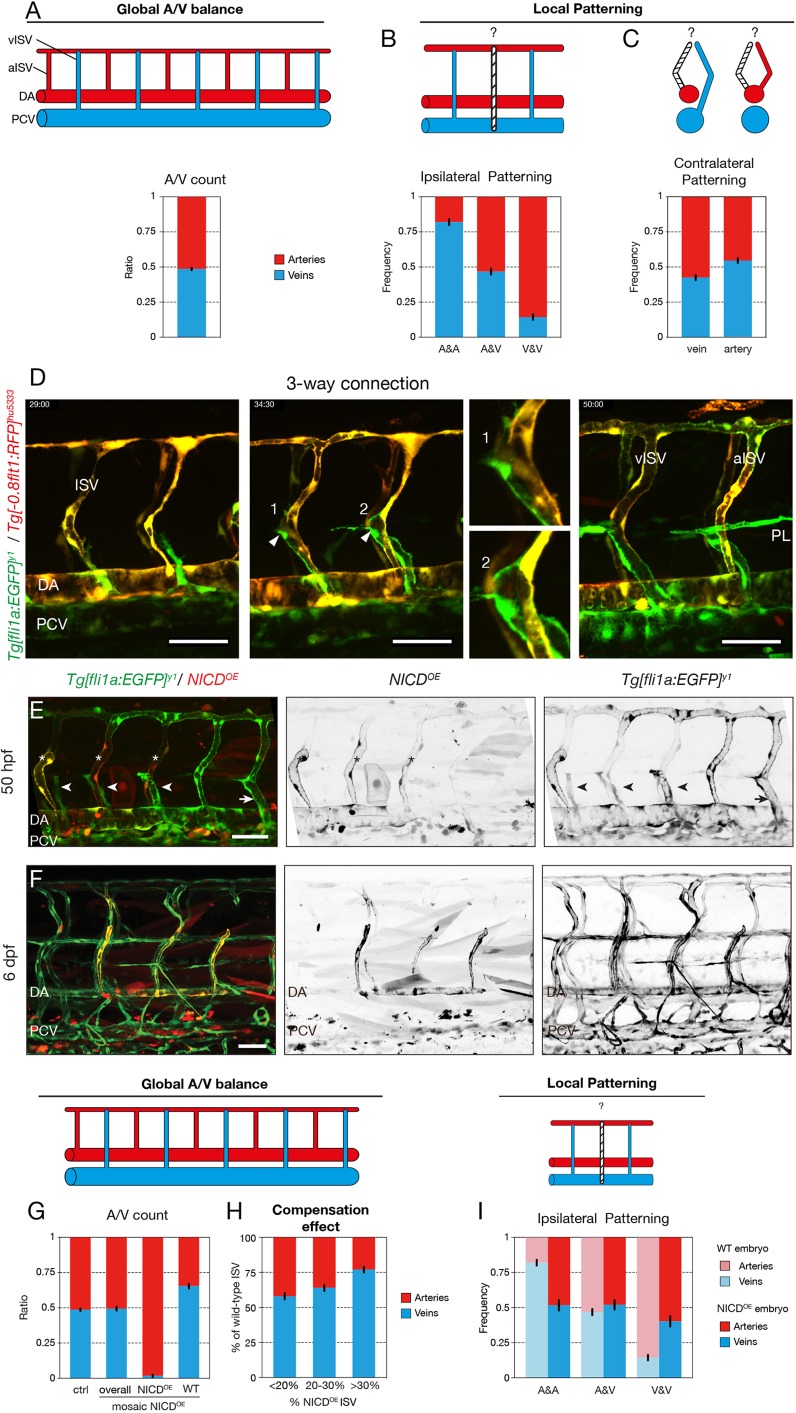
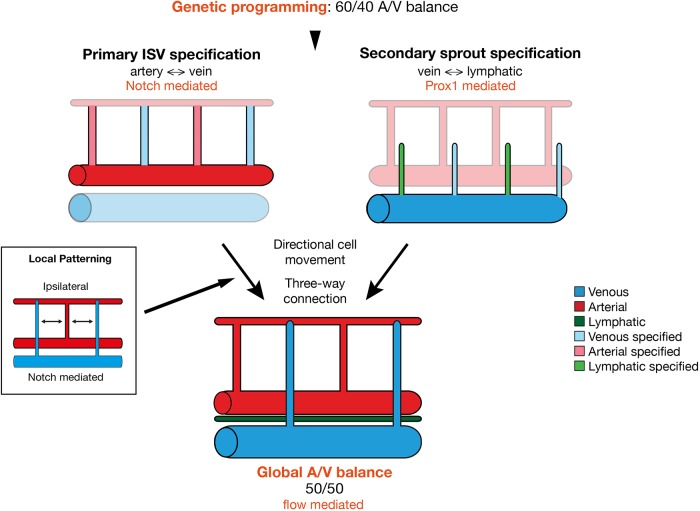
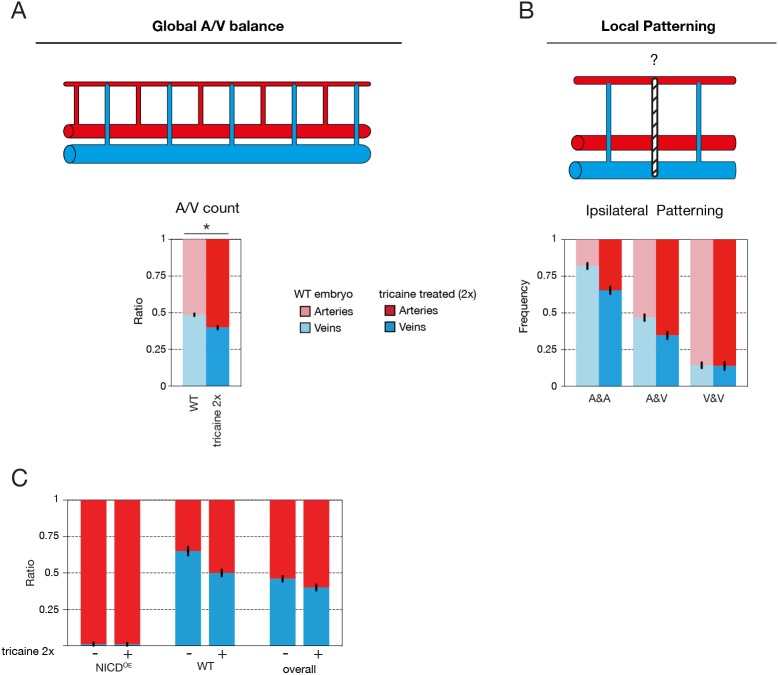
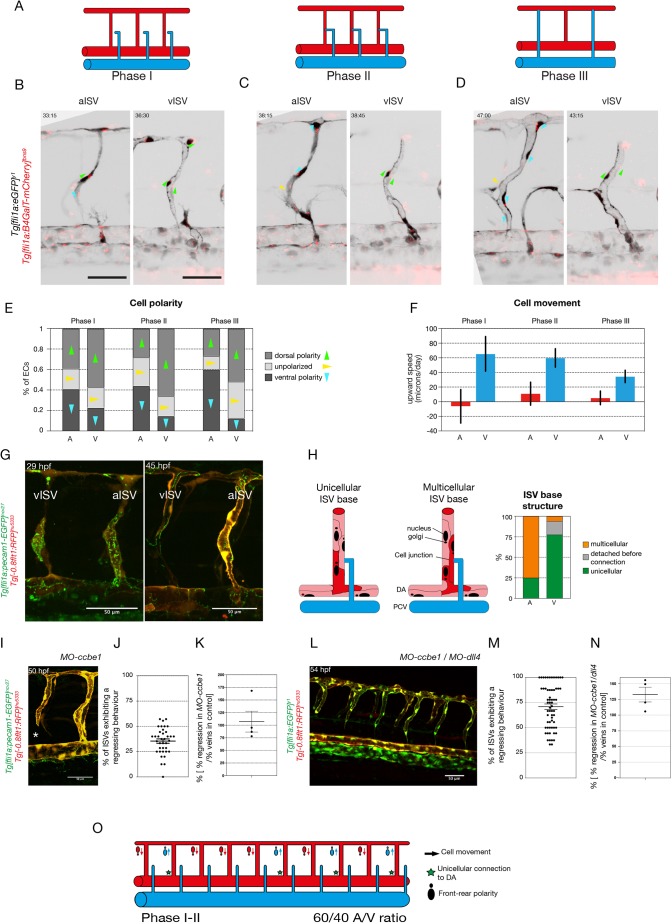
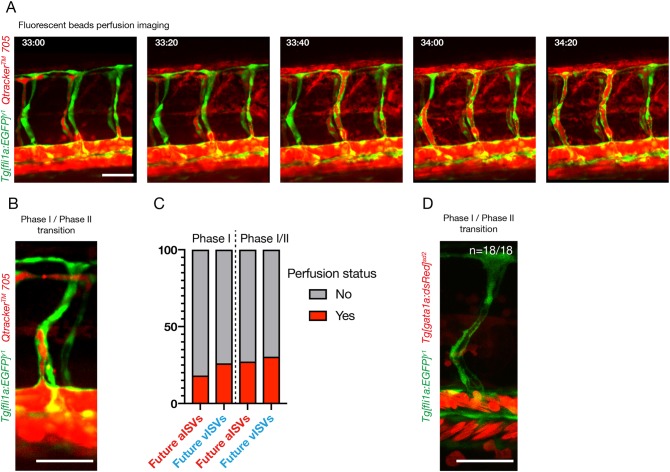
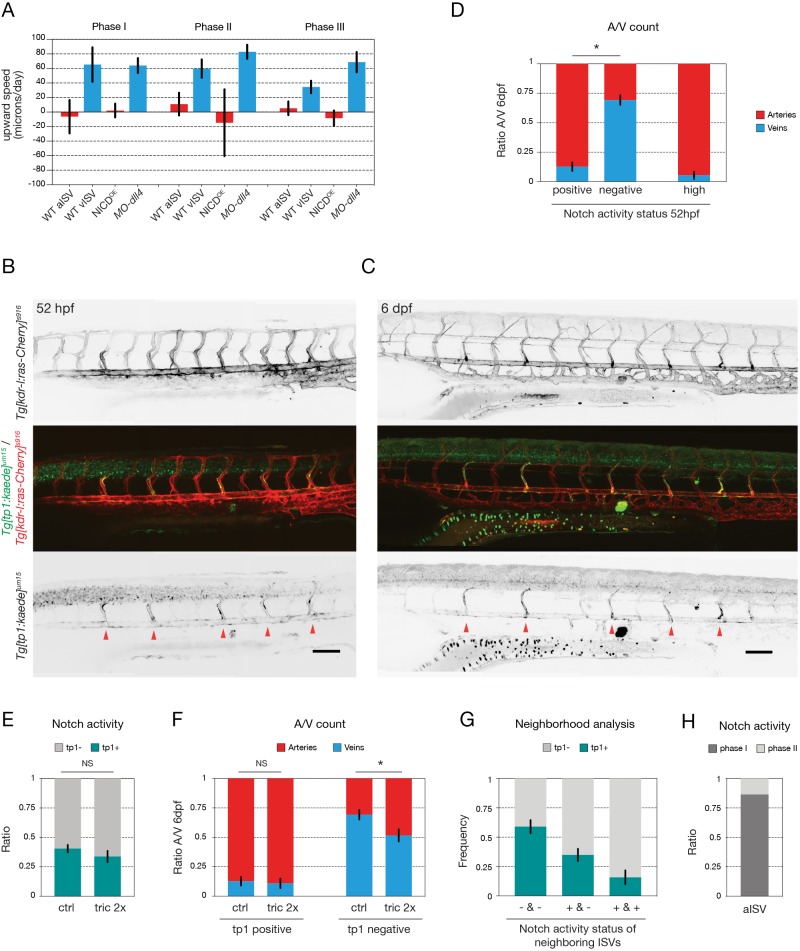
How developing vascular networks acquire the right balance of arteries, veins and lymphatic vessels to efficiently supply and drain tissues is poorly understood. In zebrafish embryos, the robust and regular 50:50 global balance of intersegmental veins and arteries that form along the trunk prompts the intriguing question of how does the organism keep 'count'? Previous studies have suggested that the ultimate fate of an intersegmental vessel (ISV) is determined by the identity of the approaching secondary sprout emerging from the posterior cardinal vein. Here, we show that the formation of a balanced trunk vasculature involves an early heterogeneity in endothelial cell behaviour and Notch signalling activity in the seemingly identical primary ISVs that is independent of secondary sprouting and flow. We show that Notch signalling mediates the local patterning of ISVs, and an adaptive flow-mediated mechanism subsequently fine-tunes the global balance of arteries and veins along the trunk. We propose that this dual mechanism provides the adaptability required to establish a balanced network of arteries, veins and lymphatic vessels.
血管网络如何获得动脉、静脉和淋巴管的适当平衡,以有效地供应和排出组织,这一点我们知之甚少。在斑马鱼胚胎中,沿躯干形成的节间静脉和动脉的强大而规则的 50:50 全球平衡提示了一个有趣的问题,即生物体如何“计数”?先前的研究表明,节间血管(ISV)的最终命运取决于从后心静脉中出现的接近的二级芽的身份。在这里,我们表明,平衡的主干脉管系统的形成涉及内皮细胞行为和 Notch 信号活性的早期异质性,这种异质性在看似相同的初级 ISV 中是独立于次级发芽和流动的。我们表明,Notch 信号传导介导了 ISV 的局部模式形成,随后,适应性的流动介导机制沿主干微调了动脉和静脉的全球平衡。我们提出,这种双重机制为建立动脉、静脉和淋巴管的平衡网络提供了所需的适应性。