Poppe Louise, De Bourdeaudhuij Ilse, Verloigne Maïté, Shadid Samyah, Van Cauwenberg Jelle, Compernolle Sofie, Crombez Geert
Department of Movement and Sports Sciences, Ghent University, Ghent, Belgium.
Department of Experimental Clinical and Health Psychology, Ghent University, Ghent, Belgium.
J Med Internet Res. 2019 Aug 2;21(8):e13363. doi: 10.2196/13363.
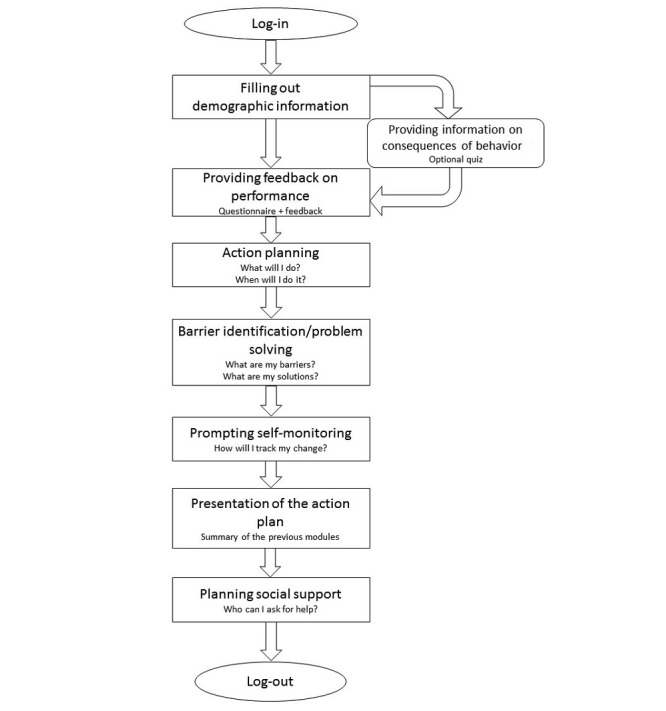
Adopting an active lifestyle plays a key role in the prevention and management of chronic diseases such as type 2 diabetes mellitus (T2DM). Web-based interventions are able to alter health behaviors and show stronger effects when they are informed by a behavior change theory. MyPlan 2.0 is a fully automated electronic health (eHealth) and mobile health (mHealth) intervention targeting physical activity (PA) and sedentary behavior (SB) based on the Health Action Process Approach (HAPA).
This study aimed to test the short-term effect of MyPlan 2.0 in altering levels of PA and SB and in changing personal determinants of behavior in adults with T2DM and in adults aged ≥50 years.
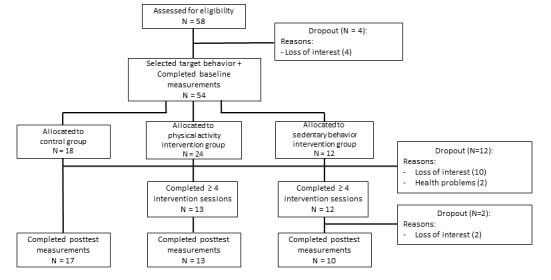
The study comprised two randomized controlled trials (RCTs) with an identical design. RCT 1 was conducted with adults with T2DM. RCT 2 was performed in adults aged ≥50 years. Data were collected via face-to-face assessments. The participants decided either to increase their level of PA or to decrease their level of SB. The participants were randomly allocated with a 2:1 ratio to the intervention group or the waiting-list control group. They were not blinded for their group allocation. The participants in the intervention group were instructed to go through MyPlan 2.0, comprising 5 sessions with an interval of 1 week between each session. The primary outcomes were objectively measured and self-reported PA (ie, light PA, moderate-to-vigorous PA, total PA, number of steps, and domain-specific [eg, transport-related] PA) and SB (ie, sitting time, number of breaks from sitting time, and length of sitting bouts). Secondary outcomes were self-reported behavioral determinants for PA and SB (eg, self-efficacy). Separate linear mixed models were performed to analyze the effects of MyPlan 2.0 in the two samples.
In RCT 1 (n=54), the PA intervention group showed, in contrast to the control group, a decrease in self-reported time spent sitting (P=.09) and an increase in accelerometer-measured moderate (P=.05) and moderate-to-vigorous PA (P=.049). The SB intervention group displayed an increase in accelerometer-assessed breaks from sedentary time in comparison with the control group (P=.005). A total of 14 participants of RCT 1 dropped out. In RCT 2 (n=63), the PA intervention group showed an increase for self-reported total PA in comparison with the control group (P=.003). Furthermore, in contrast to the control group, the SB intervention group decreased their self-reported time spent sitting (P=.08) and increased their accelerometer-assessed moderate (P=.06) and moderate-to-vigorous PA (P=.07). A total of 8 participants of RCT 2 dropped out.
For both the samples, the HAPA-based eHealth and mHealth intervention, MyPlan 2.0, was able to improve only some of the primary outcomes.
ClinicalTrials.gov NCT03291171; http://clinicaltrials.gov/ct2/show/NCT03291171. ClinicalTrials.gov NCT03799146; http://clinicaltrials.gov/ct2/show/NCT03799146.
INTERNATIONAL REGISTERED REPORT IDENTIFIER (IRRID): RR2-10.2196/12413.
采取积极的生活方式在2型糖尿病(T2DM)等慢性病的预防和管理中起着关键作用。基于网络的干预措施能够改变健康行为,并且当它们以行为改变理论为依据时,会显示出更强的效果。MyPlan 2.0是一种基于健康行动过程方法(HAPA)的针对身体活动(PA)和久坐行为(SB)的全自动电子健康(eHealth)和移动健康(mHealth)干预措施。
本研究旨在测试MyPlan 2.0对患有T2DM的成年人以及年龄≥50岁的成年人的PA和SB水平的改变以及行为的个人决定因素的变化的短期影响。
该研究包括两项设计相同的随机对照试验(RCT)。RCT 1针对患有T2DM的成年人进行。RCT 2在年龄≥50岁的成年人中进行。通过面对面评估收集数据。参与者决定要么提高他们的PA水平,要么降低他们的SB水平。参与者以2:1的比例随机分配到干预组或等待名单对照组。他们对自己的分组分配不设盲。干预组的参与者被指示使用MyPlan 2.0,包括5个疗程,每个疗程间隔1周。主要结局通过客观测量和自我报告的PA(即轻度PA、中度至剧烈PA、总PA、步数以及特定领域[如与交通相关的]PA)和SB(即坐姿时间、坐姿中断次数以及坐姿持续时间)来衡量。次要结局是自我报告的PA和SB的行为决定因素(如自我效能感)。进行单独的线性混合模型分析MyPlan 2.0在两个样本中的效果。
在RCT 1(n = 54)中,与对照组相比,PA干预组自我报告的坐姿时间减少(P = 0.09),加速度计测量的中度PA(P = 0.05)和中度至剧烈PA增加(P = 0.049)。SB干预组与对照组相比,加速度计评估的久坐时间中断次数增加(P = 0.005)。RCT 1共有14名参与者退出。在RCT 2(n = 63)中,与对照组相比,PA干预组自我报告的总PA增加(P = 0.003)。此外,与对照组相比,SB干预组自我报告的坐姿时间减少(P = 0.08),加速度计评估的中度PA(P = 0.06)和中度至剧烈PA增加(P = 0.07)。RCT 中共有有8名参与者退出。
对于这两个样本,基于HAPA的eHealth和mHealth干预措施MyPlan 2.0仅能够改善部分主要结局。
ClinicalTrials.gov NCT03291171;http://clinicaltrials.gov/ct2/show/NCT03291171。ClinicalTrials.gov NCT03799146;http://clinicaltrials.gov/ct2/show/NCT03799146。
国际注册报告识别码(IRRID):RR2 - 10.2196/12413。