Duan Yan Ping, Liang Wei, Guo Lan, Wienert Julian, Si Gang Yan, Lippke Sonia
Department of Sport and Physical Education, Faculty of Social Sciences, Hong Kong Baptist University, Hong Kong, China (Hong Kong).
Cardiac Rehabilitation Centre, Guangdong General Hospital, Guangzhou, China.
J Med Internet Res. 2018 Nov 19;20(11):e12052. doi: 10.2196/12052.
Web-based and theory-based interventions for multiple health behaviors appears to be a promising approach with respect to the adoption and maintenance of a healthy lifestyle in cardiac patients who have been discharged from the hospital. Until now, no randomized controlled trials have tested this assumption among Chinese rehabilitation patients with coronary heart disease using a Web-based intervention.
The study aim was to evaluate the effect of an 8-week Web-based intervention in terms of physical activity (PA), fruit and vegetable consumption (FVC), lifestyle changes, social-cognitive outcomes, and health outcomes compared with a waiting control group in Chinese cardiac patients. The intervention content was theory-based on the health action process approach. Self-reported data were evaluated, including PA, FVC, healthy lifestyle (the synthesis of PA and FVC), internal resources (combination of intention, self-efficacy, and planning), and an external resource (social support) of PA and FVC behaviors, as well as perceived health outcomes (body mass index, quality of life, and depression).
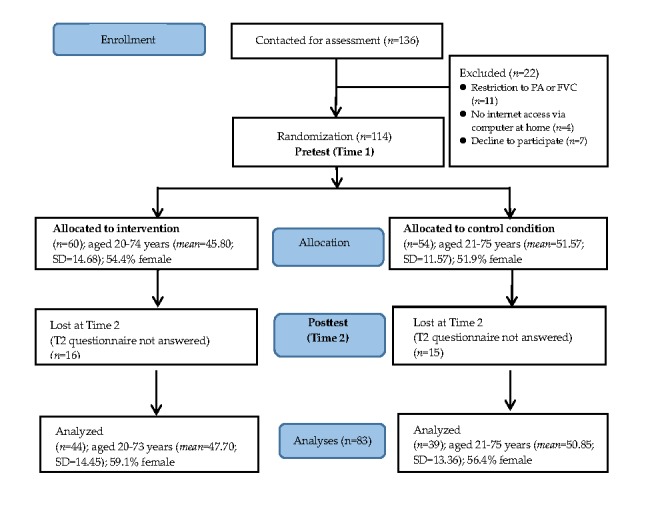
In a randomized controlled trial, 136 outpatients with coronary heart disease from the cardiac rehabilitation center of a hospital in China were recruited. After randomization and exclusion of unsuitable participants, 114 patients were assigned to 1 of the 2 groups: (1) the intervention group: first 4 weeks on PA and subsequent 4 weeks on FVC and (2) the waiting control group. A total of 2 Web-based assessments were conducted, including 1 at the beginning of the intervention (T1, N=114), and 1 at the end of the 8-week intervention (T2, N=83). The enrollment and follow-up took place from December 2015 to May 2016.
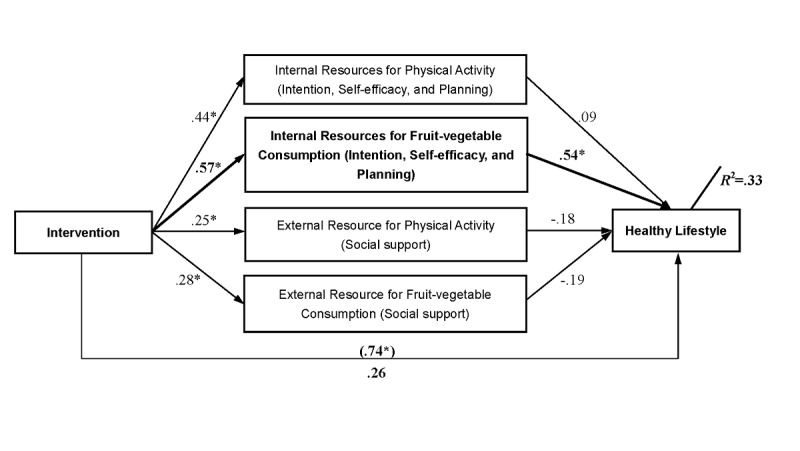
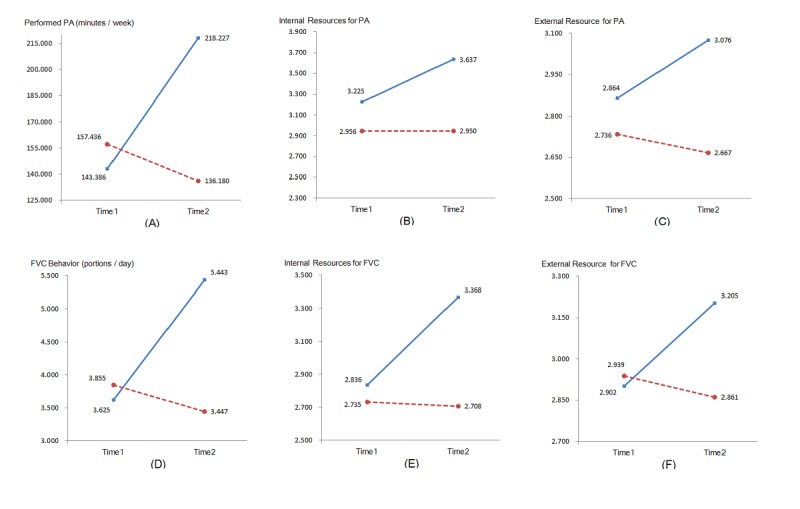
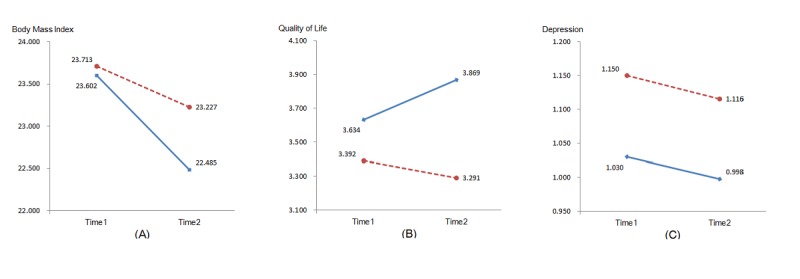
The Web-based intervention outperformed the control condition for PA, FVC, internal resources of PA and FVC, and an external resource of FVC, with an eta-squared effect size ranging from 0.06 to 0.43. Furthermore, the intervention effect was seen in the improvement of quality of life (F=16.36, P<.001, η=.17). When predicting a healthy lifestyle at follow-up, baseline lifestyle (odds ratio, OR 145.60, 95% CI 11.24-1886; P<.001) and the intervention (OR 21.32, 95% CI 2.40-189.20; P=.006) were found to be significant predictors. Internal resources for FVC mediated the effect of the intervention on the adoption of a healthy lifestyle (R=.29; P=.001), indicating that if the intervention increased the internal resource of behavior, the adoption of a healthy lifestyle was more likely.
Patients' psychological resources such as motivation, self-efficacy, planning, and social support as well as lifestyle can be improved by a Web-based intervention that focuses on both PA and FVC. Such an intervention enriches extended rehabilitation approaches for cardiac patients to be active and remain healthy in daily life after hospital discharge.
ClinicalTrials.gov NCT01909349; https://clinicaltrials.gov/ct2/show/NCT01909349 (Archived by WebCite at http://www.webcitation.org/6pHV1A0G1).
对于出院的心脏病患者而言,基于网络和理论的多健康行为干预措施似乎是促进健康生活方式养成与维持的一种很有前景的方法。到目前为止,尚无随机对照试验在中国冠心病康复患者中使用基于网络的干预措施来检验这一假设。
本研究旨在评估一项为期8周的基于网络的干预措施对中国心脏病患者身体活动(PA)、水果和蔬菜摄入量(FVC)、生活方式改变、社会认知结果及健康结果的影响,并与等待对照组进行比较。干预内容基于健康行动过程方法理论。对自我报告的数据进行评估,包括PA、FVC、健康生活方式(PA和FVC的综合)、内部资源(意图、自我效能和计划的组合)以及PA和FVC行为的外部资源(社会支持),还有感知到的健康结果(体重指数、生活质量和抑郁)。
在一项随机对照试验中,招募了中国一家医院心脏康复中心的136例冠心病门诊患者。随机分组并排除不合适的参与者后,114例患者被分配到2组中的1组:(1)干预组:前4周进行PA干预,随后4周进行FVC干预;(2)等待对照组。总共进行了2次基于网络的评估,1次在干预开始时(T1,N = 114),1次在为期8周的干预结束时(T2,N = 83)。入组和随访时间为2015年12月至2016年5月。
基于网络的干预措施在PA、FVC、PA和FVC的内部资源以及FVC的外部资源方面优于对照条件,η²效应量范围为0.06至0.43。此外,在生活质量改善方面可见干预效果(F = 16.36,P <.001,η =.17)。在预测随访时的健康生活方式时,发现基线生活方式(优势比,OR 145.60,95% CI 11.24 - 1886;P <.001)和干预措施(OR 21.32,95% CI 2.40 - 189.20;P =.006)是显著预测因素。FVC的内部资源介导了干预措施对健康生活方式采用的影响(R =.29;P =.001),表明如果干预措施增加了行为的内部资源,那么采用健康生活方式的可能性更大。
一项同时关注PA和FVC的基于网络的干预措施可以改善患者的心理资源,如动机、自我效能、计划和社会支持以及生活方式。这种干预措施丰富了心脏病患者出院后在日常生活中保持活跃和健康的扩展康复方法。
ClinicalTrials.gov NCT01909349;https://clinicaltrials.gov/ct2/show/NCT01909349(由WebCite存档于http://www.webcitation.org/6pHV1A0G1)