Department of Emergency Medicine, Columbia University Medical Center, New York, NY, United States of America.
Gen Hosp Psychiatry. 2019 Sep-Oct;60:83-89. doi: 10.1016/j.genhosppsych.2019.07.014. Epub 2019 Jul 26.
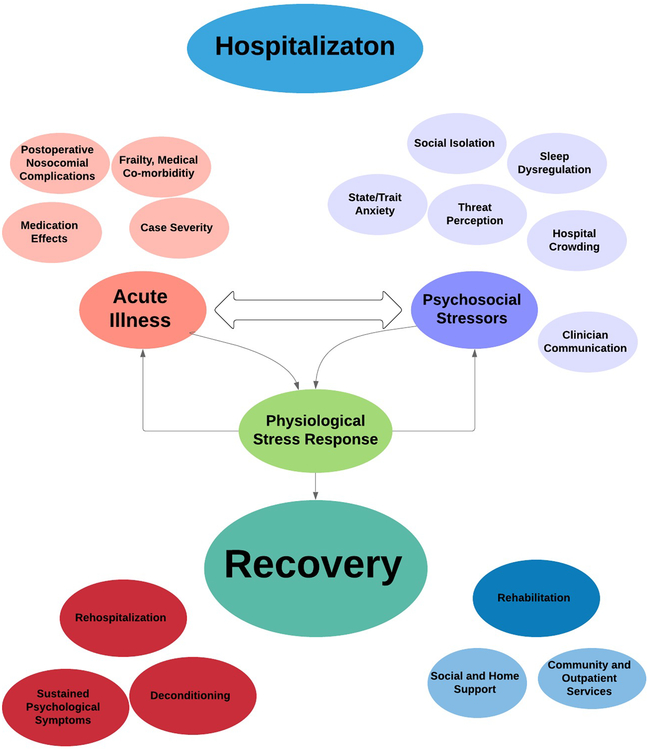
Hospitalization places patients at elevated risk for the development of "nosocomial" or hospital acquired complications, ranging from multidrug resistant infections to delirium and physical deconditioning. Adverse nosocomial psychological effects of hospitalization may also exist. This paper introduces a nosocomial based stress model, conceptualizing hospitalization as a unique period of biopsychosocial vulnerability, due to physiologic effects of acute illness and psychosocial variables of the hospital experience.
A research synthesis and narrative review was performed to evaluate evidence supporting this model, integrating existing knowledge of the psychological and physiological effects of acute life threatening events, with known sequelae associated with hospitalization.
Psychosocial factors during hospitalization may act as independent predictors of recovery following hospitalization, moderating variables impacting ongoing physiologic changes due to acute illness, and/or dynamic bidirectional elements, influencing medical and psychological outcomes in the near and long-term setting.
The Nosocomial Stress model provides a novel framework to understanding the biopsychosocial interactions between the psychological and physiologic processes associated with illness and hospitalization. Based on this model, a research agenda is proposed to assess the contributions of acute illness, the hospital experience, and their interactions on the recovery of patients following hospitalization.
住院使患者面临发生“医院获得性”或医院获得性并发症的风险增加,这些并发症的范围从多药耐药感染到谵妄和身体机能下降。住院可能还会产生不良的医院获得性心理影响。本文介绍了一种基于医院的应激模型,将住院视为一个独特的生物心理社会脆弱期,这是由于急性疾病的生理效应和医院经历的心理社会变量所致。
进行了研究综合和叙述性综述,以评估支持该模型的证据,整合了急性生命威胁事件的心理和生理影响的现有知识,以及与住院相关的已知后果。
住院期间的心理社会因素可能是住院后恢复的独立预测因素,这些因素调节了急性疾病导致的持续生理变化的变量,以及/或影响近期和长期医疗和心理结果的动态双向因素。
医院应激模型为理解与疾病和住院相关的心理和生理过程之间的生物心理社会相互作用提供了一个新的框架。基于该模型,提出了一个研究议程,以评估急性疾病、医院经历及其相互作用对患者住院后恢复的贡献。