Department of Anesthesia and Pain Medicine, Pusan National University Yangsan Hospital, Yangsan, Korea.
Department of Anesthesiology and Pain Medicine, Ansan Hospital, Korea University College of Medicine, Ansan, Republic of Korea.
Korean J Anesthesiol. 2020 Feb;73(1):36-43. doi: 10.4097/kja.19091. Epub 2019 Aug 3.
There are various reports on the effects of the anesthetic method on neurologic complications. A population-based study was conducted to estimate the effect of anesthetic method on the incidence of postoperative delirium in patients that underwent total hip replacement arthroplasty in South Korea.
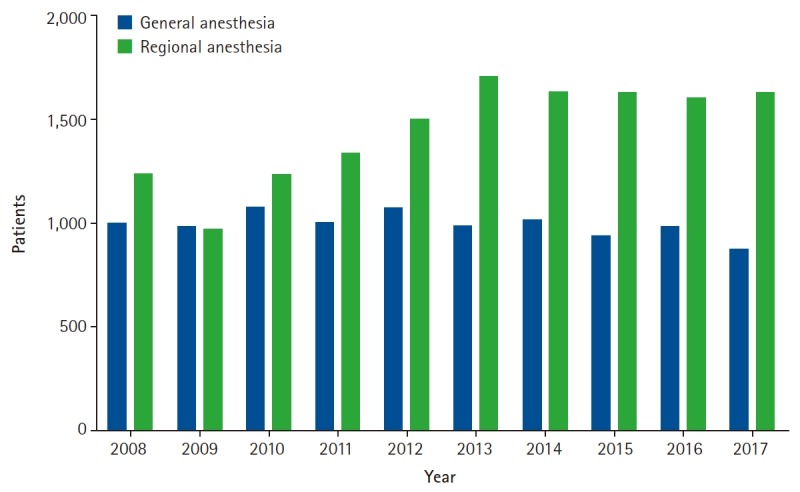
The Korean National Health Insurance claims database was used to retrospectively identify and analyze 24,379 cases of total hip replacement arthroplasty, defined as patients having a claim record with the operation code 'N0711,' from January 2008 to December 2017. Patients were divided into two groups, a general anesthesia group (n = 9,921) and a regional anesthesia group (n = 14,458). The incidence of delirium was assessed in cases when patients used medications for delirium, such as haloperidol, chlorpromazine, olanzapine, and risperidone.
Of the 9,921 patients receiving general anesthesia and 14,458 receiving regional anesthesia, 142 (1.43%) and 209 (0.86%) experienced postoperative delirium after total hip replacement arthroplasty, respectively. There was no significant difference between the groups (P = 0.92). In logistic regression analysis, sex (P = 0.038) and patients with acquired immune deficiency syndrome (P = 0.008) were predictors of postoperative delirium.
Our results revealed that the anesthetic method was not associated with the incidence of postoperative delirium. In addition, the results suggest that male patients and patients with acquired immune deficiency syndrome undergoing total hip replacement arthroplasty carefully managed for postoperative delirium after surgery.
有各种关于麻醉方法对神经并发症影响的报道。本项基于人群的研究旨在评估麻醉方法对韩国行全髋关节置换术患者术后谵妄发生率的影响。
本研究使用韩国国民健康保险索赔数据库,回顾性地确定并分析了 2008 年 1 月至 2017 年 12 月期间 24379 例全髋关节置换术患者(定义为有手术编码“N0711”的索赔记录的患者)。将患者分为全身麻醉组(n = 9921)和区域麻醉组(n = 14458)。当患者使用氟哌啶醇、氯丙嗪、奥氮平或利培酮等治疗谵妄的药物时,评估谵妄的发生率。
在接受全身麻醉的 9921 例患者和接受区域麻醉的 14458 例患者中,分别有 142 例(1.43%)和 209 例(0.86%)在全髋关节置换术后发生术后谵妄。两组之间无显著差异(P = 0.92)。在 logistic 回归分析中,性别(P = 0.038)和获得性免疫缺陷综合征患者(P = 0.008)是术后谵妄的预测因素。
我们的研究结果表明,麻醉方法与术后谵妄的发生率无关。此外,研究结果表明,行全髋关节置换术的男性患者和获得性免疫缺陷综合征患者需要在术后仔细管理以预防术后谵妄。