McGonagle Elizabeth R, Nucera Carmelo
Division of Experimental Biology, Laboratory of Human Thyroid Cancers Preclinical and Translational Research, Department of Pathology, Cancer Research Institute (CRI), Center for Vascular Biology Research (CVBR), Beth Israel Deaconess Medical Center, Harvard Medical School, Boston, MA, United States.
Broad Institute of Harvard and MIT, Cambridge, MA, United States.
Front Endocrinol (Lausanne). 2019 Jul 18;10:468. doi: 10.3389/fendo.2019.00468. eCollection 2019.
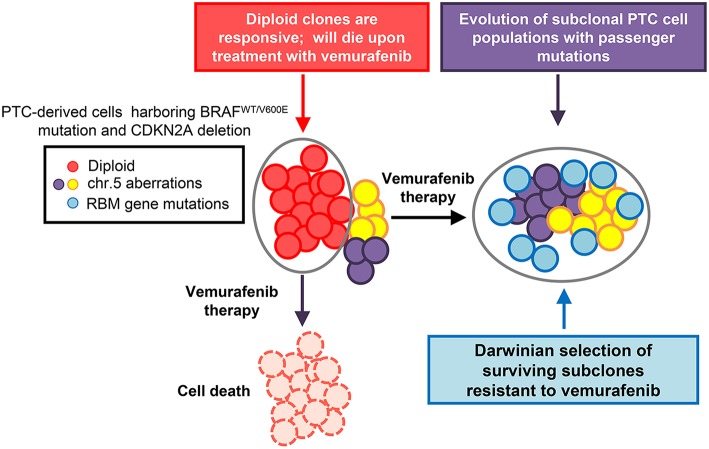
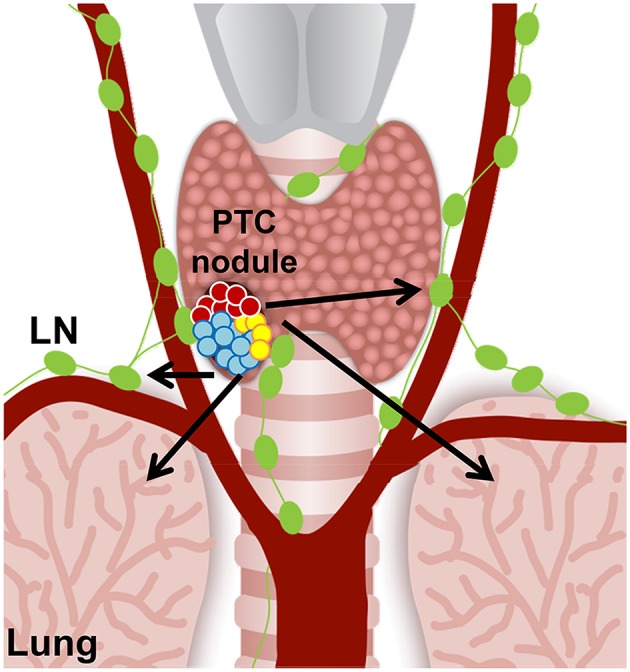
The introduction of ultra-precision targeted therapy has become a significant advancement in cancer therapeutics by creating treatments with less off target effects. Specifically with papillary thyroid carcinoma (PTC), the cancer's hallmark genetic mutation BRAF can be targeted with selective inhibitors, such as vemurafenib. Despite initial positive tumor responses of regression and decreased viability, both single agent or combination agent drug treatments provide a selective pressure for drug resistant evolving clones within the overall heterogeneous tumor. Also, there are evidences suggesting that sequential monotherapy is ineffective and selects for resistant and ultimately lethal tumor clones. Reconstructing both clonal and subclonal thyroid tumor heterogeneous cell clusters for somatic mutations and epigenetic profile, copy number variation, cytogenetic alterations, and non-coding RNA expression becomes increasingly critical as different clonal enrichments implicate how the tumor may respond to drug treatment and dictate its invasive, metastatic, and progressive abilities, and predict prognosis. Therefore, development of novel preclinical and clinical empirical models supported by mathematical assessment will be the tools required for estimating the parameters of clonal and subclonal evolution, and unraveling the dormant vs. non-dormant state of thyroid cancer. In sum, novel experimental models performing the reconstruction both pre- and post-drug treatment of the thyroid tumor will enhance our understanding of clonal and sub-clonal reconstruction and tumor evolution exposed to treatments during ultra-precision targeted therapies. This approach will improve drug development strategies in thyroid oncology and identification of disease-specific biomarkers.
超精准靶向治疗的引入通过创造具有更少脱靶效应的治疗方法,已成为癌症治疗领域的一项重大进展。具体而言,对于乳头状甲状腺癌(PTC),其标志性基因突变BRAF可以用选择性抑制剂(如维莫非尼)进行靶向治疗。尽管最初肿瘤出现了消退和活力降低等积极反应,但单药或联合用药治疗都会对整体异质性肿瘤内的耐药进化克隆产生选择性压力。此外,有证据表明序贯单药治疗无效,并会选择出耐药且最终致命的肿瘤克隆。重建甲状腺肿瘤异质性细胞簇的克隆和亚克隆,以分析体细胞突变、表观遗传特征、拷贝数变异、细胞遗传学改变和非编码RNA表达,变得越来越重要,因为不同的克隆富集情况暗示了肿瘤对药物治疗的反应方式,并决定其侵袭、转移和进展能力,以及预测预后。因此,开发由数学评估支持的新型临床前和临床经验模型将是估计克隆和亚克隆进化参数以及揭示甲状腺癌休眠与非休眠状态所需的工具。总之,在甲状腺肿瘤药物治疗前后进行重建的新型实验模型将增进我们对克隆和亚克隆重建以及超精准靶向治疗期间暴露于治疗的肿瘤进化的理解。这种方法将改善甲状腺肿瘤学的药物开发策略以及疾病特异性生物标志物的识别。