Tumor Immunology Laboratory, Department of Microbiology and Immunology, Botucatu Institute of Biosciences, São Paulo State University, Botucatu, Brazil.
DAMP Laboratory, Department of Surgery, Hillman Cancer Center, University of Pittsburgh, Pittsburgh, PA, United States.
Front Immunol. 2019 Jul 11;10:1561. doi: 10.3389/fimmu.2019.01561. eCollection 2019.
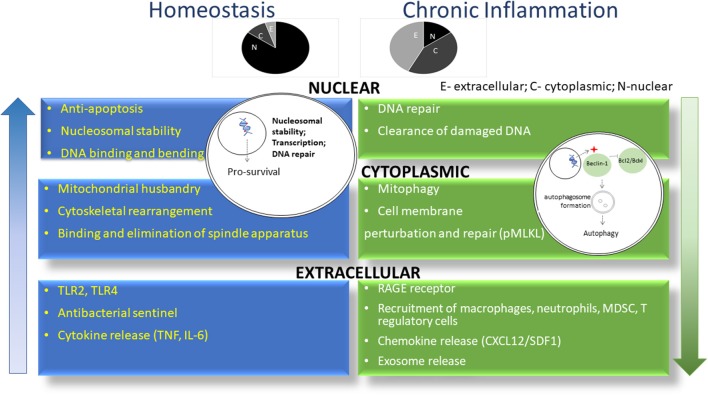
Although much has been made of the role of HMGB1 acting as an acute damage associated molecular pattern (DAMP) molecule, prompting the response to tissue damage or injury, it is also released at sites of chronic inflammation including sites of infection, autoimmunity, and cancer. As such, the biology is distinguished from homeostasis and acute inflammation by the recruitment and persistence of myeloid derived suppressor cells, T regulatory cells, fibrosis and/or exuberant angiogenesis depending on the antecedents and the other individual inflammatory partners that HMGB1 binds and focuses, including IL-1β, CXCL12/SDF1, LPS, DNA, RNA, and sRAGE. High levels of HMGB1 released into the extracellular milieu and its persistence in the microenvironment can contribute to the pathogenesis of many if not all autoimmune disorders and is a key factor that drives inflammation further and worsens symptoms. HMGB1 is also pivotal in the maintenance of chronic inflammation and a "wound healing" type of immune response that ultimately contributes to the onset of carcinogenesis and tumor progression. Exosomes carrying HMGB1 and other instructive molecules are released and shape the response of various cells in the chronic inflammatory environment. Understanding the defining roles of REDOX, DAMPs and PAMPs, and the host response in chronic inflammation requires an alternative means for positing HMGB1's central role in limiting and focusing inflammation, distinguishing chronic from acute inflammation.
虽然 HMGB1 作为一种急性损伤相关分子模式(DAMP)分子,促使机体对组织损伤或伤害作出反应,这已经得到了广泛的研究,但它也在慢性炎症部位释放,包括感染、自身免疫和癌症部位。因此,HMGB1 招募和持续存在髓系来源抑制细胞、调节性 T 细胞、纤维化和/或过度血管生成的生物学特性与稳态和急性炎症不同,这取决于先前存在的情况以及 HMGB1 结合和聚焦的其他个体炎症伙伴,包括 IL-1β、CXCL12/SDF1、LPS、DNA、RNA 和 sRAGE。大量释放到细胞外环境中的 HMGB1 及其在微环境中的持续存在,可能导致许多(如果不是所有)自身免疫性疾病的发病机制,并成为进一步加重炎症和恶化症状的关键因素。HMGB1 还在慢性炎症的维持和“伤口愈合”型免疫反应中起着关键作用,最终导致致癌作用和肿瘤进展的发生。携带 HMGB1 和其他指令性分子的外泌体被释放出来,并塑造慢性炎症环境中各种细胞的反应。要理解氧化还原、DAMP 和 PAMP 以及宿主对慢性炎症的反应的决定性作用,就需要一种替代方法来假设 HMGB1 在限制和聚焦炎症、区分慢性炎症和急性炎症方面的核心作用。