Department of Morphology, Biomedical Research Institute, Hasselt University, Diepenbeek, Belgium.
Front Immunol. 2019 Jul 17;10:1668. doi: 10.3389/fimmu.2019.01668. eCollection 2019.
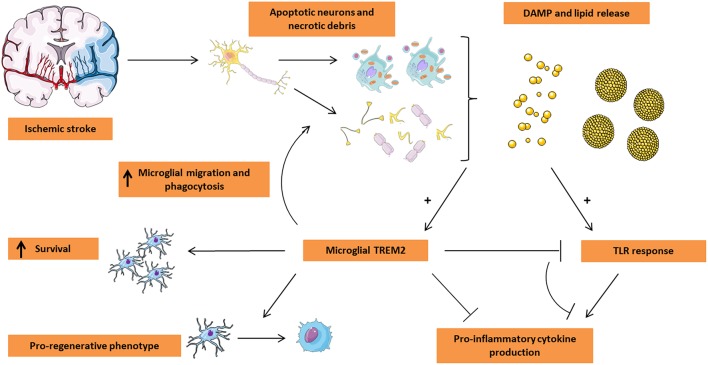
Stroke is the second most common cause of death and permanent disability. It is characterized by loss of neural tissue in which inflammation plays a crucial role in both the acute contribution to ischemic damage as in the late-stage impact on post-ischemic tissue regeneration. Microglia play a key role in the inflammatory stroke microenvironment as they can adapt a disease-promoting pro-inflammatory- or pro-regenerative phenotype thereby contributing to the exacerbation or alleviation of ischemic damage, respectively. Triggering receptor expressed on myeloid cells 2 (TREM2) is a cell surface receptor which in the central nervous system is mainly expressed on microglia. This receptor has been shown to play an essential role in microglial phagocytosis and function but its contribution in stroke pathobiology remains unclear. TREM2 was shown to be activated by nucleotides and lipid mediators, key factors that are secreted in the extracellular stroke environment by apoptotic neurons and cell/myelin debris. These factors in turn stimulate TREM2 signaling which mediates microglial migration toward- and phagocytosis of myelin debris and apoptotic cells. Moreover, microglial TREM2 appears to counteract the toll-like receptor response, thereby decreasing the production of pro-inflammatory cytokines. Finally, TREM2 is involved in microglial migration, survival, and is suggested to directly stimulate pro-regenerative phenotype shift. Therefore, this receptor is an attractive target for microglial modulation in the treatment of ischemic stroke and it provides additional information on microglial effector functions. This short review aims to elaborate on these TREM2-mediated microglial functions in the pathobiology and resolving of ischemic stroke.
中风是第二大常见的死亡和残疾原因。它的特征是神经组织的丧失,其中炎症在缺血性损伤的急性贡献和对缺血后组织再生的后期影响中都起着至关重要的作用。小胶质细胞在炎症性中风微环境中起着关键作用,因为它们可以适应促病的促炎或促再生表型,从而分别加剧或减轻缺血性损伤。髓样细胞表达的触发受体 2(TREM2)是一种细胞表面受体,在中枢神经系统中主要在小胶质细胞上表达。该受体已被证明在小胶质细胞吞噬作用和功能中发挥重要作用,但它在中风发病机制中的作用仍不清楚。TREM2 被证明可被核苷酸和脂质介质激活,这些因子是凋亡神经元和细胞/髓鞘碎片在细胞外中风环境中分泌的关键因素。这些因子反过来刺激 TREM2 信号转导,介导小胶质细胞向髓鞘碎片和凋亡细胞的迁移和吞噬作用。此外,小胶质细胞 TREM2 似乎可以抵消 Toll 样受体反应,从而减少促炎细胞因子的产生。最后,TREM2 参与小胶质细胞的迁移、存活,并被认为可直接刺激促再生表型转变。因此,该受体是缺血性中风治疗中小胶质细胞调节的一个有吸引力的靶点,并为小胶质细胞效应功能提供了更多信息。这篇简短的综述旨在详细阐述 TREM2 介导的小胶质细胞在缺血性中风发病机制和解决中的功能。