LIV, Facultad de Medicina, Universidad Autonoma del Estado de Morelos, Cuernavaca, Mexico.
Instituto de Biotecnologia, Universidad Nacional Autonoma de Mexico, Cuernavaca, Mexico.
Front Immunol. 2019 Jul 18;10:1677. doi: 10.3389/fimmu.2019.01677. eCollection 2019.
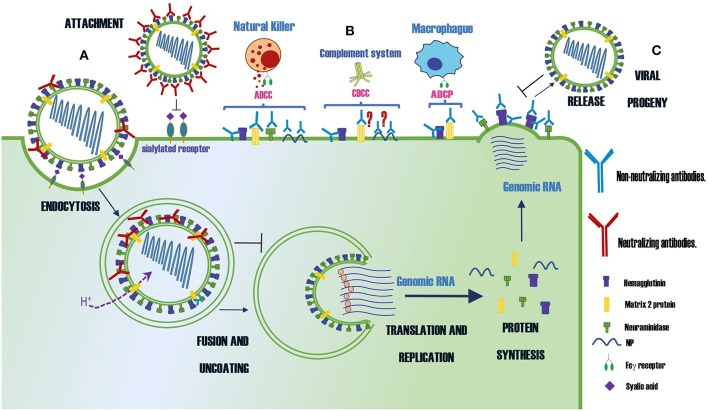
The influenza A virus infection continues to be a threat to the human population. The seasonal variation of the virus and the likelihood of periodical pandemics caused by completely new virus strains make it difficult to produce vaccines that efficiently protect against this infection. Antibodies (Abs) are very important in preventing the infection and in blocking virus propagation once the infection has taken place. However, the precise protection mechanism provided by these Abs still needs to be established. Furthermore, most research has focused on Abs directed to the globular head domain of hemagglutinin (HA). However, other domains of HA (like the stem) and other proteins are also able to elicit protective Ab responses. In this article, we review the current knowledge about the role of both neutralizing and non-neutralizing anti-influenza proteins Abs that play a protective role during infection or vaccination.
甲型流感病毒感染仍然是人类的威胁。病毒的季节性变化以及完全新型病毒株引发周期性大流行的可能性,使得生产有效预防这种感染的疫苗变得困难。抗体(Abs)在预防感染和阻止感染发生后病毒传播方面非常重要。然而,这些 Abs 提供的确切保护机制仍有待确定。此外,大多数研究都集中在针对血凝素(HA)球形头部结构域的 Abs 上。然而,HA 的其他结构域(如茎部)和其他蛋白质也能够引发保护性 Abs 反应。在本文中,我们综述了目前关于中和性和非中和性抗流感蛋白 Abs 在感染或接种疫苗期间发挥保护作用的认识。