Wang Shubin, Xu Steven, Chao Shiaoman, Sun Qun, Liu Shuwei, Xia Guangmin
Key Laboratory of Plant Development and Environmental Adaptation Biology, Ministry of Education, School of Life Sciences, Shandong University, Qingdao, China.
United States Department of Agriculture-Agricultural Research Service (USDA-ARS), Cereal Crops Research Unit, Edward T. Schafer Agricultural Research Center, Fargo, ND, United States.
Front Plant Sci. 2019 Jul 17;10:919. doi: 10.3389/fpls.2019.00919. eCollection 2019.
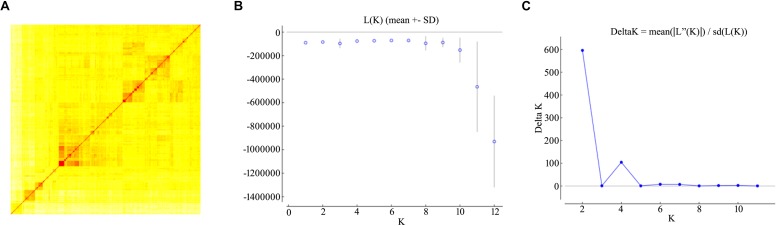
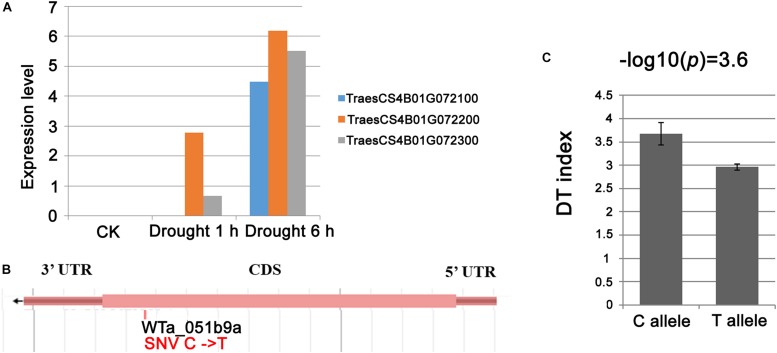
Uncovering the genetic basis of key agronomic traits, and particularly of drought tolerance, addresses an important priority for durum wheat improvement. Here, a genome-wide association study (GWAS) in 493 durum wheat accessions representing a worldwide collection was employed to address the genetic basis of 17 agronomically important traits and a drought wilting score. Using a linear mixed model with 4 inferred subpopulations and a kinship matrix, we identified 90 marker-trait-associations (MTAs) defined by 78 markers. These markers could be merged into 44 genomic loci by linkage disequilibrium ( > 0.2). Based on sequence alignment of the markers to the reference genome of bread wheat, we identified 14 putative candidate genes involved in enzymes, hormone-response, and transcription factors. The GWAS in durum wheat and a previous quantitative trait locus (QTL) analysis in bread wheat identified a consensus QTL locus.4B.1 conferring drought tolerance, which was further scanned for the presence of potential candidate genes. A haplotype analysis of this region revealed that two minor haplotypes were associated with both drought tolerance and reduced plant stature, thought to be the effect of linkage with the semi-dwarfing gene . Haplotype variants in the key chromosome 4B region were informative regarding evolutionary divergence among durum, emmer and bread wheat. Over all, the data are relevant in the context of durum wheat improvement and the isolation of genes underlying variation in some important quantitative traits.
揭示关键农艺性状,特别是耐旱性的遗传基础,是硬粒小麦改良的一个重要优先事项。在此,我们对代表全球种质资源的493份硬粒小麦材料进行了全基因组关联研究(GWAS),以探究17个重要农艺性状和一个干旱萎蔫评分的遗传基础。使用包含4个推断亚群和一个亲缘关系矩阵的线性混合模型,我们鉴定出了由78个标记定义的90个标记-性状关联(MTA)。通过连锁不平衡(>0.2),这些标记可合并为44个基因组位点。基于这些标记与普通小麦参考基因组的序列比对,我们鉴定出了14个涉及酶、激素响应和转录因子的假定候选基因。硬粒小麦的GWAS和之前普通小麦的数量性状位点(QTL)分析确定了一个赋予耐旱性的共有QTL位点4B.1,并对其进一步扫描以寻找潜在候选基因。该区域的单倍型分析表明,两种次要单倍型与耐旱性和植株变矮均相关,推测这是与半矮秆基因连锁的效应。关键的4B染色体区域中的单倍型变异对于硬粒小麦、二粒小麦和普通小麦之间的进化差异具有参考价值。总体而言,这些数据对于硬粒小麦改良以及一些重要数量性状变异潜在基因的分离具有重要意义。