Department of Anaesthesiology, Taipei Veterans General Hospital, Taipei City 11217, Taiwan.
Department of Biomedical Engineering, National Yang-Ming University, Taipei City 11221, Taiwan.
Biomed Res Int. 2019 Jul 16;2019:4206795. doi: 10.1155/2019/4206795. eCollection 2019.
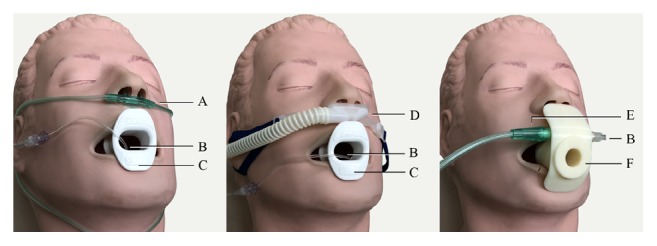
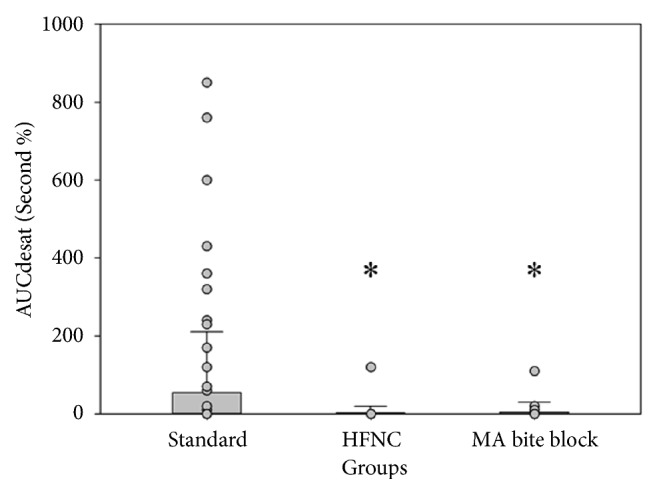
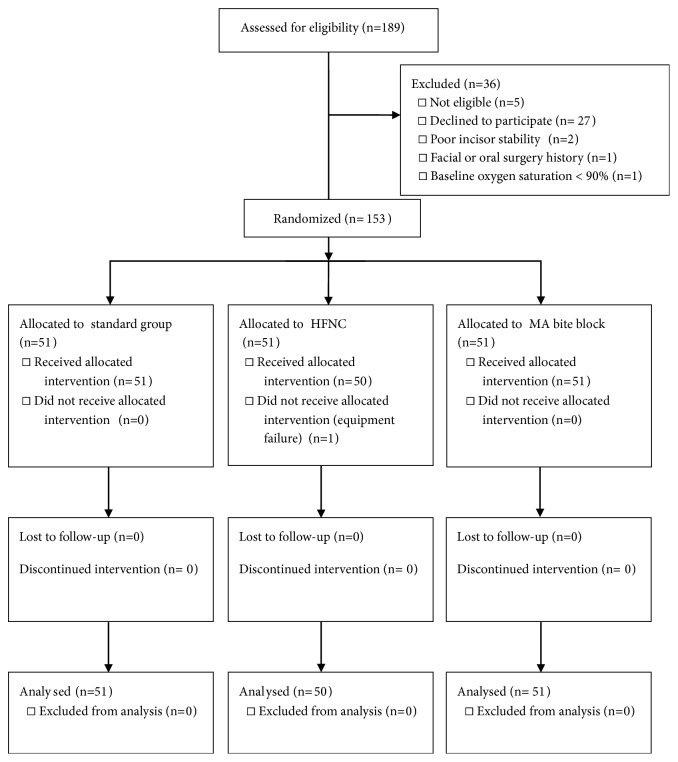
During sedated endoscopic examinations, upper airway obstruction occurs. Nasal breathing often shifts to oral breathing during open mouth esophagogastroduodenoscopy (EGD). High-flow nasal cannula (HFNC) which delivers humidified 100% oxygen at 30 L min may prevent hypoxemia. A mandibular advancement (MA) bite block with oxygen inlet directed to both mouth and nose may prevent airway obstruction during sedated EGD. The purpose of this study was to evaluate the efficacy of these airway devices versus standard management. One hundred and eighty-nine patients were assessed for eligibility. One hundred and fifty-three were enrolled. This study randomly assigned eligible patients to three arms: the standard bite block and standard nasal cannula, HFNC, and MA bite block groups. EGD was performed after anaesthetic induction. The primary endpoint was the oxygen desaturation area under curve at 90% (AUC). The secondary endpoints were percentage of patients with hypoxic, upper airway obstruction, and apnoeic and rescue events. One hundred and fifty-three patients were enrolled. AUCdesat was significantly lower for HFNC and MA bite blocks versus the standard management (p= 0.019). The HFNC reduced hypoxic events by 18% despite similar airway obstruction and apnoeic events as standard group. The MA bite block reduced hypoxic events by 12% and airway obstructions by 32%. The HFNC and MA groups both showed a 16% and 14% reduction in the number of patients who received rescue intervention, respectively, compared to the standard group. The HFNC and MA bite block may both reduce degree and duration of hypoxemia. HFNC may decrease hypoxemic events while maintaining nasal patency is crucial during sedative EGD. The MA bite block may prevent airway obstruction and decrease the need for rescue intervention.
在镇静内镜检查期间,上呼吸道会发生阻塞。在张口食管胃十二指肠镜检查(EGD)期间,鼻呼吸通常会转为口呼吸。高流量鼻导管(HFNC)以 30 L/min 的速度输送湿化的 100%氧气,可预防低氧血症。带有氧气入口的下颌前伸(MA)咬合块,氧气入口同时通向口腔和鼻腔,可能会预防镇静 EGD 期间的气道阻塞。本研究旨在评估这些气道设备与标准治疗方法的疗效。对 189 名患者进行了评估以确定其是否符合入组条件,最终 153 名患者符合入组标准。本研究将符合条件的患者随机分配至 3 个治疗组:标准咬合块和标准鼻导管组、HFNC 组和 MA 咬合块组。在全身麻醉诱导后进行 EGD。主要终点是 90%(AUC)时的氧饱和度下降曲线下面积(AUC)。次要终点是缺氧、上呼吸道阻塞、呼吸暂停以及需要抢救的患者比例。153 名患者入组。HFNC 和 MA 咬合块组的 AUCdesat 明显低于标准治疗组(p=0.019)。尽管与标准组相比,HFNC 组的气道阻塞和呼吸暂停事件相似,但缺氧事件减少了 18%。MA 咬合块组缺氧事件减少了 12%,气道阻塞减少了 32%。与标准组相比,HFNC 和 MA 组分别减少了 16%和 14%需要抢救干预的患者数量。HFNC 和 MA 咬合块都可能减少低氧血症的程度和持续时间。在镇静 EGD 期间,HFNC 可能会降低低氧血症的发生率,同时保持鼻腔通畅至关重要。MA 咬合块可以预防气道阻塞并减少抢救干预的需要。